Conversation About Conversation

I like to joke that typical dinner conversation at my house delves into the Big Questions, discussing Life, The Universe, and Everything.  It’s true that what Bird and I consider normal mealtime chat includes the stigma on mental illness, the treatment of women throughout history, the state of the education system in the US, and so on.  I never knew this kind of thing wasn’t necessarily typical until I began having dinner at friends’ houses and learned that when they talked about their day, they stopped there.  They literally just talked about their day, and maybe what they had planned for the next day, or the weekend, and maybe a funny story from last summer when they all went inner tubing and the youngest dropped her sunglasses and cried.  I mean, we had those conversations too.  (Believe me, there are plenty of stories we love to bring up at the slightest provocation.  Remind me to tell you about the time Dad got a speeding ticket.)

But we also enjoyed going off on extended tangents about abstractions and Important Concepts while our dinners cooled in front of us.

And I am so grateful for that.

My family’s tendency to engage in abnormally esoteric dialogue gave me a foundation for extracting themes from the literature I read in All the English Classes Ever.  It gave me a vocabulary for identifying abstract concepts.  It gave me practice for listening to others and having a Real Discussion as opposed to a shouting match.  And it gave me the mindset that led me to the Writing Center.

My university’s Writing Center became my haven during a semester when things were pretty rough for me.  I found an affirmative place where like-minded people weren’t afraid to have conversations about their enthusiasm for language.  Even though the required job trainings take chunks of valuable Netflix  time out of my evenings, I love them.  I love getting to talk about the importance of body language while working with a student and our desire to change the campus perception of us as a personification of spell check.  It almost feels like spending an evening at home again.

The environment that encourages these conversations is slowly helping me figure out what I want to do with my life.  Not the answer to the perpetual question of What I Want To Do, as in a job, but the values I believe the world needs to see more often and how those should influence my own choices.  If I never talked with anyone about these things, I would probably be facing those looming Life Decisions with even more paralyzing terror than I currently have.  As it is, I am buoyed by the knowledge that somewhere out there are other people who like to have conversations about conversation.

others

Libraries I Have Known

The Southern Belle was dubious when I strode toward the checkout station with a baker’s dozen of books, most of them hardcover, in my arms. She added her own modest three novels to the stack, then proposed using the plastic bags provided by the library to transport our literary loot out to my car.

I scoffed.

“Nearly all of these are hardcover – they’ll tear holes right through those bags,” I told her, starting to gather the scanned books back into my arms.  The Southern Belle sighed, and because she is a fabulous friend, grabbed half the stack for herself so I didn’t actually have to carry them all.  I would have, though.  I’ve done it before.

0973c21b26cff02884470cb1f045bef5

To me, a library trip is only successful when it results in such a large haul of reading material that I can’t quite open the front door when I get home.  I’ve developed this habit from childhood; ever since I got my first library card in kindergarten, I would toddle up to the counter with a stack of books tucked under my chin, my fingers barely gripping the bottom of the pile as I propped it against my torso.  The librarians would lean down and peer at me as I tried to shove my heap up and over the counter for them to scan.  “Are you really going to read all those?” they would ask, half to me, half to my mother, who stood by nodding.

“Oh yes, she will,” my mother said.

That was in the first library I knew, the brick one with the lane of trees out front and Reading Riley, the brass turtle, on his pedestal just outside the door.  That was the library where, seized by one of those fevered obsessions that strikes third-graders, I checked out nearly every book available on lemurs and wrote a report.  For fun.  During the summer.

That library is gone now, torn down and the spot where it stood filled in with mountains of dirt.  The city promised a new library in that same spot, a bigger, better one.  A year, two at the most, they said.

It took five.

During those five years, the temporary library was crammed into a space that used to house an auto parts store.  Many of the books, including some of my favorites, were now in storage elsewhere.  I had to request a lot of things from other branches.  The librarians who had watched me grow up shook their heads whenever I asked about a beloved volume.  Probably in a box somewhere, they said.

Now we have a new library, with floor to ceiling windows and self checkout stations and conference rooms for readings and signings and book clubs.  There’s a job search area with resources for unemployed people, a teen area, a kids area.

I think the kids section might be the only one without computers.

Of course I miss the library of my childhood, the one with brick walls and a hushed atmosphere and a counter that allowed me to get to know the people who worked there.  But at school, what I’m really homesick for are those teetering, heavy stacks of pleasure and leisure reading.  Spring break means getting to pile books up to my chin, crash through the door, settle in, and devour half the stack in one afternoon.  And that, to me, is home.

Productive Procrastination

College

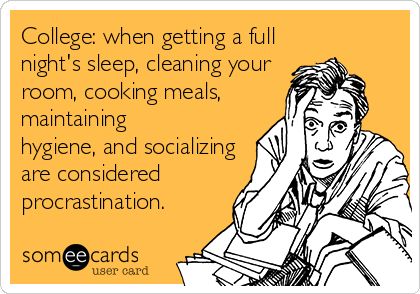
Productivity is weird, particularly in college.  One can be domestically productive, or scholastically productive, or literarily productive (I may have made that one up), but it seems that one cannot be productive in all these areas at once.

This morning, in a burst of motivated energy, I did three loads of laundry and put them all away, changed my sheets from flannel to cotton because it’s finally above 50 degrees, did the dishes, tidied the kitchen and living room, read my Shakespeare assignment for Monday, found articles for my Coleridge presentation on Tuesday, caught up on Doctor Who recaps on my favorite blog, read a great deal of my leisure book, and planned out my homework schedule for tomorrow.

Unfortunately, this leaves me with a presentation and an HTML project to finish, two papers to start, a five page rough draft of a creative nonfiction piece to write, meals to plan, and grocery shopping to do, not to mention preliminary research to do for my thesis project.  So although I feel like the day was well-spent, academically speaking my to-do list has not shortened by much.

The Commodore pointed out that I’m laying the groundwork for the homework I have to tomorrow, since I found sources for the projects I have to finish this week.  And now that some domestic chores are out of the way, I’ll have the uninterrupted time I need to delve into the more time-intensive tasks I left for tomorrow.

At least, that’s how I keep rationalizing it to myself.  Yes, I was productive today…just…not with homework.  But in college, little else tends to matter.  So tomorrow should be…busy.

“This is Mother Land”

One of my grandma’s friends, Sally, was going through her old papers recently when she came across a scrap from September, 1998.  Apparently when I was little, my nana would take me with her to visit Sally, a retired schoolteacher who was fascinated by the stories that came pouring out of this jabbering toddler.  One in particular evidently demanded recording:

This is Mother Land – It’s a place for mothers with fevers. Would you like to have a seat on our bench? Rule number one is – I’m going to explain to you about mothers with fevers and babies with colds.  This baby has no cold.  This baby has a cold that is SO bad – This is a big sneeze – a really big sneeze.  The mother has a fever.  It started in her head.  The arrows show where the fever goes.  It went down to her belly button.  It went down her arms to her hands.  It went all the way down to her toes.

Age 4, 9/22/98

This subject matter probably had to do with the fact that my baby sister had been born not eight months previously.  I don’t know why I never explained what Rule Number One was, but I’m curious as to what my four-year-old self would have said!  Similarly, I kind of want to know if the bench was a real piece of furniture or just a figment of my overactive imagination, and if I was actually drawing arrows on some kind of diagram while I said all this.

My parents always said I was telling stories my entire life. As my mom liked to tell people, I didn’t start speaking in sentences; I started speaking in paragraphs.  I chuckled along, happy that my parents didn’t mind that I wanted to major in creative writing and work as a writer.  But to see it written down is to see proof that I really have been doing this since I could talk. Sally’s beautiful handwriting, left over from a day when penmanship was as important in schools as the Pythagorean Theorem, captures my four-year-old imagination’s ramblings, setting my sentences down far more coherently than I probably said them at the time.  Even though I can’t quite make out the narrative arc of this particular “story,” I can see the roots of one of my favorite fiction-building tendencies: fantasizing and describing new places and cultures, building a whole “land” out of thin air.  This is where the magic begins for me, the words that will spill over into every part of the rest of my life: a four-year-old jabbering away.