The Future Mr. Changeling

The Engineer and I are getting married!

Remember when I said our spring break was lovely?  That was a bit of an understatement.

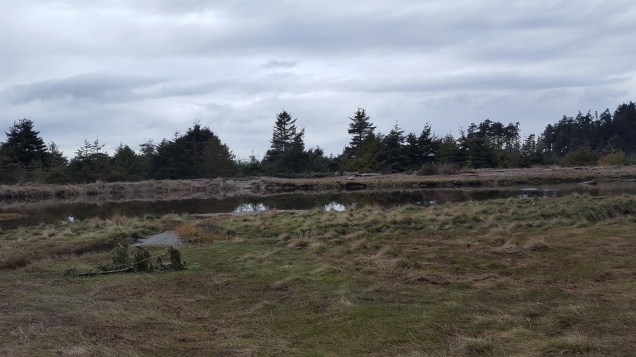
At his insistence, I had gone up to visit the Engineer’s house on the peninsula, even though I could only stay for one day.  We went for a walk on the beach at Salt Creek, which was nothing unusual; since it’s one of our favorite places, sometimes we go there every single day of my visit.
2017-03-15 15.55.02-1

Once a group of college students left, we had the whole beach to ourselves.  It was a delightfully “west side” type of day, a little breezy and overcast but nothing like the freezing weather we’ve been having in our little college town.  We meandered down the beach and back again, chatting and pointing out pretty rocks or a bird on the water.

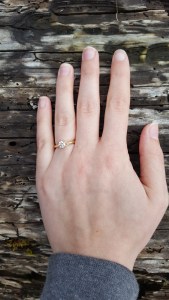
I didn’t notice at the time, but the Engineer was making sure to keep me on his right side and wouldn’t hug me too closely, because the ring was in his left coat pocket!  He wouldn’t even let me put my hands in his pockets to warm them, as I sometimes do; he just held my hand and kept choreographing our movements so I wouldn’t notice the box.

2017-03-15 14.46.17
The log I decided to Instagram right before he proposed

Finally, when I stopped to take an Instagram picture peer through the tunnel formed by a driftwood log, the Engineer followed me with something slightly more than his usual amused expression on his face.  He hugged me, fumbled in his pocket for a moment (“Don’t be ridiculous, it’s just his phone,” I told myself), then pulled away and got down on one knee (“That is not a phone.”).

Holding up the ring, he asked if I would marry him.

“Of course I will!” (Then I asked if he was serious, because it’s good to check, apparently.)

We walked back along the beach, both grinning, when a family of bald eagles flew overhead.  Two of them landed in the top of a nearby tree and started squawking to each other.  They stayed perched there for nearly an hour while we sat on Our Log (the log that we sit on every time we go there, where we first had a conversation about getting married years ago) and talked.  The solitude of the beach gave us a bit to process what had just happened and enjoy our shared excitement before we had to start telling people.

We still had another week of grad school visits ahead of us before going back to school, so we spent the next few days calling friends and family and swearing them to secrecy so we could tell certain people in person when we got back.  Those reactions were well worth the wait, most notably the Commodore, who was in town for her spring break as well, setting down her coffee in order to scream and jump up and down; my current roommate, who sent her parrot on a panicked circuit around the room when she leapt up to hug me; and our other friend C., who took a full ten minutes of small talk to notice the ring before stopping midsentence to stare, count my fingers to be sure that yes, it was the correct ring finger, and jumping up and down.  (A lot of jumping was involved here.)

I’m very excited for our newest adventure to start.  Can’t wait for September!
2017-03-15 15.55.41-1
He chose well!

Review: The Forgotten Room

*Requisite spoiler warning.

I love old houses for the stories they seem to hold, particularly places where it seems as though the owners have just picked up and left.  I love generational sagas too, the types of stories where you see how the family stories intertwine and get to trace characters growing up, disappearing and reappearing and making you gasp, “Oh, so that’s what happened to him!”  So the collaborative novel from Karen White, Beatriz Williams, and Lauren Willig, The Forgotten Roomlooked to be right up my alley.

The Forgotten Room follows three different women in New York City in three different times: Olive in 1892, Lucy in 1920, and Kate in 1944.  They all come to the same building, an old mansion (well, new in Olive’s time, a hospital in Kate’s) searching for answers about what happened to their family.  And they all meet men, whose connections to the Pratt mansion run equally deep.  Each new couple delves a little bit deeper into the mystery of the previous generation, which the authors handle well – the reader knows more than the characters do, but never enough to completely solve the puzzle until all is unveiled at the proper moment.

I also saw a certain amount of developing feminism in each of the women’s experiences.  Having recently lost her father, Olive pushes back against the strictures of 1890s society with her reluctance to marry the first man who comes along.  She prioritizes finding the truth about her father’s death over her mother’s expectations, which is a small battle but a significant one for her time.  Lucy makes further steps with her refusal to become the secretary who sleeps with her boss, even going so far as to turn him down flat in a speakeasy.  Even more than Olive, Lucy insists on moving forward on her own terms, whether romantically or careerwise.

Kate’s struggle with blatant workplace misogyny and sexual harassment is the most obvious instance of feminism in the novel.  Her male supervisor not only sneers at the idea of a female doctor, but regularly undermines her treatment of her patients – when he’s not trying to get her alone in the storage closet.  Frankly, it was this battle against sexism, particularly when a young nurse looked to Kate as an ally and role model, that interested me more than any romantic entanglements.  That was where the novel fell short for me: these women had their own original motivations and desires, but that independence was quickly thrown out when they met The Man in their respective stories.  Though the ending(s) were cute enough, it wasn’t quite what I was hoping for.

Still, the parallel stories and the building tension as the generational mystery continued were intriguing enough to give this 4/5 stars on Goodreads.

Is This Really the Story We Want to Keep Telling?

When I first saw the trailer for Split, I knew I wouldn’t be going to see it.  For one thing, the scene shown in the teaser where three girls are abducted in a parking lot marked it clearly as Horror, and I hate scary movies.  (Not to mention that I already check under, behind, and around my car before I get in, lock my doors, and immediately drive away from any given location, so thank you Hollywood for reinforcing my paranoid safety check.)  Then there was James McAvoy’s character, who apparently is yet another example of Hollywood’s fascination with (and frequent mistaken representation of) dissociative identity disorder (DID).  It seemed unlikely to me that situating a person with mental illness as a kidnapper and probable villain could involve tasteful representation of mental health problems, so that gave me another reason not to bother.

Last week, two of my coworkers began discussing the movie.  They expressed their admiration for the apparent “twist” ending, praised James McAvoy’s acting, then turned to me and asked if I’d seen it.

“No, and I don’t plan to.”

“Why not?” one coworker exclaimed. “It’s awesome!”

“I don’t like thrillers,” I started, “and even more importantly,” louder over their protests that it wasn’t that scary, “I think it’s contributing to social stigma surrounding mental illness by continuing to portray people with those illnesses as automatically dangerous or monstrous.”

They looked at me.  “It’s actually sooooo good!” one of them said, but her voice was quieter.

“I’m sure it’s an interesting story,” I said, “and I’m sure that as far as movies go it has all the drama and suspense that it needs to.  But I don’t agree with perpetuating damaging stereotypes to do that.”

There was a slightly awkward pause.

“His acting was, like, insane, though,” the other coworker finally said, and they were off again.

I have no doubt that McAvoy’s acting in this movie was impressive; just watching the trailer, I was amazed by his ability to differentiate and fully inhabit even the few personalities shown there.  I have no doubt that the writers constructed a compelling enough storyline to accomplish all the goals of the genre.

My problem is with the priorities that this movie represents, the priorities that keep allowing movies like this to be made instead of giving us popular culture filled with realistic and non-shameful pictures of mental illness.  My problem is that even this article in The Guardian outlining cinematic misrepresentation of DID through the years ends with praise for McAvoy’s acting.  We keep putting “It’s a good story!” and “It’s a chance for the actor to show off their talent!” above the damage done by shoving mental illness into the same old categories.  And mental health deserves better from our popular culture.

Individuals with illnesses other than DID suffer from this idea of the “mentally ill monster” too.  Schizophrenia is the most directly affected, since it is often mistakenly conflated with DID and therefore seen as farther along on the “crazy” spectrum.  Depressed people are often assumed to be suicidal, even though the reality is that symptoms vary widely in intensity and depending on the individual.  As for anxiety, our society already mistrusts people who cannot conform to the Extrovert Ideal, so sufferers of anxiety are often watched as though they might “snap” at any moment.

This isn’t just me over thinking things, either.  The American Psychological Association has done studies interpreting the link between media and the perception of mental illness as dangerousness.  While conclusions vary, the researchers agree that this link does exist and that it is actively contributing to continuing stigma against mental illness.

Given all these perceptions and pictures of mental illness surrounding us, no wonder few people seek help when they need it.  Who would want to seek out a diagnosis or admit to having one of these problems?  Who would voluntarily categorize themselves as a monster?

I congratulate James McAvoy on his talent in his chosen profession.  But I refuse to pretend that admiration for a complete stranger is more important than the work we need to do to alter the perception of mental illness in our popular media.  Now, a movie about a man with DID figuring out how to live everyday life despite the society he lives in constantly viewing him with fear?  That’s a movie I’d go see.