NerdCon Stories Part 3: Saturday

2016-10-15-09-55-24
I figured if there was anywhere to wear my Augustus Waters t-shirt, this was it.

Saturday morning began bright and early with a John Green Yoga Adventure hosted by YogaQuest MN.  This was basically like MadLibs with yoga poses: one of the instructors read a narrative in which the protagonists of Green’s novels found themselves outside their stories and tried to find where they belonged, while the other instructor led us through poses associated with each character name, certain nouns, and some verbs.  Whenever Hazel from The Fault in Our Stars was mentioned, for instance, we did Warrior II, because she is a strong female lead.

After yoga I ran back to the hotel for breakfast in the Executive Lounge (leftover perks from having to stay on the pullout couch in the Executive Suite!) before heading off to “Centering Women in Fiction: Removing Your Unconscious Bias.”  A panel of amazing women creators talked about internalized and learned biases that even we women have against ourselves, and how we can combat those by supporting (and even demanding) those stories when they do appear.  The girl power in the room was fantastic.  I also ran into Shayna from the feminist publishing panel the day before, so we sat together and chatted a bit.

When that panel let out, I went back to the expo hall because I wanted to try out the Depict-O-Mat.  Essentially, it’s some people in a box who interview you for a few minutes and then produce an impromptu puppet show starring you.  In mine, I was Queen of the Dragons.  Plus I got to keep the puppet!

After some lunch, it was time for our kaffeeklatsch with Saladin Ahmed.  Twelve attendees got to sit down with a featured guest at kaffeeklatsches (so called because there were coffee and tea available) for an hour and chat about creativity, process, and whatever else we wanted.  Though I didn’t actually talk, it was just nice to hang out and hear others’ thoughts on representation, writing, publishing, and reading recommendations.

From there, I dashed straight to the auditorium to get a good seat for the afternoon variety show.  This is also where I found Shayna again and she joked that I must be stalking her.

2016-10-15-16-55-45The variety show included a Q&A lightning round with a squid, a conversation between Nalo Hopkinson and Daniel Jose Older, a lip sync battle, and a talk by John Green.  All I’ll say about that talk is that 1. he made me cry again and 2. you should go read it.

After the variety show I went down to something called Story Circle, where we all literally sat in a circle and talked about nerdom.  I got to say some things about Arabian Nights and how cool it was to be at NerdCon: Stories in the first place, so that was definitely fun.

My last panel at NerdCon was “Breaking into Publishing,” which is pretty self explanatory.  I got some good notes, some good quotes (my favorite was “How did I break into publishing?  With a black ski mask at night.”), and some good motivation to actually finish my manuscript so I can start querying! (I also saw Shayna.  Again.  Really can’t blame her for thinking I was stalking her.)

And thus, knowing I had a shuttle coming at 5 am the next day, my NerdCon: Stories experience was over.
NerdCon Stories Part 2: Friday

After hanging up with Dad, I walked a few blocks to the light rail and rode it back to the airport to pick up my phone.  Fortunately I had a few hours before the first panel I really wanted to attend, so I wasn’t missing any of the convention as a result of my predicament.

Riding the light rail without my phone was surprisingly serene.  Public transportation in new cities always reminds me of taking the T on my visits to Boston and riding the Tube around London, and without any games to play or people to text, I was left to look out the window at the city around me.

Of course, once I got my phone back, I immediately began documenting the experience via Snapchat, Twitter, and texting.

2016-10-14 10.40.51.jpg
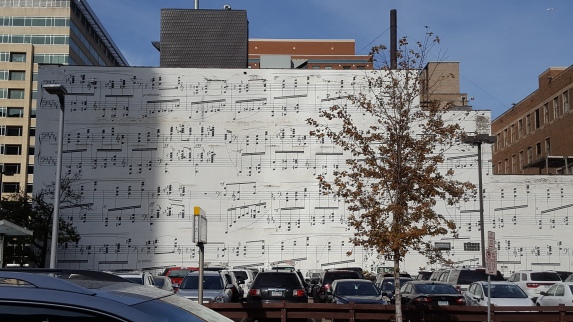
The wall of a parking lot right outside my hotel.  I wonder what melody it is.

Back at the hotel, I took one of Minneapolis’s many downtown skyways to the convention center, a convenience that made running back to my hotel room between panels much easier.  Unfortunately, I was too late to attend the Mental Health in YA Literature panel, but I was overjoyed to see that it was filled to capacity because so many people wanted to discuss that topic!  After checking in and getting my preordered t-shirt, I wandered around the expo hall a little and bought some typical convention center fare for lunch.  The tables were huge, so huge that you were almost forced to sit with strangers because it was too ridiculous to have a table for 10 all to yourself.  Thanks to this, I soon discovered one of the perks of NerdCon – social interactions aren’t as awkward because everyone is around the same level of nerdiness.  For instance, a random guy asked to sit at my table, struck up a conversation, and ended up showing me his short story.

2016-10-14-11-18-24After lunch I wound up in a panel on self-promotion, which was entertaining if not particularly enlightening.  All of the panelists claimed not to be good at self-promotion, which seemed like poor planning, but since I wasn’t terribly invested in the topic I just enjoyed the banter between the featured guests.
Then came A Brief Exploration of Feminist Publishing, in which I met several wonderful ladies who are also striving to both find women in writing and create their own content.  We talked about the point at which we first realized the divide between male and female authors, who our favorite women writers are, and the history of feminist publishing.  I loved my little group and our whole discussion was fantastic.

The Writers Panel with Ben Blacker was up next.  I made more new friends as we filled up a ballroom and waited for the interview to begin.  The interviewee?  John Green.2016-10-14-16-24-04

I will admit to quietly flailing in my seat and taking far too many pictures as John came out and introduced himself.  But as their conversation began, I found myself simply needing to listen.  I was so grateful that John was so generous in sharing his writing experiences of the past and present, and that he was willing to delve into mental health and personal balance as well.  One part in particular hit me in a visceral way, because he used a similar word choice to what I tell myself when I talk about my depression.  The interview closed with questions from the audience, which John answered thoughtfully.  (I will update this post with a link to the podcast when it is released.)

My first day at NerdCon: Stories closed with an invitation to dinner with one of my favorite bloggers from SnarkSquad!  Mari and I had connected over Twitter when I realized we would both be at the convention, and she was nice enough to include me in a dinner with a few other internet friends.  After dinner, I went back to my room, watched the end of the second Harry Potter movie on TV, and went to bed (a real bed, having switched rooms earlier in the day!).


Read about my travels to NerdCon: Stories here!  And read about my adventures on the second day of the convention here!

NerdCon Stories Part 1: Getting There is Half the Battle

This past weekend, I had the privilege of attending NerdCon: Stories in Minneapolis.  I’ll post about the various instances of awesomeness in later posts, but first: the adventure of getting there.

I raced home from work on Thursday to frantically finish packing and dash to the airport, only to receive a notification from my handy dandy airline app informing me that my flight had been delayed. On the plus side, I had time between flights, so I wouldn’t miss my connection. And now I had time to eat some lunch without getting too stressed. Still, I’ve never been good at sitting around and waiting for things to happen or planes to take off. I don’t always like the journeying part of travel.

So I got to the airport in the pouring rain with about an hour to spare, taking the steadily increasing delay into account. And I waited. I made it through our tiny little convenience-store-sized security system. And I waited some more.

When they began boarding, I realized that I had yet to be assigned a seat according to the app (I was flying standby thanks to my dad’s Pilot Privileges). So there was some slight panic as I approached the gate agent and asked, “Is there room for me?” That’s always the danger when you’re non-revving – will someone else, someone who can pay, dash up at the last minute and get you kicked off? Will you find yourself stranded?

I did not. I was quickly assigned a seat in a half-empty plane and made it to Seattle with no issues. My dad and his wife met me there for a brief dinner and hugs before I was the last person let onto my flight to Minneapolis. We landed around midnight local time, but my body clock thought it was only 10:00, so I felt okay. I made my way through the airport to the shuttle kiosk, and I reached for my phone to look up my confirmation code.

It wasn’t there.

I pawed through my bag, upending it in front of the kiosk, sitting cross-legged on the floor and swearing for a good five minutes. It wasn’t there. How could I have been so stupid as to lose my phone in an airport?  Well, if I was lucky, I had left it somewhere outside of security.

I was not lucky.

If I was lucky, someone would find it and turn it in. And someone did, but not until I had called the airport assistance line and left a message describing the phone and telling them to call my dad if anyone found it, and by the time the nice people directed me to the employee who had collected my phone, she had already locked it up nice and safe and inaccessible until regular business hours the next morning. I would have to come back, she said, or they could ship it to me.

Now, I had been without a working phone whilst traveling before, in Nottingham, and I vaguely recalled this initial feeling of immediately wanting to call and text anyone and everyone who might ever want to communicate with me for any reason. The very fact that I couldn’t get through to Mom or Dad or the Engineer made me want nothing more than to hear their voices.

So I fretted all the way to the hotel, resolving to take the light rail to the airport first thing in the morning and retrieve my communicatory abilities.

At the hotel, I met a bow-tied, bespectacled concierge who very nicely informed me that the hotel was sold out, so they were putting me up in the Executive Suite for the night.

“It’s usually used for meetings,” he said, showing me a brochure picture, “but it also has a queen-sized pullout couch!”

I could have cried. It was nearly 1 in the morning by this point, the hour that even my time-zone-differentiated body wanted nothing more than a comfortable place to sleep. Of course, it wasn’t the concierge’s fault, and he gave me Executive Level Privileges and free coffee vouchers for the entirety of my stay, assuring me as he did so that I would of course be allowed to move rooms the next day. Still, upon my arrival at the 23rd floor (really the 22nd since they skip 13, but we’ll ignore that), I was dismayed, not impressed, by the size of the room. There was indeed a faux marble conference table with high-backed chairs around it, a kitchen, a fancy bathroom, a little foyer, and a huge TV. But all I could focus on was the sad little lumpy pillow in the middle of the pullout couch. At least I didn’t have to set it up myself, I supposed. Even so, the room had too many corners, too many things in it to make me feel secure.

Thinking of security, I went to call my parents and the Engineer on the landline to assure them that I had reached the hotel and was not kidnapped or otherwise incapacitated on my way. But none of the long-distance calls would go through. It might have been for the best, since that would have been more expensive than I could afford, but it just made me more upset (we were now approaching 2 in the morning). So I decided to email them all.

Except the WiFi wouldn’t work.

At this point, I’m sure someone of sounder mind than I would have called or marched downstairs and demanded that these things be fixed. All I wanted to do, though, was go to sleep.

And sleep (fitfully) I did, until the phone rang with what I assumed to be my wakeup call.  Instead, it was my loving, long-suffering father, who had gotten a call from the Minneapolis-St. Paul airport at 5 am his time, letting him know that my phone had been turned in.


Read about my first day of the convention in NerdCon: Stories Part 2!

Review: What We See When We Read

This book is blowing my mind.

If you’ve ever had a lucid dream, or a dream where you suddenly became lucid and realized it was a dream, Peter Mendelsund’s What We See When We Read is a little like that.  Many of us readers claim to have mental movies of our favorite stories that played in our heads when we followed the written adventures.  We know these beloved characters like our own friends, like our own family.  Of course we can picture them!

But Mendelsund asks what their noses look like, and suddenly you concentrate too hard and the character suddenly becomes bits and pieces of specific description connected only by the hazy assumptions you make.

The book is as much a visual experience as it is a text, which is appropriate, considering Mendelsund sets out to challenge our concept of “seeing” when we read.  His text is creatively arranged on the pages, switching from black-on-white to white-on-black.  Some pages are blank.  Some have only one word.  Some squish the words together to literally illustrate his point about accumulating evidence about a mental picture as we progress through a book.  Illustrators’ interpretations of famous characters peer out from the book, sometimes half-hidden by more of Mendelsund’s words, or even by the descriptions from their own novels.

Reading anything else after spending a little time on one of Mendelsund’s chapters is like lucid dreaming.  You become very aware of the process your brain is going through to construct a mental image of the things represented only by printed characters on a page (or screen).  “Of course she has blonde hair, he said so, but what are her eyes like?” you think to yourself.  Mendelsund doesn’t just deal with physical characteristics either; he points out how the way we “see” characters changes depending on their actions as well.  Personally, I realized I had some placeholder characters in my head, a set of generic faces and figures that stand in and receive customization the more I get to know a character.

Even settings, which seem so obvious – it’s the background of all the action, of course I know what it looks like! – are revealed to be blurry at best, with a few stark details jumping out because they are motifs, or murder weapons, or somehow important to the plot.  My visions of Versailles (I’m currently reading America’s First Daughter and they’re in Paris right now) suddenly look like Impressionist paintings with a few photographs cut and pasted on by a two-year-old.

But it’s still magical that my brain can even construct that much out of symbols printed on paper.

Like any book that asks you to think about thinking, this is not something to tackle right before bed, or before you have to really use your brain for anything else.  But as a reader, and as someone who love to spread that love of reading around, I think it’s a process worth examining – and subsequently marveling at.  Because after all, Mendelsund only points out yet another reason that reading is amazing.

Review: The French Executioner

*Note: This is a review of a book I have already finished and therefore contains spoilers.  Proceed with appropriate caution.

Very few people cheer at the mention of Anne Boleyn.  At least, few people in the crowd at the conference dinner I was attending, where the panel of writers had just been asked, “Who is your favorite character in history, fictional or real?”  One author replied, “Anne Boleyn,” to which I responded with a quiet-ish “Whoo!”  I earned some weird looks, but apparently I also caught the attention of the author, C.C. Humphreys.  After dinner when I went to purchase a copy of his book and get it signed, he said, “Weren’t you the one who cheered when I mentioned Anne Boleyn?”

I grinned.  “She’s just so fascinating!  If I could have dinner with anyone living or dead, it would be her.”

So we chatted about the enigmatic queen for a few minutes, he signed my book “In honor of Anne,” and I went home.

And devoured the book in two days.

The book follows Jean, the titular French executioner, as he struggles to carry out his promise to Anne to bury her six-fingered hand at a certain crossroads in France.  The queen asks him to do this to prevent her powers from being used by her enemies, and enemies there certainly seem to be: an archbishop and his cronies chase Jean and his group of misfits (including a Viking!) all over Europe in their efforts to capture the hand and harness its power.

Now, as I told Mr. Humphreys, I am captivated by Anne Boleyn.  I have read everything from Philippa Gregory’s The Other Boleyn Girl to Antonia Fraser’s The Wives of Henry VIII, and she remains one of my favorite historical figures to examine and wonder about.  The impressive thing about The French Executioner was that, even though it takes place after Anne’s beheading, I found an entirely unique characterization of her.  Humphreys presents an Anne who even her executioner willingly recognizes and idolizes as his queen, but she’s not the manipulative, political strategist seen in other interpretations.  Nor is she an innocent, necessarily, a mere pawn in her father’s schemes.  Humphreys’ Anne, with her concern for keeping her power from being used for evil, is somewhere in between, and even though you know she has to die, and even though there are hints of something dark in her, you regret it.  You wish it didn’t have to be this way.

This connection to the characters is not limited to Anne.  Jean is conflicted about becoming a sort of accidental leader when he’s always followed orders himself.  His friends, mostly mercenary soldiers, must consistently decide whether or not Jean’s mission still aligns with their own interests.

On occasion, this devotion to characters leads the plot to some questionable places.  Conflicts from the core group’s past surface only long enough to send them on the next leg of their journey, then conveniently sink back into oblivion. I wished Humphreys would spend some of his excellently written descriptions on further developing the characters I was already rooting for, rather than presenting us with yet another obstacle standing between them and Anne’s hand.  The supernatural elements I believed – Humphreys has an incredible knack for the eerie and otherworldly – but some of the sidebar missions just felt like a stretch no matter how much I enjoyed reading them.  The characters drive the book, so that even when they somehow end up rowing on a ship for a while (honestly it seemed like Humphreys just had fun writing a sea battle) you still want things to turn out well for them.

In fact, the characters (and a new interpretation of Anne Boleyn!) made me so happy that despite the plot’s shortcomings, I gave it 4 stars on Goodreads.


Who’s your favorite historical figure to read about?  Have you read a great book about them that renewed your interest?  Do you think characters should drive the plot, or vice versa?  Let me know in the comments!

Adventures on the Peninsula

Since she was leaving for college in a few weeks (though Mom, Dad, and I were largely still in denial about it), I decided to take Bird with me to visit the Engineer’s family on the peninsula.  She’d never seen it before, and she wanted to meet his dog, so we went up for a few days.

Salt Creek

The first evening, we went down to Salt Creek, one of my favorite places in the world.  As we walked along the beach where the river ran down to the ocean, we noticed an…odor.  The Engineer commented that it smelled like low tide, then added, “Oh.  Or it’s that.”

That was a dead sea lion.  It had been washed up long enough that its ribs and vertebrae were starting to show and the fur was beginning to slough off its skin (I’d forgotten that sea lions had fur, actually).  As we edged around it, Bird, future veterinarian that she is, said, “Aw, it’s cute!”  The Engineer and I did not exactly agree, but at least Bird’s curiosity didn’t let the dead animal ruin the evening.

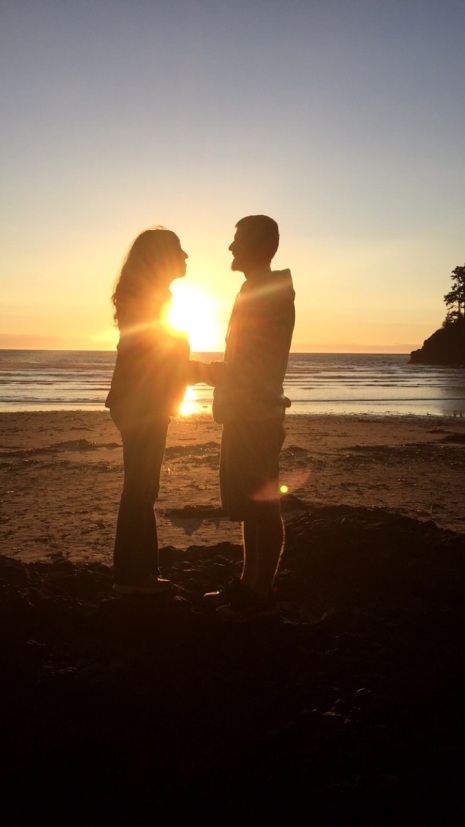
We walked along (now suspicious of every pile of kelp lest it contain another dead animal), climbed some rocks, and watched the sun set over the water.

IMG_18591
Bird got a cute silhouette shot of the Engineer and me

Hurricane Ridge

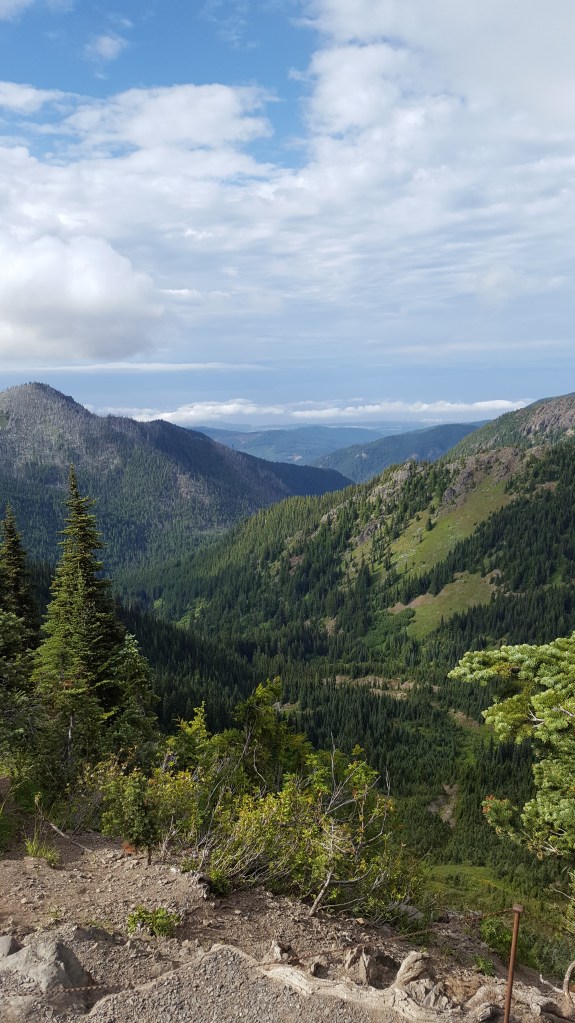
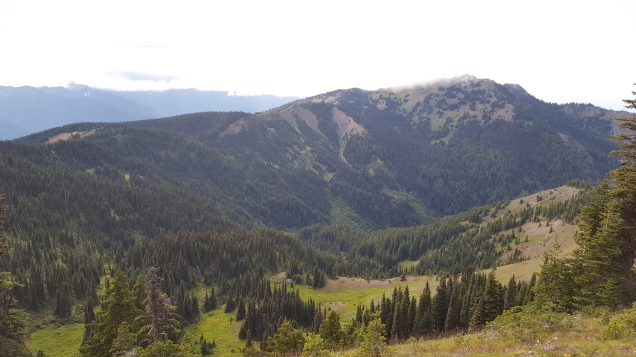
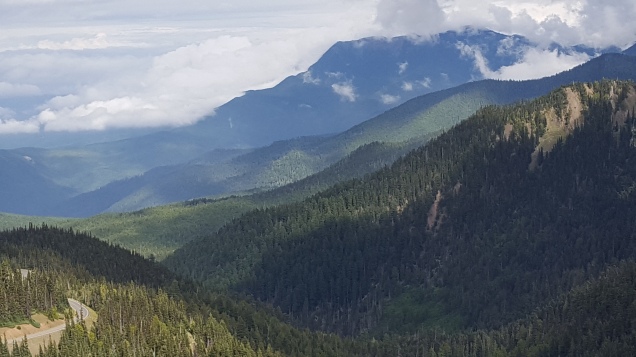
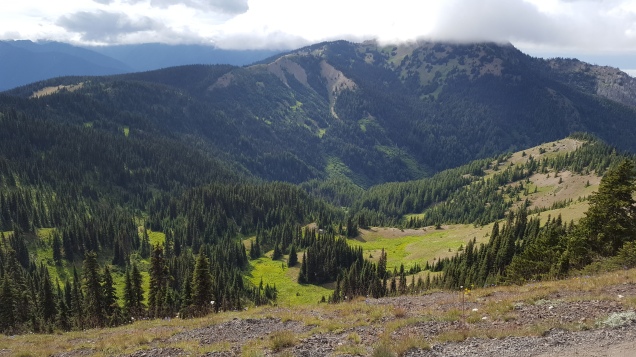
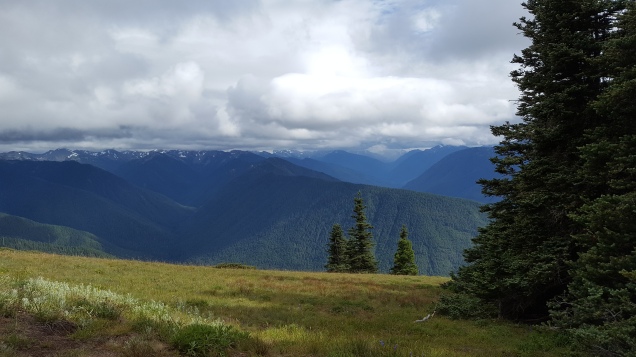
After some car troubles, we made it up to Olympic National Park.  The road up to Hurricane Ridge involves a lot of winding turns and a few tunnels hugging the side of the mountain.  At the visitor center, we saw a few marmots in a meadow and an utterly complacent deer sauntering through the parking lot.  Not wanting to stay too long since we had borrowed the Engineer’s mom’s car, we headed up one of the short trails, a 1.5 mile loop that promised “spectacular views.”

2016-08-02 16.38.12
On our way up the trail

As we climbed, we saw a doe grazing on the hillside below us – then noticed her two adorable fawns!  Farther on, a brown shape scurried across the trail, eliciting a yelp of, “Marmot!” from Bird.

“That’s a grouse,” the Engineer said.  I noticed movement at the foot of a nearby bush.  The grouse had a chick with her, a fluffy, energetic chick that seemed to ignore all of its mother’s cackles that probably meant, “Get over here this second or I swear I will feed you to those humans myself.”  Kids, right?

At the top of the trail…well, the view did not disappoint.

2016-08-02 17.00.242016-08-02 17.07.132016-08-02 16.48.082016-08-02 16.58.23

Marymere Falls

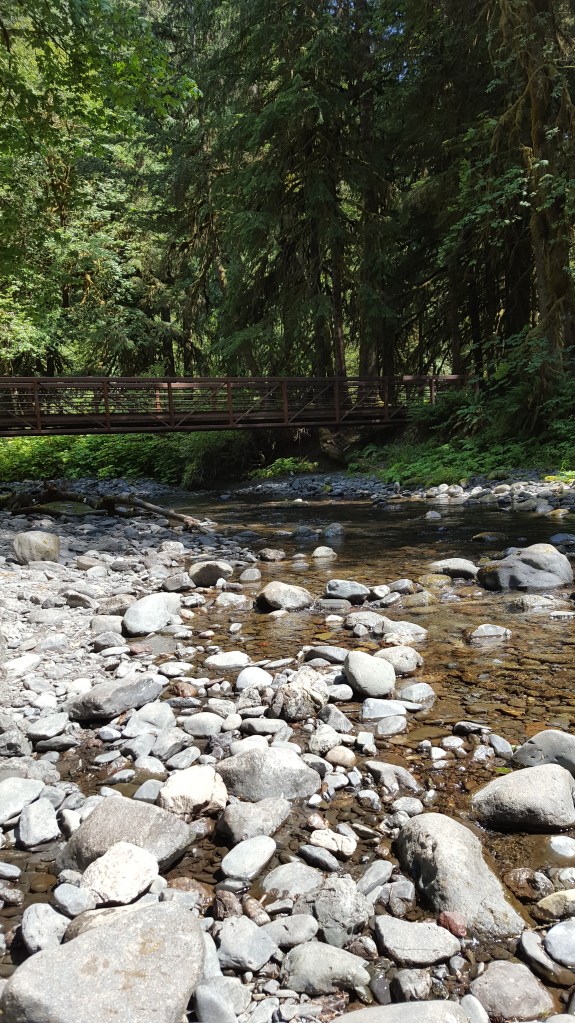
Since we seem to make this hike nearly every time I visit the Engineer’s family, we had to visit Marymere Falls before we left.  The trail winds through the forest to find the creek, where you can wade straight into the water from a wide gravel shore.

20160803_135748

20160803_140030Bird pointed to a natural, miniature harbor and said, “That’s where Ratty ties up his boat, and he and Mole can get up to their house through that tunnel in the bank, there.”  We discussed the logistics of hiding the canoe from humans, and where Badger’s house might be (further up in the woods, we decided), baffling the Engineer, who had never read The Wind in the Willows.  (Though he’s quite used to me pointing to little holes in tree trunks and insisting that fairies and elves must live there, so we probably didn’t sound too absurd.)
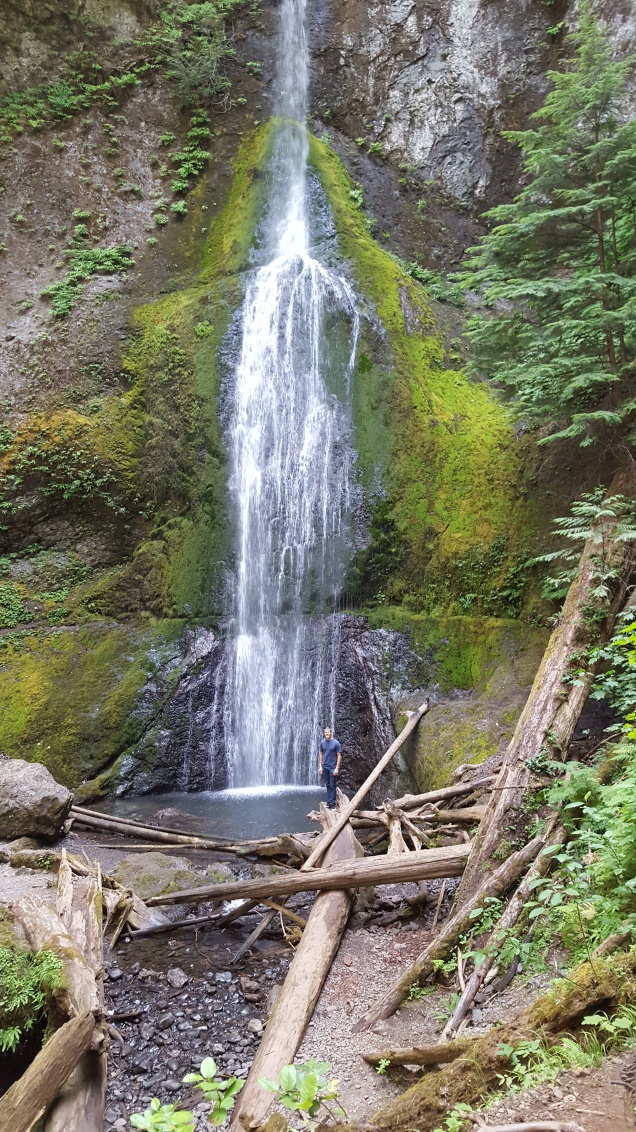
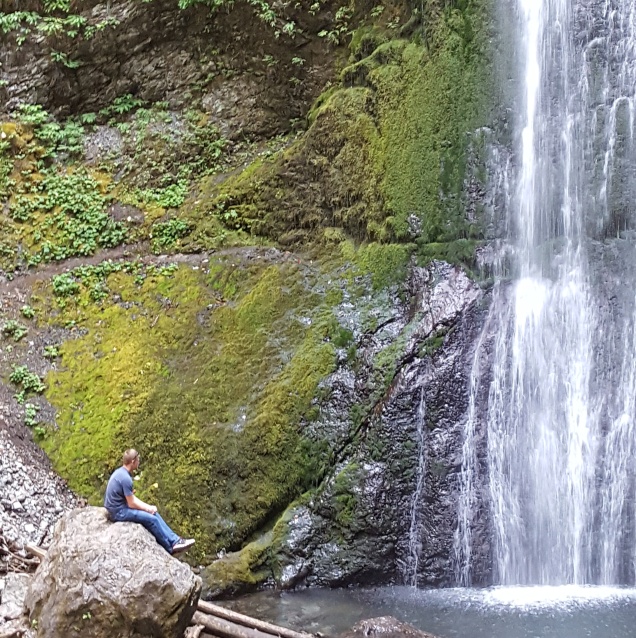
 

After crossing two bridges over the creek and its tributary, the trail turns steep.  We led Bird up to the higher vantage point first, then followed the loop down to where you can look up at the full height of the falls.  The Engineer and I slipped past the railing and climbed down to the pool at the base of the waterfall.

20160803_141737

IMG_20160803_191359

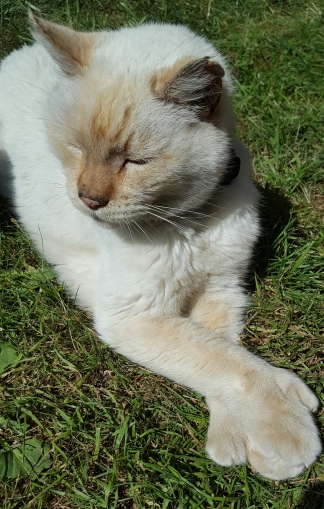
Once we’d made it back down the trail, we decided to go for ice cream at Granny’s Cafe, where we met a 12-toed cat!


2016-08-03 19.16.08.jpg
He looks like he has mittens on!

So there you have it, dear readers: proof that Bird and I do, occasionally, go outside and enjoy ourselves.

Convention

a meeting or formal assembly, as of representatives or delegates, for discussion of and action on particular matters of common concern

a rule, method, or practice established by usage

“So L. told me you do creative writing?” my coworker said/asked.  I looked up from my lunch in the workplace kitchen, slightly startled.  This coworker had always scared me a little.  But I’m always happy to nerd out a little about creative writing.

“Yeah, I want to be an author of long-form fantasy novels.  And maybe some historical fiction.”

She nodded, “That’s awesome,” and suddenly I found myself answering a lot of questions.  What was my writing schedule?  What podcasts did I listen to?  Who were my workshoppers?  What was my plan for getting an agent?  What was my timeline for finishing my novel?  What conferences had I been to?

“Actually, I’m going to a conference next weekend,” I said, and described it.  She waved a hand dismissively.

“Too many academics there.  You want to network at WorldCon or something like that instead,” she said.  “That’s where L. and I met Professor T. and A. B. – you know who that is, right?”  I could only shake my head as she barreled onward, completely overwhelming me with instructions as to how to make writing my career.  By the time she was done, I felt utterly hopeless.  How on earth was I going to educate myself on all these aspects of the publishing world?  And how had I ever thought I could be a writer when I was so ignorant?  I needed to catch up!

Then last weekend I went to that conference I told my coworker about.  My coworker probably wouldn’t have thought much of it.  I didn’t get any business cards, and I didn’t pitch a book idea to any agents or editors.  I had lunch and sat through panels with friends I had made the year before.  I chose seminars based on where I am in the writing process (very, very early stages).  I asked questions about things that interested me.  I nerded out about Anne Boleyn with a historical fiction writer.  Perhaps it didn’t do anything to greatly benefit my fledgling career, but the conference definitely benefited me.

Since announcing my intention to stay in our Small College Town and work on my writing while the Engineer finishes his degree, I’ve received a lot of advice about how to network (a terrifyingly vague term that still makes me cringe) and “start a career” despite my remote location.  But that’s never been what writing is about for me.  Yes, I’d love to write a bestselling novel, because it would mean other people wanted to read the same kinds of stories I’m interested in writing.  Taking time to write every day is more about seeing what I can do than about building any type of career.  I want a network of fellow writers and readers more than I want to memorize a roster of Who’s Who in Writing.

I do understand and appreciate the intentions of the people who ask me about my networking plans.  In many industries, connections are vital, and the earlier you make them, the better.  I realize it must seem like I’m approaching things a bit sideways.  This isn’t how convention says progress is made.  But I’m starting to value progress in my own head over progress on a society-based timeline.  At that conference, for example, one panelist said that his own shift in perspective came when he started calling himself a writer, even though he still had another full time job.  “Writer” was who he was, not just what he did.  That makes sense to me.  That is a step that feels concrete and real to me, even if my coworker might give me a pitying smile and say that until I can put it on my resume, I’m not really a writer.

I know that I am.  And that knowledge will give me the energy to keep working so the world can know it too.

So today I bought my ticket for NerdCon: Stories in October.  I’m going to meet up with the Commodore and talk about stories – written, filmed, recorded, sung, pantomimed, or any other kind of story – for a weekend.  And I’m extremely excited.  Maybe I’ll meet a future employer.  Maybe I’ll just have a really good time.  But I’m okay with either outcome as long as I can come home and write about it.

Succulents and Stress Spirals

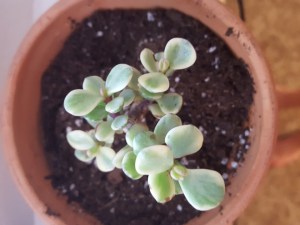
I potted some plants the other day.  I pulled on my brand new neon orange gardening gloves, scooped Miracle-Gro into an azure blue pot, and settled some spiky purple blooms around a central plant with trumpetlike white flowers.  Promptly forgetting the names of the plants, I have dubbed the spiky purple ones dragonsbane after a plant described in Dealing With Dragons.  I haven’t come up with a name for the white ones yet.  There’s also an adorable tiny succulent on my windowsill, which I have named Junior after the asparagus from VeggieTales.

I was proud of this attempt at gardening.  I was adding life to my home (and the plants seem like they’ll probably survive!).  That burst of productivity even extended to vacuuming, cleaning the kitchen, and balancing my budget.  It was a good afternoon.

Then the next day I came home from work and didn’t move from my couch for the entire afternoon.  Dinner was forgotten.  The dishwasher did not get unloaded.  Nothing happened except that I sat on the couch, coloring, until Netflix asked, “Are you still watching?” (a message I can’t help but read with a judgey inflection, even if Netflix is truly just concerned for my wellbeing).  Even my mindfulness coloring book didn’t seem to help my mood.

And all I could think about was, “I never do anything anymore.  I am so unproductive.  I’m going to completely fail this year” – and there I went, slipping and sliding down a Stress Spiral.  Basically, when I get into this self-overwhelming mindset, I use my current mood/emotion/situation to build illogically dramatic visions of the future.  In this case, it went something like:

I’m not feeling productive today ⇒ I’m falling behind on all the things I wanted to do today. ⇒ I’m going to fall behind on all the things I wanted to accomplish this year. ⇒ I won’t get any writing done. ⇒ I will be a failure at achieving my dream of being an author.

Looking at this through a logical lens, of course, the extrapolation falls apart.  For one thing, this year is not the only year I have in which to become an author.  I have my whole life to do that; this is just some time I happen to have set aside to work toward that specifically.  Scaling it back down, the dishwasher could conceivably be unloaded the next day.  And a bout of unproductive-ness one day does not mean I’m that way all the time – just the day before, I’d potted plants!  I’d budgeted!  I’d been an adult!  But the funny thing is that on those Good Adulting Days, I never think to myself, “I am always like this.”  Those thoughts only come on days when I am not being who I want to be.

IMG_20160714_121549My favorite counselor once told me, “Emotional states are not personality traits.”  It’s a helpful thing to repeat to myself when I’m scrabbling for a toehold in a Stress Spiral (and not just because it rhymes).  At some point I developed the habit of mistaking my darker moods for reflections of my Core Self, and as painful and overwhelming as that is, it’s a difficult habit to break.  So I journal, because sometimes just identifying the twists and turns of the Spiral helps me unravel it.  I talk to the Engineer, whose belief in my abilities is dazzling and unwavering.  I text my friends, who tell me I’m putting too much pressure on myself.  And I stand at my window and see that Junior seems to be doing just fine.  So odds are I’ll be fine too.

Adulting: Why Not Celebrate Small Victories?

Two friends of mine are getting married next weekend.  Though I’m not in the wedding, they asked me to lector, so I’m driving 3 hours to the rehearsal dinner the day prior to the actual ceremony.  Since I didn’t want to drive another 6 hours round-trip between the rehearsal and the actual wedding, I booked a hotel room.  As soon as I received the confirmation email, I took to Facebook:

Just made my own hotel reservation for the wedding of two friends.  Am I adulting?

Normally I cringe at words like “adulting.”  Innocent nouns should not be pressed into service as verbs unless absolutely necessary.  But the verb form of “adult” is one I will allow for the simple reason that it is the most expressive word for the situation at hand.  “To adult,” according to Urban Dictionary, means “to do grown up things and hold responsibilities such as a 9-5 job, a mortgage/rent, a car payment, or anything else that makes one think of grown ups.”  Frequently appearing as a hashtag on social media, it can be used ironically (“Goldfish crackers and prosecco count as dinner, right? #adulting”) or seriously (“Checkbook balanced, apartment cleaned, laundry done, and dinner in the oven. I’m adulting well today!”).

The term has come under fire for its celebration of everyday chores.  Some who are already proficient at adulting (or like to pretend they are) say that everyone has to do these things.  You’re not special for cooking a real meal or running a vacuum.  A recent Cosmopolitan article argued that emphasizing the basics of grown-up life undermines real accomplishments like career growth, adding that this probably stems from Millennials’ “extended adolescence” because “growing up may feel optional” nowadays.

While many young people do benefit from still living at home and the perks of having their parents do most of the grocery shopping, this actually makes adulthood more scary, not less.

I was fortunate enough to have parents who insisted I learn to cook some basic meals and keep a bathroom sanitary before I went off to college.  They gave me a larger allowance in high school with the understanding that I would use it to purchase my own clothing, coffee, etc. so I could learn to manage income and savings on a small scale.  Though I’m sure I rolled my eyes at these lessons (sorry, Mom and Dad), I’m grateful for them now.  But no parent can teach their kids everything, at least not specifically (“Today I’m going to show you how to call the insurance company for a quote and where to find your policy number on that stupid little card”).

Many of us also grew up hearing that we could do anything, be anything we wanted, follow our dreams, etc.  And those are wonderful things to hear when you’re a kid.  They are also very broad, sweeping encouragements, with little to say concerning the nitty gritty of how to support yourself while chasing those be-anything dreams.  Again, I was lucky; both my parents were happy to help me pursue my love of writing, and at the same time they made sure I would be qualified and capable of holding a day job until that passion could become a sustainable career.

But guess what?  Adulthood is still really freaking scary.  Yes, the big career moves are nerve-wracking, but it’s also the little things that no one tells you about, like having to put towels down when it’s too late in the evening to call maintenance.  Even when you have a potential safety net at home, couldn’t you feel a certain amount of pride when you stop being complacent with letting your parents do everything?  If I lived at home, I would be proud when I made dinner for the family.  And now that I don’t live at home, I still like to send my mom pictures of the flowers I potted or the art I finally hung up on the walls.  These are small accomplishments, yes, but they’re still symbols of independence I am still learning to claim.

Perhaps this is nothing new.  Perhaps every generation up to this point has felt the same way as they’re thrown into the deep end of Grown Up Life.  But we have social media now, and ways to connect internationally with other people who are experiencing the same thing.  The only difference between us and the young adults of the past is that we can be much more public with our anxiety, and we can cheer each other on through the victories, big and small.

So I will keep on adulting, thank you very much.


Review: The Transcriptionist

*Note: This is a review of a book I have already finished and therefore contains spoilers.  Proceed with appropriate caution.

Mom sometimes says that when I type, it sounds fake, like someone is just smashing the keys randomly to sound as though they’re doing work.  My speed is mostly due to practice – we took “Computer” every year in elementary school and it was always the same.  When I’d finished all the lessons (my least favorite was alternating between L and the semicolon key over and over), I’d try out the Freetyping section until I found a sentence that seemed to flow for me, then repeat it relentlessly until I could do it fast without mistakes.  I first broke 100 words per minute with 100% accuracy on the bizarre query, “Did you know there is a curious creature called the Platypus?”  (Even as a 6th grader, I doubted the capitalization of the creature’s name was correct.)  After that, I quickly realized that in order to keep up with my own thoughts, typing out my stories was much more effective than trying to scribble them down on paper (though I still take notes and journal by hand).

It is this love of typing that led me to pick up Amy Rowland’s debut novel, The Transcriptionistsince the title implied a theme of words and the channels we use to convey those words.  And I was right, in a way.  The eponymous transcriptionist, Lena, works at a New York newspaper, transcribing articles and interviews on tape and sending the words on their way.  She frequently describes it as being a mere conduit and letting other people’s words run through her.  Even in her conversations outside of work (which, initially, are few and far between), Lena quotes from literature she’s read rather than create her own sentences.  She worries that she is dissolving, drowning in Other People’s Words.

The book is a chronicle of Lena’s reaction to one “story so shocking” that it drives her to begin pricking, then ripping, holes in the bubble of words that suffocates her.  There are other characters who can be divided into two camps: those who do not understand what is so wrong with a comfortable, even easy, job, and those who acknowledge her fear and support her in getting unstuck.

There are animals in Lena’s world, too – a pigeon that never leaves the balconette outside her Recording Room window, and a lion that becomes depressed after eating the woman whose death becomes the shocking story that jolts Lena out of her torpor.  She also frequently dreams of a mountain lion from her youth that terrorized her farming community.  Lena’s relationships with these animals reveal as much about her as her relationships with other humans, yet not in a sappy or heavyhanded way.  The pigeon’s true significance is withheld until the very end, and the two big cats’ effects on Lena are far from straightforward.

I was riveted by the idea of someone’s agency suffocating beneath too many words, seeing as my own relationship with language has been one that allowed me to discover aspects of myself rather than bury them.  The only weakness in Rowland’s prose was her tendency toward verbose dialogue that didn’t seem real – but then again, given Lena’s propensity for letting Other People’s Words slip into her conversation, perhaps it was appropriate to the character, if a bit distracting for the reader.

Lena’s long-ignored fears bubble to the surface and carry the plot swiftly along in a brilliant example of how the struggle to change one simple life can be just as compelling as a sweeping drama.

4/5 stars on Goodreads


Have you read The Transcriptionist?  What did you think of it?  What is your relationship with words like?