Oh, You Don’t Want To

If I had a dollar for every time someone asked me, “And what are your plans after graduation?” I could probably pay for another year of college.

But that’s just kindly curiosity.  People are just being inquisitive, or concerned for my welfare, or even just making small talk.  I get that.  It’s what we ask as humans, isn’t it?  What are you going to be when you grow up?  What college are you going to?  What outcome are you aiming for after this Big Socially Recognized Transition?

What gets me is the number of opinions offered based on my answer, no matter what that answer is.  It’s usually, “I don’t know,” to which they reply, “Oh, you don’t want to decide anything now, you’re so young!”  If I elaborate, “Maybe grad school,” then the op-eds really start flying.

“Oh, you don’t want to get an MFA in creative writing – all you can do with that is teach.”  “Oh, you don’t want to study literature – all you can do with that is teach.”  “Oh, you don’t want to stay at the same school for your Master’s.”  “Oh, you don’t want to lose any momentum by taking a year off.”  “Oh, you don’t want to stay in school forever – work for a few years, then come back and get that degree.”

If I mention a job?

“Oh, you don’t want to stay here, publishing is much bigger in New York.”  “Oh, you don’t want to go into editing, there’s no money.”  “Oh, you don’t want to go too far from home.”  “Oh, you don’t want to get stuck in some office job, you’re much too smart for that.”  “Oh, you don’t want to waste any time, you should start networking now.”

And forget even hinting that the Engineer might come into it.

“Oh, you don’t want to make decisions based on a boyfriend.”  “Oh, you don’t want to do a long distance relationship, so few couples can handle that.”

And on and on it goes.

I’ve been calling these bits of speech opinions rather than advice.  That’s because of the four- or five-word formula at the beginning of each snippet: (oh) you don’t want to.

Don’t I, though?

Don’t I want, in some moments, to study more creative writing because it’s what I love?  Don’t I want, at times, to elbow my way into publishing regardless of the paycheck?  Don’t I want to take the person I’ve been dating for years into account?

How kind of these opinions, sensing my confusion, to tell me what I want.

I’m used to some of these.  I’ve heard them before.  “Don’t worry, lots of people change their majors,” acquaintances would say, trying to give me a way out after I told them I was majoring in creative writing.  Sounds an awful lot like, “Oh, you don’t want to do that.”  But I did, in fact, want to.  It was like Warner thinking Elle Woods couldn’t get into Harvard even after she, um, did. 

like it's hardMy chosen area of study, like Elle’s sudden decision to pursue law, has raised a few eyebrows.  It seems implausible that writing would maintain such a strong hold on me, especially in a society that places so much emphasis on money making.  I get it.  And, following up on those undergraduate doubts, it makes sense that people would make similar assumptions about my choices post-grad.

I know most of these people mean well.  They want to see me succeed, or at least not starve to death or bankrupt my parents within a year of graduation.  They probably believe that their opinions are, in fact, good advice, and I appreciate that intention.

That’s where I run into trouble.  I was raised to respect adults, to seek advice from those with more life experience than me.  So I don’t really want to just start arguing with everyone – “Oh, you don’t want to [insert action here]” “OH YES I DO COME AT ME BRO.”  But I don’t know how to politely disengage when the opinions are irrelevant to me (such as when the information is outdated or based on hearsay, or just has to do with their own worldviews that I don’t necessarily share).

And even if the advice underneath the opinion is sound, I can’t help chafing at that formula. You don’t want to.  Words carry weight in my world, and that particular phrase is like an anvil dropped from a Looney Tunes cliff.  If you know what I do and do not want – why did you ask in the first place?
To Whom Much is Given

Mom, Bird, and I said grace before our meal in the food court at the mall last night.  No one shouted at us, threatened us, or asked us to leave.

We were at the mall to shop for dresses for a friend’s wedding later this summer.  Bird and I have never had to worry about whether or not our eventual marriages will be legally recognized in our home state.

I’ve been fortunate enough to live most of my life in a relatively tolerant community in one of the country’s most tolerant states.  I’ve been even more fortunate not to need this tolerance for my own sake, because I was born a white, middle-class, heterosexual female who identified as her biological gender.  I fell into pretty much every category of “majority” you can think of.  Admittedly, I didn’t realize just how blessed I was until I started college and the bubble of my existence dramatically widened (with the help of the internet, particularly Tumblr).

When the Supreme Court made its decision on marriage equality, I was overjoyed for my friends who could now plan the weddings of their dreams.  When I heard about the Charleston shooting, I mourned the victims – and got angry about the ignorance displayed by those who tried to dismiss the racist implications of the massacre.  I was still seeing these things from the outside, and I was not directly affected, but that does not excuse me from working to change things for the better.

I’m still learning, still developing my worldview (and I pray it won’t become as rigid and cemented in ignorance or partial knowledge as some of the people giving out their opinions like candy from a stranger’s van), still figuring out what I can do from here to help – or at least not make it worse.  I don’t know.  Sometimes it feels too big.

014b868afc10c6e19990969f956e90f6And I’m realizing that the best thing I can do is listen.  I don’t say this as if I can somehow validate others’ experiences simply because I, a privileged person, take the time to listen to them, people who have been denied something (or several somethings) that I have been blessed enough to have.  Their humanity validates their experiences.  We are all people no matter how many variables we can or cannot check off on a list of too-easy identifiers.  Yes, we are different, but that does not negate the intrinsic personhood or value of those different from me.

And my privilege or luck or whatever you want to call it does nothing if I let it drag me into complicity with the current value system that wrongs so many other people.  I guess what I’m working on is finding not the role that society tells me I should take up by virtue of all these things out of my control (ethnicity, sexuality, etc.), but a role in helping all of us crawl a little bit further out of that society’s reach to where we can start building and changing things.

To do that, I’m going to have to learn.  And to learn, I’m going to have to listen.

It doesn’t feel like enough.  I wish I had more ideas, more answers, more words.  But at least I can demonstrate my respect for my fellow human beings and remain open to educating myself and others.

One of the most sincere forms of respect is actually listening to what another has to say.

~Bryant McGill

An Announcement

For a while now, I’ve been toying with the idea of incorporating my stories and creative nonfiction pieces into this blog, but thought that it might disrupt the tone and the types of posts I normally write.  So I decided to create a separate-but-linked site called Changeling Scribbles where I could publish my narratives in serial form (not serial killer form, mind you – that’s a different blog entirely – but in installments).  I think working like this will help me a) force myself to actually keep writing every day, b) finish some of the ideas that have been floating around my laptop forever, c) stick to a schedule, since hopefully people will be anticipating the next chapter, and d) start getting used to the idea of people actually reading my writing, since I’m typically very private about my works in progress.

The beauty of this arrangement is that if you’re interested in reading my stories, you can follow this other blog, but if that sounds like one of the most boring/terrible/torturous propositions in the world, you don’t have to!

My first post on the new blog, changelingscribbles.wordpress.com, will go up on Monday.

I’m kinda nervous.

But I think this will be a fun experiment, even if no one ends up reading it.

Feminism and Texting Family Members

“Take your boyfriend with you.”

I had just texted my dad that the teeny-tiny cracks spidering up the side edge of my phone, which hadn’t been a problem up until now, had left a snowflake of glass in the flesh between my forefinger and my thumb yesterday.  He said that the Phone Store should replace it, no problem.  Then my screen flashed again with a second text.

“Take your boyfriend with you.”

Now why should I have to do that?  Why should I have to drag the Engineer along as a buffer so the Phone Store Employees won’t sneer at me and patronizingly tell me that the only way I get a new phone is with a new contract that will (obviously) cost my father millions?

The Engineer, as much as I love him, is useless when it comes to my phone.  He can’t figure out touchscreens to save his life.  He has a flip phone with a QWERTY keyboard and is quite happy with it.  But the Phone Store Employees will not know that.  They will know only that he is a man, and therefore automatically more knowledgeable of technology and money-handling in general and less likely to be trifled with than me, a woman.

Grr.

I don’t blame my dad for this.  Honestly, I’ve never particularly enjoyed going in to try to get someone to replace or repair something for me without an adult there.  But I’ve also grown up around my mother, who can make a grown man turn pale in the face of her righteous indignation when she is dissatisfied.  Not that she flies into a rage if her soup is tepid, but she also isn’t one to back down if something needs to be made right.  As I tentatively step into adulthood, I’m slowly learning to hold my ground and evenly ask for decent treatment and service, the way my mom has my whole life while my dad was off on trips for the airline.  I may be a daddy’s girl in some cases (if I were at home, I would probably barely look up from my laptop long enough to hand Dad my phone to go get it fixed, but that’s mostly because I’m lazy), but here at school, I do have to run my own errands, fill up my own car, take care of my own apartment, etc.  And why shouldn’t that independence of school life extend to getting a warrantied phone replaced?

Furthermore, it’s a sign of a deeper societal issue that Dad didn’t even have to explain why he thought I should take my knight in shining armor with me.  He wasn’t suggesting it as a date idea – our family has some weird ideas about love, but getting a phone replaced is not exactly a typical couples activity – nor was he saying that the Engineer should tag along to learn the ropes of getting Phone Store Employees to listen to him.  The implied subtext, the only underlying message that makes sense as Society has taught us, is that I needed the Engineer, the man in my life in a protective role, to accompany me the same way my other friend did to the mechanic’s last semester, and for the same reason: that I would not be taken seriously on my own.

ADDENDUM: According to the Commodore, the acceptable reason that you should ever have to have a male accompany you anywhere is just in case you need someone to sacrifice in Trial By Combat.  Obviously, since we are Strong, Independent, 21st Century Women, we could handle such a challenge on our own, but it’s much more convenient bringing someone to sacrifice in our stead.  These things happen.

Running Pell-mell

You know when you were a kid and you used to fling yourself headlong down any hill you could, not caring that you might trip and roll to the bottom because grass was soft and you were invincible and even if you ran smack into a tree and got a knot on the head you would probably lie there grinning because it was a joy just to run?

You know when you started to grow and your limbs were too long or too uncertain for the rest of your body and you cartwheeled like a starfish, slowly and heavily, and suddenly halfway down the hill you became aware that the upper half of your body was leaning just a bit too far forward and would get to the bottom just a bit quicker than your legs could and it pulled you up short, heartbeat staccato, because suddenly you cared if you tripped because there were rocks embedded in the soil?

You know when you first stopped at the top of a hill to examine, objectively, whether or not it just might be too steep, too much like the obtuse angles in the textbook in the backpack weighing you down, and ended up edging down sideways because it was safer?

You know when a hill started sounding more like an obstacle than fun?

You know when going downhill started to have a negative connotation, because when a business or school or a relationship went downhill it was bad news?

You know when you seem to be perched at the top of an impending week, peering over the edge of Sunday night and wondering how fast you’ll end up rushing down Monday’s slope into the fray, and you can’t remember when running pell-mell down a slope went from exhilarating to overwhelming…

Home

Freshman year of college made me overly conscious of the word “home.” I consciously said I was going back to my dorm, or my room. When I did say “home” by mistake, my friends looked at me, puzzled.

“I don’t mean home home,” I said.  We used repetition for emphasis, as if we were gossiping about who like liked who else in eighth grade.  As the year went on, I slipped into using the word more and more often.  Now, in my third year of undergrad, my friends and I know when someone means “home” vs. “home home.”  There’s a subtle difference that truly collegiate ears can hear.  But it still strikes me sometimes that I now have three “homes.”  I have to wonder if it cheapens the word.

I had been through a phase like that before, when my dad finally bought a house after the divorce. I was determined not to bestow the term “home” on his bachelor pad, angry as I still was. But after a while I admitted that Dad’s house was just as much a home base for me as Mom’s, particularly as college loomed and I was clinging with white knuckles to everything familiar in the face of having to go away to a huge campus (by my sheltered standards, anyway) where the only people I knew were the ones I never really liked in high school.  “Home” was suddenly akin to “haven,” and it stayed defined that way for the first half of my college career, particularly since I found myself having to move once a semester for a year and a half for various unforeseeable reasons.

But now, as a new transition rears its head like the Cave of Wonders bursting out of the desert, I find myself thinking more about “home” as something I am about to create than something preexisting.  In a way, this is sad.  I love being able to return to the places where I grew up and revisit the life I used to have.  However, since Bird took over my room (I had the bigger one all through high school) as soon as I went to college, I haven’t actually gone home to the room of my adolescence for almost three years now.  Instead, I’m arranging the apartment the Commodore and I share, making it suit us both, and spending pretty much all my free time either here or over at one of my friends’ apartments.  I’m enjoying our little nest (and I love not having to move again until at least graduation!).  But even this is temporary by nature; I’m not even living here full-time, since I go home for breaks.  (Not that I’ll be home for the summer – I have an internship three hours away.)

The Southern Belle and I were discussing our plans for the summer, and she brought up a good point.  She told me that although she looks forward to returning to the South, it’s not because she wants to see the people and places she left behind, but rather because she is excited to see how she as an adult fits into that space.  It’s about her, not her past.

I agree.  “Home” is shifting from “origin point” and “haven” to “where we fit/belong in the world” – and that might not be the places we grew up anymore.  I’ll always love going home to my parents, but soon my “home home” will change.

Part of me wants the glamour of city life, living in some brick apartment building with plenty of character and becoming a regular at the coffee shop down the street, walking to work or taking the subway in flats and changing into my heels in the elevator.  Part of me wants the quiet of suburban or even secluded country life, where I can putter in the yard and make a house a comfortable place for me and my family to spend our days, not having to venture too far into society if I don’t feel like it, having a view of something other than concrete.

Surprisingly, only a very tiny part of me wants to run back to the “wispy peach” room at my mom’s house and the “papyrus green” one at my dad’s.  It sounds more exciting to me right now to have the agency to create my own home – furnished, of course, with the beloved, familiar, castoff furniture we’ve been saving in the basement for years.  And for once, I’m okay with the uncertainty.

Hell Hath No Fury Like a Perfectionist in a Group Project

I have trust issues.  More specifically, I have trust issues when it comes to group projects.

You see, the trouble with group projects is that in my formative years, everyone in the group got the same grade regardless of the amount of work they had put in.  I learned very quickly that if I let most of my classmates half-ass our posterboards and say “I don’t care” the whole time, the end result would be a posterboard I was embarrassed to stand in front of while we presented to the class.

So I took over.  The way 5th grade me saw it, they didn’t want to do the work, and I didn’t want them to do the work, so everyone was happier if I just made everything just the way I wanted it.

But then high school came, and even though I still ended up taking over most of my group projects, I had a new weapon at my disposal: evaluations.  Secondary education, apparently, was not quite so idealistic in its assumptions of how children would divide the labor.  These new teachers knew perfectly well that the nerds and perfectionists (and believe me, I stand proudly at the intersection of that Nerdy Perfectionist Venn Diagram) would end up doing all the work if the slackers had no carrot or stick to move them along.  Suddenly I had power; instead of being the group workhorse or overachiever, I was the taskmaster.  With a gleam in my eye that was the precursor to my Soul Burning Glare, I quietly but significantly jotted down notes of who was and was not working during group meetings.

I was usually a benevolent dictator, or at least I tried to be.  After all, I only wanted what the rest of the group wanted: to get a good grade.  But it was often difficult not to wish that I could just do the whole thing myself and only have to worry about my own time management.

Of course, group projects have taught me some valuable skills, though probably not the teamwork and collaboration my teachers hoped I would get out of them.  More accurately, I learned that most of the other kids actually didn’t mind pitching in but were afraid to try to wrest control from me.  (To be fair, I probably wouldn’t have responded well to an outright coup.)  I learned to delegate, to reluctantly relinquish little bits of the project, and to pretend to be okay with relying on other people.  And I found allies in unexpected places.

Sophomore year of high school, we had to draw a map of the Odyssey, including quotes from the book.  My group sat around on the floor of the hallway, staring at the markers and the terrifying expanse of blank butcher paper in the center of our circle.  They all claimed not to have a mental picture of Odysseus’ journey.  Conscious by then of my domineering tendencies, I had been trying to bite my tongue, but at that I pulled out a pencil and started sketching the islands as I had envisioned them the whole time we’d been reading.  After I placed the islands, my group members followed behind with the markers to color them in and add some scenery.  That night I went home and compiled a list of short quotes we could write next to each island and showed up to the next class ready to write and draw, feeling as though I hadn’t done much.  At the end of that meeting, as we divvied up the remaining labor for the weekend, I volunteered to take the poster home and finish it.

“I think,” a boy named Will said, looking at the printed list of quotations in my eager hands, “that since Grace has done pretty much everything so far, she shouldn’t have to do anything else.”  A murmur of agreement ran through the group, and I blushed down at the poster.  He didn’t say it meanly, as though he thought I had steamrolled all over everybody.  He simply acknowledged my work and kindly pointed out that they could take it from there.  It was a nice moment.

But then I had to keep six people on task for an entire semester-long government project senior year, and my exasperation with group projects was cemented.

I understand that they have their place.  Really, I do.  I’ve learned from having to deal work with other students and communicate with them.  But college is so busy already that I would rather not have to track down five other people and twenty disparate pieces of the project just so we can pass the class.

As for the basic argument that we’ll need to work in groups in our careers?  Just one more reason I want to be a happily introverted writer tucked away in my garret.

Everyone Thinks I’m Graduating

“Wait. You’re going to be here next year?”

I had just told one of my coworkers about my plans to apply for a slightly elevated position (think Supervising Student Employee instead of just Student Employee) at our job next semester when utter confusion clouded her face.

“Ye-es…” I said, equally confused.  “I’m a junior.”

“Oh my God!  We all totally thought you were leaving this year!”

My boss had the same reaction when I popped my head into her office to ask when the applications would be out.  I mean, she seemed excited that I’ll be sticking around for another year, but she definitely thought I was leaving in May.

When I asked another coworker, she said, “Yeahh, I thought you were a junior because you’re the same year as the Commodore, but everyone else seemed so sure you were graduating.”

This is all very strange to me.  First off, it’s always weird to find out other people discuss you when you’re not around.  I suppose the fact that I’m well-known at work bodes well for my plan to take on more responsibility there.  And it’s not like they’re all rooting for me to leave.  It’s just strange to think of myself being referred to in the third person in my own absence, a little like realizing that all the people you pass by briefly and think of as extras or one-dimensional characters in your own life in fact have their own three-dimensional lives in which you are merely an extra passing through the background too.

Secondly, this idea of me graduating anytime soon, though terrifying, is quickly becoming a theme in people’s assumptions.  “You’re a senior, right?”  Um, no.  “But you’re graduating early, right?”  Again, no.  “Are you gonna get an internship for next year?”  Maybe I just give off Almost Done With College vibes or something.  Or I just appear incredibly mature for someone who is only in her third year (yeah, right).  Or somehow, because I was always the Smart Girl, finishing school in the traditional time span of four whole years seems too long, too commonplace to people looking in on my life.  But I’m happy here.  I’m good at this.  So yes, I will be here another year, which puts me graduating right on time – for me.

Conversation About Conversation

I like to joke that typical dinner conversation at my house delves into the Big Questions, discussing Life, The Universe, and Everything.  It’s true that what Bird and I consider normal mealtime chat includes the stigma on mental illness, the treatment of women throughout history, the state of the education system in the US, and so on.  I never knew this kind of thing wasn’t necessarily typical until I began having dinner at friends’ houses and learned that when they talked about their day, they stopped there.  They literally just talked about their day, and maybe what they had planned for the next day, or the weekend, and maybe a funny story from last summer when they all went inner tubing and the youngest dropped her sunglasses and cried.  I mean, we had those conversations too.  (Believe me, there are plenty of stories we love to bring up at the slightest provocation.  Remind me to tell you about the time Dad got a speeding ticket.)

But we also enjoyed going off on extended tangents about abstractions and Important Concepts while our dinners cooled in front of us.

And I am so grateful for that.

My family’s tendency to engage in abnormally esoteric dialogue gave me a foundation for extracting themes from the literature I read in All the English Classes Ever.  It gave me a vocabulary for identifying abstract concepts.  It gave me practice for listening to others and having a Real Discussion as opposed to a shouting match.  And it gave me the mindset that led me to the Writing Center.

My university’s Writing Center became my haven during a semester when things were pretty rough for me.  I found an affirmative place where like-minded people weren’t afraid to have conversations about their enthusiasm for language.  Even though the required job trainings take chunks of valuable Netflix  time out of my evenings, I love them.  I love getting to talk about the importance of body language while working with a student and our desire to change the campus perception of us as a personification of spell check.  It almost feels like spending an evening at home again.

The environment that encourages these conversations is slowly helping me figure out what I want to do with my life.  Not the answer to the perpetual question of What I Want To Do, as in a job, but the values I believe the world needs to see more often and how those should influence my own choices.  If I never talked with anyone about these things, I would probably be facing those looming Life Decisions with even more paralyzing terror than I currently have.  As it is, I am buoyed by the knowledge that somewhere out there are other people who like to have conversations about conversation.

others

Productive Procrastination

College

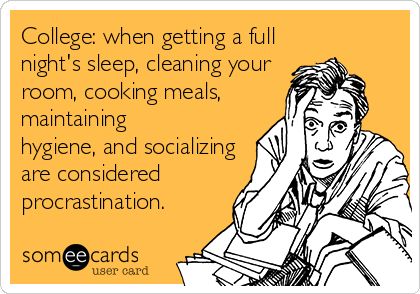
Productivity is weird, particularly in college.  One can be domestically productive, or scholastically productive, or literarily productive (I may have made that one up), but it seems that one cannot be productive in all these areas at once.

This morning, in a burst of motivated energy, I did three loads of laundry and put them all away, changed my sheets from flannel to cotton because it’s finally above 50 degrees, did the dishes, tidied the kitchen and living room, read my Shakespeare assignment for Monday, found articles for my Coleridge presentation on Tuesday, caught up on Doctor Who recaps on my favorite blog, read a great deal of my leisure book, and planned out my homework schedule for tomorrow.

Unfortunately, this leaves me with a presentation and an HTML project to finish, two papers to start, a five page rough draft of a creative nonfiction piece to write, meals to plan, and grocery shopping to do, not to mention preliminary research to do for my thesis project.  So although I feel like the day was well-spent, academically speaking my to-do list has not shortened by much.

The Commodore pointed out that I’m laying the groundwork for the homework I have to tomorrow, since I found sources for the projects I have to finish this week.  And now that some domestic chores are out of the way, I’ll have the uninterrupted time I need to delve into the more time-intensive tasks I left for tomorrow.

At least, that’s how I keep rationalizing it to myself.  Yes, I was productive today…just…not with homework.  But in college, little else tends to matter.  So tomorrow should be…busy.