Housing

any shelter, lodging, or dwelling place
the act of one who houses or puts under shelter

I’ve been frantically thinking, texting, and talking a lot about housing lately.  An internship for this upcoming summer would only work out if I could find a place to live for the duration of the internship – within a week.  I work best in specifics, so I don’t think it helped that the vague term “housing” could mean “any” place I could find to live.

“I would live under a bridge to make this internship work,” I joked to several people – and I half meant it, too.  This was my dream internship: an editorial position with a small company close to home that had connections to the larger publishing industry.  The interview process was nerve-wracking precisely because I wanted it so much, and I was so happy when I got the job, that to have it rescinded because I couldn’t find a distant cousin willing to let me live in their attic for the summer didn’t bear thinking of.  It frustrated me that I had too many options, rather than not enough, because it meant I had to investigate more of them, and choose from several, and investigation and choosing took time.

Eventually it worked out that I’ll be staying with the Engineer’s grandparents, for which I am exceedingly grateful.  I grew up in a home with a mother who is, as the Southern Belle put it, “an honorary Southern lady,” so I know the depth of true hospitality.  Housing someone is not just allowing them to sleep under your roof.  It is protecting, sheltering, providing a haven.  It’s appropriate that the word can be both a verb and a noun.  I will be housed.  I have found housing.  And someday, I hope, I can house and shelter and protect guests of my own.
Lent

1. simple past tense and past participle of lend
2. (in the Christian religion) an annual season of fasting and penitence in preparation for Easter, beginning on Ash Wednesday and lasting 40 weekdays to Easter, observed by Roman Catholic, Anglican, and certain other churches.

I grew up hearing a lot about what I should give up for Lent.  (By the way, guys, I’m Catholic.)  There were the traditional years where chocolate hypothetically never touched my lips.  When I got older and my mom introduced the idea of giving something to God instead of giving something up, I said a few rosaries before bed.  Lent was the technically-40-days-but-feels-like-forever season before Easter, when my parochial classmates and I had to sit through weekly Stations of the Cross and go to extra all-school Masses and I looked longingly at the Easter dress hanging in my closet that I couldn’t wear yet.

Meanwhile, I heard another version of the word, uncapitalized this time, in the old-fashioned books we read.  The people in them talked about having “lent” someone a book, or a cup of sugar, or a carriage.  Like “dreamt,” it seemed so much more romantic than saying you loaned something to someone.  So, naturally, I tried to use such vocabulary whenever I could.  (I probably sounded pretentious to my third grade classmates, but then again I could spell “pretentious” and they didn’t know what it meant, so they just called me a nerd instead.)

And yet I never connected these two meanings in my head, the capital L and the lower case, until recently.  The term for the liturgical season originally came from an Old English term lencten, which literally meant the lengthening of the daylight hours.  This is the part of the year when the days oh-so-gradually begin to stretch themselves out like cats elongating their spines in the sun, digging their claws in for summer.  (And yes, when I was younger, the Lenten season seemed to lengthen itself just to torment me.)  But, ideally, isn’t this time of preparation for Easter meant to help us stretch our spiritual muscles a little bit?  The idea of lengthening, to me, now calls to mind the idea of reaching out toward God, lending Him something precious to me and, having lent Him the time I used to spend on that Very Important Thing, perhaps realizing that the hours were always meant to be devoted to Him anyway.  It’s not really lending God anything, because I already believe that everything is His.  So maybe Lent is about stripping away the arrogance that leads me to believe that I am doing Him a favor.  Maybe it’s about realizing it’s He Who is doing the lending here.

The Flowers on My Kitchen Table

images (2)

I got flowers yesterday.

My boyfriend, the Engineer, knows very well that my favorite flowers are sunset colored roses.  I don’t know why, exactly, I love these particular blooms so much, but they bring me a specific kind of joy.  Their subtle scent, their soft, smooth petals, their paleness tinged with fire – seeing a bunch of them on my kitchen table just makes me smile.

And yet, they’ll be gone, drooping and withered, within a few days.

In the Internet frenzy recently leading up to Valentine’s Day, I saw an image of a girl with about five bouquets of a dozen red roses.  The caption, emblazoned in large white print over her, asked, “Am I the only one who would rather have something useful than this?”  I used to agree (even though everyone in my family and friend group says I’m impossible to shop for) that I wanted something that would last.  I took a utilitarian approach to gift giving and receiving.  Books I could keep for years, coffee I could use to power through the day, a gift card I could use to fund the purchase of something I needed or wanted.  Other than looking pretty for a few days and maybe making for good Instagram pictures, what purpose did flowers serve?

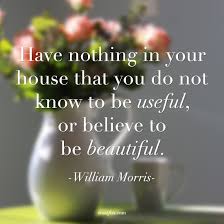
But for the few days they survive in their vase on my kitchen table, I truly can’t help smiling every time I walk past my roses.  So maybe I’m allowed to have something with no purpose beyond that of making me happy.  After all, that William Morris quote doesn’t say that the things in your house must be both useful and beautiful – only that they should be one or the other.  If both, so much the better.  If only one of the two, well, the human spirit needs Beauty to survive as much as it does the Plain Jane Useful Things.

As for their transitory nature, their fleeting existence, the roses are perhaps all the sweeter for it.  There’s something about knowing they aren’t a permanent new fixture in my house, that I won’t become accustomed to their presence and hardly notice them at all in a few months like I do with my artwork and other Useful And Beautiful Things, that makes the short time I do have them around all the more special.  They make me smile precisely because they are new and beautiful and their beauty will not cease to be new to me by the time they wither.

Throwing Sharp Things

I had just walked into the apartment when WHUMP!  Something flew into my roomie, the Commodore’s, closet door, followed by cheers from her and our neighbor, the Hamster.

“Um…whatcha doing?” I asked, tentatively tiptoeing toward her door.  The Hamster popped his head around the door frame, grinning at me.

“We’re practicing with our throwing knives!” he announced.  Sure enough, the two of them had stacked a pyramid of cardboard boxes in front of the Commodore’s closet and stood over by her window.  With a flick of the wrist, the Commodore sent another blade flying into an Amazon Fire box.  It stuck.

“This is so fun!” she exclaimed, reaching forward to pull her weapons out of the cardboard.

The Hamster proffered his knives to me, hilts first.  “Do you want to try?”

“Is that even a question?!”  I took the set of three knives and, after a few practice flicks, sent one hurtling toward the boxes.  It hit, bounced off, and lay flat on the carpet.  I sighed.

The Hamster and the Commodore told me they’d had several throws just end up sticking in the carpet, or even the closet door above and around the pyramid.  (Oh well.  We probably would have lost our security deposit anyway by the time we finally move out of the apartment.)  But as the night went on, a lot of throws flew straight and true to their targets.  I even had one go through a hole in a box to pin the back wall of the box to the closet door behind it!  The Commodore was aiming for a specific box with an enemy’s name on it, while the Hamster and I were just sort of trying to stab boxes in general.  The poor cookie mascot on one of them ended up rather tattered and scarred.

After a particularly bad round, where none of my throws stuck, I noted, “Even when they don’t hit, there’s something really satisfying about throwing sharp things at a great speed.”  The Hamster and the Commodore enthusiastically agreed.  It was like being little again and illicitly running with scissors (not that we ever did that, of course…).  It was the heady feeling of realizing that we were all legal adults and could, if we felt like it, spend the evening hurling sharp bits of metal at a pile of cardboard in our own home.  It was cathartic, stress relieving, and just plain fun.  I could imagine myself as one of my childhood heroines in battle – never mind that the target was stationary and less than five feet away.  Even though I’d never thrown a knife before in my life (and keep in mind, boys and girls, these were sets of throwing knives, specifically designed and balanced for the purpose, not like your ordinary Cutco stock), I’d always wanted to try it.  And I didn’t need anyone’s permission.  The opportunity just presented itself.

Of course, I never exactly expected to come home one evening and find two people in my apartment tossing blades around as a way of blowing off steam.  But then again, that’s why I love my friends: we’re all a little weird.

[I feel like I should put a disclaimer: no one was hurt.  We took turns and stood well out of the way while throwing and never even jokingly aimed at one another.  Ironically the next day I stabbed myself while cutting an apple, but that’s another story.]

Tired

1. exhausted, as by exertion; fatigued or sleepy
2. weary or bored

When did this become our default setting?

It seems that nearly every time someone follows the polite convention of asking another someone how they are, the answer ends up being, “Tired.” Or some less blunt variation: “Oh, I’m okay. Tired.” “Pretty good. Tired.” “Great! But also tired.”
Is there something in the water here that makes it impossible to get enough sleep? Is coffee not actually all we need to function? (Just kidding. #CoffeeIsLife) Are we all just lagging in our efforts to maintain the breakneck speed of college life?
Heyyy…wait a minute…

Someone told me last week to take a moment and see how my body felt when I tried to push away a negative thought – not my mental discomfort, just my body. Weirdly enough, it takes physical energy to put up a roadblock for distracting/insecure/negative/angry/inappropriate thoughts, so I can only imagine how physically draining my homework load must be. Not only carrying around the textbooks (I pulled something in my elbow this week picking up my backpack!), but carrying around the mental load of an ever-shifting To Do List takes its toll.
Add this to the fact that we are going going going 12+ hours a day, then have to go home and do homework, and yeah, we’re going to be tired.

Bird read somewhere that the average high-school student these days has the anxiety level of an average mental patient from the 1950s.  She told me this in the same phone conversation where she informed me that she had done homework for more hours than she slept the previous night.  I remember being tired all the time in high school too, and how I thought being able to focus on the things I’m passionate about in college would make me at least a little less exhausted.  But now we’re expected to be adults while still adhering to school standards, making huge life decisions (Shall I become one of Those People with an Advanced Degree?  What if I Graduate Early?  What if there’s a Major Upheaval in my life in the next few years?) in between classes and completing job and internship applications in the little time we have left over from homework.

I love school.  School is what I am good at.  I value my education highly.  But I also think it says something, not necessarily a good something, that the default State of Being for my friends and I is “tired.”  I can’t help looking forward to a time in my life when someone can ask how I am and I can say, “Good, thanks” and leave it at that.

Pampering to Excess

On Thursday night I ate chocolate in the bathtub.

I had taken a shower to get clean and then decided that I deserved a moment to just be. And so I filled the tub with all the hot water in our water heater; I mixed in the lavender bath salts I got for Christmas; I put on the anti-stress face mask I bought on a whim in the cosmetic aisle of WinCo last week; I turned on Pandora and climbed in and soaked until my fingers and toes turned to raisins.  And I reached over the edge of the tub and broke off bits of chocolate to eat.

It was dark chocolate, 86% cocoa, Ghirardelli Midnight Reverie, almost too bitter but in the way that coffee is sometimes almost too bitter when it’s brewed good and strong.

I focused on that bitterness, and the sweetness that tempered its edge.

I focused on the water cooling around me by degrees, and the way it cushioned my limbs.

I focused on the lyrics of the songs echoing off the linoleum from my laptop, and the swelling chords of harmony behind the singers’ voices.

I breathed for what felt like the first time all week.  Sensations, rather than racing thoughts, filled my consciousness.  And I thought, I probably needed this.  I needed a little peace of mind, and a piece of chocolate.  But the latter is usually easier to find on a college campus than the former.

List

a series of names or other items written or printed together in meaningful grouping or sequence so as to constitute a record

I am a very happy writing nerd today.

As part of the Visiting Writers Series at my university, two editors from well-known literary reviews are putting on a week-long, one credit workshop on editing and publishing.  It meets for three hours in the evenings, so I was initially a tad concerned about this loss of such a large chunk of homework time (not to mention dinnertime!).  Still, I thought, when else in my life will I get this kind of opportunity, to spend so much time in a relatively small and intimate group receiving direct feedback and advice from a successful editor and writer?

So I went last night, our first meeting, and we worked with lists.

As evidenced in previous posts, I organize my life several times a day, usually centering around lists.  I list the meals I need to take time to eat, the homework I need to do, the extracurricular projects I need to complete, the friends and family I need to call.  Listing things, for me, is already powerful in that it corrals my thoughts and lends them sequence, categorization, order.

In the workshop, we extended this philosophy to creative nonfiction, producing lists under thematic headings.  We began our sentences with “I remember,” listing memories that may not have come in order but nevertheless hung together coherently by virtue of their status as List.  We scribbled down things we hate, love, or are embarrassed by.  We listed aloud the nuances that distinguish memoir from essay.

Many of us lauded the catharsis of writing this way, of simply letting the thoughts stream out and trusting that the format of List would make them somehow One Thing.  For me, particularly when writing I Remembers, the experience was both aching and freeing.

In one of my other classes, Shakespeare Before 1600, “list” tends to have another definition.  The Bard uses it to mean “wish” or “desire,” as his characters tell one another, “Do what you list.”  Sometimes the lists are even a physical place, referring to the barriers of the tiltyard where noblemen jousted and wore their ladies’ favors on their lances.

These associations bring new depth to our modern understanding of “list.”  To create order out of a jumble of tasks and thoughts, to explain and group discrete ideas, one must take into account one’s own desires, as well as the desires of others.  Occasionally, one must also be aggressive and run at the list head-on, barreling through it and emerging victorious with a series of unhorsed opponents lying prone on the ground.  (I speak metaphorically of course, although if anyone knows how to joust, please let me know in the comments because that is awesome.)  We “list” things to discover “what we list” and what is worth “going to the lists” for.

Choose and/or Combine:

Sequence.

Wish.

Combat.

Decidedly Neutral Face

The Southern Belle and I couldn’t help but shake our heads at the tightness and shortness of the skirts in the crowd around us. One girl actually pulled her hem up as she wobbled by like a baby giraffe in sequined stilettos.  Considering this was a business etiquette dinner and the dress code was supposed to be “business dress,” I could only imagine what “business” these girls were aiming for.

“Oh my gosh,” the Belle said, turning to me, “what if we get to our tables and we have to listen to them all night?”

I batted my eyelashes at her and said with a smirk, “Then we will wear our Decidedly Neutral Faces and focus on the food.”  She grinned; this was a plan my dear Southern Belle could get behind.

You know the expressionless expression described in books when a character very determinedly lets nothing of his/her emotions show on his/her countenance?  Well, the Belle and I have that down to an art.  Usually the idea is to keep our true feelings under wraps – except from each other.  We can take one look at the other’s face and know precisely how hard she is working to keep that Decidedly Neutral Face on.  It’s particularly useful in situations where outright eye rolling would be rather rude and we need a moment to muster up some faux enthusiasm.

We’ve utilized it many a time, but we first put a name to it during our attempt at Yogalates (yoga + Pilates) last year.  We had decided to take another class at the rec to balance out the cardio of Zumba with some muscle toning.  However, within five minutes of the class beginning, I knew I couldn’t spend a semester doing this.

As soon as the instructor said, “Namaste” and dismissed us, the Southern Belle appeared at the side of my mat.  “So, we’re never doing that again.”

“Oh thank goodness,” I gasped.

She laughed.  “I was looking at you to see how you felt about it and you had this Decidedly Neutral Face the whole time.”

“I was trying to be polite!” I protested.

“I know, but because I know you I could tell you were just so done.”

That’s the nice thing about our friendship, I suppose: we can communicate almost telepathically.  We also let each other rant and get a little bit judgey sometimes, because we both know that ultimately the other is a perfectly nice person with a little bit of sass that needs to be relieved every now and then.  Unfortunately, taking baby steps into adulthood means that the even nearly audible eye rolls of our adolescence are now harder to get away with, even if we are well-mannered enough to keep the actual thoughts to ourselves (we did complete the etiquette dinner with flying colors, after all).

I’m trying to shift my default thought process from the negative to the more positive side.  I’m dissecting why I have the reactions I do, and working on reminding myself that I don’t know the whole story from just a glance.  And generally, I’m getting better at not reacting so quickly based on my snarky inner monologue.

But sometimes, it’s really useful to just hide those habitual thoughts behind a Decidedly Neutral Face – and have a friend who knows exactly what I’m thinking.

Definitive

  1. most reliable or complete, as of a text, author, criticism, study, or the like
  2. having its fixed and final form

I’ve been noticing this word a lot lately, particularly on Pinterest and Buzzfeed.  It seems like nearly every post involves a “definitive” ranking or roll call of some pop culture reference.  But by definition, every list cannot be definitive.  There are too many other people waiting in the wings of the Internet to rank the Pretty Little Liars’ season 1-infinity outfits, or the best animated Disney films (ALL OF THEM) or the things all 90s kids remember.

Some of these lists I might be willing to believe, considering the source.  Oh My Disney, for instance, might have a reasonable claim on being the “most reliable” place to find a list of the Disney princes’ hairstyles.  But they fail the second definition in that these lists, however authoritative the source, will never be in their “fixed and final form.”  Just try Googling “definitive ranking of” and finish the phrase with your own favorite fandom/fruit/fish family.  See how many results turn up.

definitive

124,000 search results in 0.36 seconds.  Nice work, Google.  But do these really deserve the title “definitive?”  Most can probably be dismissed out of hand because of their purely opinionated basis, with little or no authority to back them up, and the rest – well, as long as someone else comes out with their own “Definitive Ranking” next week, none of these will ever be the “final and fixed form” of the list.

Which begs the question, why are we so fond of this word on the Internet?  If the fluidity of our medium means that in the next hour someone else with more authority can come along and write their own post about the subject, why do we grasp at the title of “definitive” for ourselves?  The very place we publish these things undermines our credibility.

I tried to think of places I use or hear this word in my everyday life.  I realized that I, too, want to create something “most reliable and complete,” hopefully in a “final and fixed form.”  For several years, I’ve told anyone who would listen that I want to write the definitive work on the Arabian Nights.  That obsession is worthy of its own post(s), but now that I think about it…can I really claim for myself that my eventual tome will be the definitive work?  Or is it something that others will have to decide about my work later?

How does one dare claim this word?  It’s just daunting.  And yet, I applaud those who put forth their opinions and personal research with this brave word attached – as repetitive as it is to see so many supposedly definitive lists on Pinterest.

Immersion

My creative nonfiction professor has instructed us to immerse ourselves in a subculture somewhere in our little university town and write 4-5 pages about it by next Tuesday. We are reading In Cold Blood, Truman Capote’s compelling nonfiction novel (a genre assignment many are still uncomfortable with) about a violent quadruple murder in Kansas, told in riveting – but to some people, questionable – detail. Capote moved into the little town where it all happened and spent months exhaustively investigating the crime. This book ruined his life, our professor tells us. He never quite recovered from the experience of immersing himself in the murders.

And this is the guy you want us to imitate? I can’t help thinking.

I chose to immerse myself in my roommate’s work at the daily newspaper on campus.  The newsroom swallows up hours of her life, yet I have very little idea of what she actually does there, and despite fending off multiple suggestions/hints/nudges that I should come work there too, I’m curious and perhaps willing to look a little closer.

What does “immersion” mean, anyway?  I’ve most commonly heard the word attached to study abroad programs that promise you’ll return fluent in another language thanks to the miracles of “language immersion.”  When I’ve found my subculture, must I eat/sleep/breathe it?  Should I attempt to dive straight in, or am I allowed to observe for a little while?  Should I ignore all other concerns, even if those around me are doing homework or browsing Pinterest?

The infinitive, the command “to immerse,” calls to mind that moment of slipping underwater, taking a deep breath and letting the surface close over me and saturate my scalp, tendrils of hair drifting indifferently upwards and outwards while I float, suspended, between planes.  There’s something to the word that connotes downward movement into some substance or place, while also allowing me to be weightless.  I don’t know how that works, exactly; but it makes me think of dipping my head underwater, and it makes me thirsty.

Immersing oneself in water carries significant symbolic weight, too.  Going down into water often represents baptism, or at least some kind of vital change in a person or character’s life.  Capote had certainly changed by the time he came up for air from the little town in Kansas.  Ideally, an experience that results in a truly good creative nonfiction piece will probably change the writer somehow.  But, so far, we have not discussed what we’re supposed to do when we do finally break through the surface again and withdraw ourselves from the subculture.  We have not talked about what that will do to us.  We are supposed to be leaping off the docks here.

That’s the thing about “immersion.”  It sounds timeless, yet permanent.  To completely go into something, after all, is quite an undertaking.  And once you are there, suspended between those planes, with the dappled light and all your sensory information shifting in new and interesting ways…the word seems to suggest you might want to stay.