Endings Are Weird

The Southern Belle and the Commodore both presented their thesis projects (thesises?  thesi? theses, I think) the other day, and, unsurprisingly, passed with flying colors.  Now I can welcome them to the Post Thesis Haze, the phase in which we come to terms with the fact that this Big, Looming Thing is really over and done with.

The Southern Belle commented on the weirdness of this while we walked around the track in the gym yesterday.  She remarked how as freshmen, we were told we would have to complete a thesis, but we sort of ignored it for the first 2 1/2 years of our undergrad, until they made us attend a thesis proposal seminar junior year and the reality of the project suddenly hit home.

“And now it’s over,” she marveled.  I nodded.  The vague cloud of expectation that had been hanging over our heads since freshman year had dissipated, and its absence was a little strange.  My thesis, the biggest thing standing between me and graduation, is over, but I still have a few final projects, a few more classes to attend, a survey or two to fill out.  I thought all these things would conclude at the same time, but they refuse to line up that nicely.

We kept walking, past the huge posters of euphorically grinning students the gym plasters around the track to show how wonderful college is for your health.  These posters have featured the same wide smiles since our freshman orientation (my favorite was the vet student in a lab coat high-fiving a pug), but sometime last week they updated them.  New fonts, new slogans, new faces.

There’s something about the institutional-ness of College that always suggested to me that I would be the thing that changed over the course of my four years here.  I, the organic, malleable, almost-adult, would shift and grow against the background of the unchanging brick buildings.  But since I’ve been here, The University has added new dorms, gutted old classrooms, begun new projects that won’t be finished until after I leave.  The editing and publishing certification I added to my degree is only 2 years old.  Things have sprung up, collapsed, grown, shrunk.  As a freshman, I thought that only the students would do all that.  As a senior, I’ve learned otherwise.

Still, the literary side of me wishes the gym had at least kept the old posters until we graduated.  It would have made for a neater ending.

Senseless Part II

I knew something had happened when my friends’ Facebook profile pictures changed color.

The black, yellow, and red were unfamiliar to me.  We don’t spend much time on geography in school these days.

We should probably change that.

I clicked on ATTN:, a news source I follow on Facebook, to read about the attacks.  The state of emergency.  The outpouring of support on social media.  The cartoon someone made of a French flag hugging a Belgian flag.

At the bottom of the article, ATTN: had one of its usual poll questions.

“Are you shocked by this act of violence?”

The options for answering were “Yes” or “No.”  But all I could think was, “I wish I was.

This seems to be how the world is now.  I am far from blase about it, but no, I was not shocked.

Instead, I will be shocked, happily so, as in the wake of the Paris attacks last year, by humanity’s best responding to this demonstration of its worst. The volunteers.  The blood donors.  The people across faiths praying for peace.  As Mr. Rogers said, I will look for the helpers.


How to Help Victims of the Brussels Attacks Whether You’re in Europe or Across the Globe (Bustle)

Donate to Belgian Red Cross


Dressing for Success

I think I might be addicted to high heels.

I’ve developed occasional shooting pains in my legs, which most people tell me is probably something to do with a nerve in my back or something.  Whatever it is, it’s not helped by my habit of wearing heels, boots, and flats with little sole or support.  So, after a particularly bad occurrence of this nerve pain one night, I decided to be responsible and take care of myself and wear supportive tennis shoes to campus the next day.

I hated them.

With every step, I felt horribly underdressed.  Never mind that every other girl I passed wore yoga pants and a hoodie, or socks with sandals.  My personal style does not involve tennis shoes and a t-shirt anymore, but I felt like I couldn’t wear my normal clothes with my tennies.  Tennis shoes go with gym clothes, not a nice blouse and skinny jeans.

It didn’t help that I didn’t sleep well the previous night, so that day was already off to a sluggish start.  Whenever those days happen, I Dress for Success, tricking myself into thinking I’m on top of things by wearing heels and a blazer.

d702e2e20cd110d7cb6c421b58cbd422Dressing up wakes me up.  Wearing heels or heeled boots makes me feel more powerful, walk a little taller, and generally feel like I can Do More Things (plus people in crowded hallways get out of my way faster when they hear me coming).  It’s one of those fake-it-till-you-make-it things, I think.  So, conversely, dressing casually makes me feel unmotivated and lazy.  Lacking nice shoes affected my mood for the whole day.
But at the same time, I want to take care of my body.  So the next day, I pulled out my ankle boots with the thick, supportive soles (no heels, either!), and wore those instead.

Compromises are wonderful.

“They John Boy-ed Him!”

Because my mom enjoyed The Waltons, Bird and I occasionally ended up watching her DVDs of the eponymous family and their neighbors on Walton’s Mountain.  Usually it was just the early years, the ones before Ma got sent to a sanitarium for tuberculosis (because the actress quit) and Mary Ellen got married.  The later episodes just weren’t as good, according to Mom, for multiple reasons.  But one day we found The Waltons on TV and decided to watch it.  Other than the actors all looking a bit older and dealing with somewhat more dramatic issues, it seemed pretty normal.  There was a stranger living with the Waltons now, but we figured he was a cousin or something.

Except everyone kept calling him John Boy.  The narrator.

“That’s not John Boy!” we exclaimed.  Mom laughed.  Apparently the role had been recast between seasons at some point.

We couldn’t believe it.  They were just asking us to believe that this was John Boy, the aspiring writer through whose eyes we saw everything on Walton’s Mountain?  It was clearly a completely different person.

“Yeah,” said Mom, “one season he went off to fight in the War and when he came back, it was this guy!”

“Wow,” said Bird.  “War really changed him.”

Once we recovered from our laughter and agreed never to watch those later seasons again, this experience gave rise to a new phrase in our household. “John Boy” became a verb, meaning “to recast a character without warning or transition and simply ask the audience to go along with it.”

I was home on a break from school one day when Mom and Bird wanted to catch up on the season finale of a show we were currently watching.  Bird, who was texting a friend who had already seen the episode, suddenly burst out laughing at her phone.

“They replaced the brother!” she gasped.  “Oh my gosh, they John Boy-ed him!”

Sure enough, toward the end of the episode, the family entered their home to find a strange boy leaning against the kitchen table.  Gasping, they all embraced him, addressing him by the brother character’s name.  Apparently he had been at boarding school (because the old actor was in rehab or something).

“Well,” Bird deadpanned, “John Boy’s home from the War.”

Full Circle, or The Ins and Outs of Bus Routes

I’m sure the bus driver thought we were crazy.

The Commodore and I, mere freshmen at the time, had grown tired of dining hall fare and decided to take advantage of the communal kitchen in our dorm.  We weren’t too ambitious – something as simple as pasta and Parmesan would have made us happy.  But neither of us had any ingredients, and the small convenience-store-like market downstairs didn’t stock much beyond dental floss, Snapple, and crackers.  So we needed to go grocery shopping.

We didn’t have a car, either.

So we decided to take the bus.

We boarded the bus early in the evening, joining a handful of grad students who lived off campus and the few fellow dorm-dwellers who were venturing outside university-owned territory.  We wanted to be back for youth group at 8:00, so we figured we had allowed plenty of time.  The Commodore, better versed in the bus routes than I, showed me the loop we would be taking on the map.  Our chosen bus ran through the part of town affectionately known as Apartment Land (where we now live), then through campus to the downtown area where Safeway awaited.  It would be a while, but it was better than walking.

Eventually, as another batch of upperclassmen got off to trudge toward their respective apartment complexes, I asked which bus we would take to get back.  The Commodore flipped through the bus schedule while I mused aloud about the weirdness of boarding public transportation with bags of groceries at our feet.

“I’m sure we’re not the only students to do it,” the Commodore said, scanning the page.  “This is a college town.  Plenty of people probably don’t have cars.”  She pointed to a colored route on the map.  “This is the one we’ll take back.”

“OK.  How often does it come?  Is this going to be a super speedy shopping trip, or do we have time for Starbucks?”

“Ummm…” She ran a finger down the column of ETAs for each stop.  “Uh oh.”

“What?”

As it turned out, we were on a daytime bus that was making its last loop of the day.  The night schedule wouldn’t start until 9:00 pm – an hour after youth group – and it wouldn’t get to Safeway until almost 10:00 – an hour after the store closed.

So we sat and we rode the bus all the way through its loop back to our dorm.  The driver gave us a puzzled look when we stayed on all the way through town, even when he had to stop at the transit center for almost 20 minutes.  By the time we got back to our dorm, we were the last people on the bus.  Stepping off, we smiled and thanked the driver, who just sort of squinted at us before driving away.  We ended up with no groceries, no dinner, and not going to youth group either!

I was thinking about this adventure while riding the bus home last week.  I truly hate the crowded nature of bus travel, so I’ve learned to time my rides home, waiting until about 20 minutes after classes let out and the swirling mass of people leaving campus has ebbed.  I have the bus tracker that allows me to get to the stop right on time, and I know exactly which routes to take depending on which building I’m coming from.

This is a far cry from our unexpected full-circle ride freshman year.

College, of course, is about much more than learning to navigate public transit and plan your grocery shopping trips better.  But it’s those unexpected parts of my college education that have arguably helped me grow the most.


PS – this is my 100th post on this blog!  Which is strange to think of.  When I started, I figured it would be a once-a-week thing that might trail off into oblivion once I got bored, but instead it’s been a way for me to chronicle and process my thoughts, as well as keep up my (admittedly sporadic) writing habit.

Thank you to everyone who finds reading about my life to be entertaining – I hope you enjoy what you find here.


Shell Shock

When my professor called on me, I couldn’t contain an inarticulate growl before proceeding with my response to his question.

“Wow,” he said.  “The rage is strong with you today.”

It was indeed.  We were discussing the two doctors who “treat” Septimus Warren Smith in Virginia Woolf’s Mrs. Dalloway, and which of the two was worse/more destructive in his treatment of PTSD.  If you never read Mrs. Dalloway, Septimus is a character suffering from “shell shock” – hearing voices, seeing his dead friends, believing himself the recipient of a grand message from the universe, and feeling suicidal in the aftermath of serving in WWI.  The first doctor, Holmes, literally pushes Septimus’s wife, and therefore her worries for her husband, aside in order to lecture Septimus about how there is nothing at all the matter with him and how he should just get a hobby and go outside more.  The second, Sir William, agrees that Septimus is ill, but his focus is on normalization – that is, getting Septimus back to being a Contributing Member of Society, Back to Normal, and if he can’t do that, then letting him stay in an asylum rather than burden society any longer.

Grr.

These two delightful characters undoubtedly spring from Woolf’s own experiences with medical professionals while struggling with manic depression.  And even though Mrs. Dalloway was published in 1925, these doctors are still representative of social reactions to mental illness.

Setting my rage aside for moment (difficult as that is), I can understand the outside perspective.  It’s difficult to “believe in” an affliction we can’t see.  It’s not like a broken leg or a bleeding wound – there’s nothing visibly wrong, so a tiny doubt wriggles its way in.  He seemed fine two weeks agoIs she really that sick if she’s still getting all her work done?  He’s always been so reasonable – is he really thinking of suicide?  We base our assumptions on what we’ve seen and known of people up to this point, and sometimes it’s difficult to overcome that desire for them to “prove” that they’re “really sick.”  Similarly, I can see why, once we realize that something really is wrong, we want our friend/family member/classmate to Get Well Soon.  We want them Back to Normal, because isn’t that what they’re supposed to want too?  Our society often views healing as a process with an end point, a time in the future when the sick person will have Gotten Over It, whether It is a cold or the flu or the death of a loved one.  Of course, we are not completely callous.  We know that some things take longer to heal from than others.  But we’re still envisioning an end point rather than the possibility of “living with” the thing.  “Living with” seems to suggest an uneasy compromise, which we don’t like, because there’s the underlying possibility of another upset where the Bad Thing takes over, and of course we don’t want to see this person go through that again.

So I can understand these viewpoints.

But people who hold these views usually cannot understand me.

Both Holmes and Sir William fail to recognize and validate the reality of mental illness.  Yes, it’s difficult to “see” sometimes, but that doesn’t mean the person is making it up.  Visibility does not equal proof.  And, while there are sadly a few individuals who do make things up to get attention, why should that be our default assumption?

As for the push to Get Better Soon, while it usually comes from a place of genuine care and concern, it forces the sufferer to “take responsibility” for their illness – a problem that is actually beyond their control.  It may make the person feel as though the longer they take to get Back to Normal, the more irritated or fed up their support system will get.  Believing that the people around you think you should be over something makes you question yourself and begin devaluing the reality of your experience.  Also, prioritizing Back to Normal-ness denies a major fact of mental illness: it doesn’t always go away.  Balance can be achieved.  Strategies can be developed.  But when there is something chemically awry in a person’s brain, it can’t always magically be fixed.  So in that case, “living with” it instead of being crushed by it is actually a victory.

We have progressed significantly since the days of Septimus Warren Smith and his two horrible, horrible doctors.  But there is still room for improvement and understanding.


Still Alive, Just FYI

Sorry about the radio silence lately, but my undergraduate thesis is due tomorrow so I’ve spent the past few weeks alternately crying, tearing my hair out, complaining a lot  to the Engineer (he is a saint and a far better human being than I deserve in my stress spirals), and occasionally hitting a great writing streak and slamming out a dozen pages at once.  At the moment, I’m trying to write my precis (basically an abstract, but I can’t use any “jargon,” which I didn’t realize was a thing that happened when you’re just talking about storytelling, but apparently it is) and then format my final draft.

And then I turn it in.

Eek.

So anyway, once that’s turned in and I give my presentation in 2 weeks, I’ll have more brain space to write blog posts, so there will be a regular(ish) schedule again after that.

Pinky swear.

Powered by Coffee

Coffee should be black as hell, strong as death, and sweet as love

~Turkish proverb

At Starbucks, it’s a skinny vanilla latte (unless it’s fall, in which case it’s a chestnut praline latte, or a skinny peppermint mocha at Christmastime).

At Zoe’s, our local coffeehouse where I spent so much time that occasionally I got free coffee, it’s a dirty chai latte (two shots of espresso if I’m having a rough day).

At the coffee cart in the Hospitality Business Management building, it’s a hazelnut lavender latte (trust me, it’s divine).

At the shop downstairs in the student union, it’s a Thin Mint Mocha (or a London Fog if I’ve been stressing out and my stomach is in knots).

And at home, it’s my just-right combination of Italian Sweet Creme and Gevalia dark roast in one of my mugs from England or New Orleans or Chicago or wherever.

I love my coffee.  I’m definitely addicted – I get withdrawal headaches, not to mention extremely irritable and rather fatigued, whenever I accidentally decrease my intake.  And I know I probably spend too much on it – I attained Gold Status in my Starbucks membership without even trying.  The Engineer doesn’t even drink coffee, nor does he know most of my drink orders at any of the above places (which isn’t his fault, since if I’m in the mood where I need coffee now I’m probably being rather antisocial).

But I figure there are worse things I could be addicted to.  And besides the energy boost, it’s kind of a security blanket.  When everything in my day is going wrong, or I need the mental fortitude to face a scary Monday, one sip of coffee comforts everything.  As I told my counselor a few semesters ago, no matter what else happens, nothing can ruin coffee.  It’s happiness in a mug.

Rejecting a Resume Builder

I might have done something dumb.  Or I might be getting the hang of self care.  The line between the two, at least for me, is occasionally hazy.

The email came from out of the blue, with Congratulations! in the subject line next to the name of the University Lit Journal.  I’ve been published in this journal before (2 stories in one issue, actually), and submitted to it multiple times…but not this past semester.  I hadn’t had time to work on anything I felt confident submitting.

Confused, I clicked.

They had accepted my piece for publication, pending revisions, and needed a bio and headshot of me by Friday.  I didn’t recognize the title of the piece they mentioned, but the girl who had emailed me knew me from previous classes and one of my other friends was the managing editor, so it probably wasn’t a case of mistaken identity.  I texted Editor Friend.

“Um, it’s the piece you wrote for Professor C’s class,” he said.  “Last spring?  Here, I’ll email it to you.”

Vague memory dawned.  It was a creative nonfiction piece about my time abroad the summer before, but I was thoroughly “meh” about how it turned out.  Professor C, though, loved it.  He had encouraged me to submit it to University Lit Journal and, when I wasn’t sure, asked if he could at least use it as an example for his creative nonfiction editors.  I said that was fine, and maybe I would revise and submit it for publication eventually.  I never got around to it – had forgotten all about it, actually.

And now University Lit Journal was offering to publish it.

I remember how it felt getting the email saying that not one but both of my previous (fiction) pieces had been accepted.  I was exhilarated.  Over the moon.  Skipping down the sidewalk (well, I do that anyway because I’m basically a 5-year-old pretending to be a college student, but you get the picture).  The meeting with the editors to go over revisions was one of the best workshopping experiences I have ever had, and I was truly proud of the product when it came out in print.

This time around, all I felt was panic.

I did not have time budgeted for this.  I did not have a spare hour to meet with the editors again, much less several afternoons to devote to revising the piece to a point where I would be happy to see it in print (again, this was not my favorite thing I’ve ever written, and though when I reread it I could see some potential, it would take a while).  And I had no desire to carve out that time.  I didn’t want to rush to a meeting where my own writing would make me feel harried and inconvenienced.  I didn’t want to spend energy that I needed for class, work, thesis, feeding myself.  I didn’t want to pick up a project that someone else had started on my behalf.

“How much would you hate me if I said no?” I texted Editor Friend.

Some people might think I’m crazy for retracting my piece.  “How much time could it really have taken?” they might cry.  “You should have jumped at the chance to get published again!  I’m sure if they wanted to print the story it would have been fine no matter how you felt about it.” And maybe, being a young almost-graduate who’s hoping to get an entire book published eventually, I should have been grateful for the chance to have another printed piece on my resume.

But I just wasn’t.  And I have enough of a sense of ownership of my writing that I wanted to be excited if I was going to have something printed.  I didn’t want it to feel – well, like this.

So I retracted my “submission” and immediately breathed a sigh of relief.  Now I could focus on the stuff I want to write – like my thesis, my manuscript, and this blog.  Maybe it wasn’t the best choice for my resume, but it was what I needed to do for myself right now.  And I’m okay with that.

The Blessings Jar

I can’t work in clutter.  My room, in the upheaval and un-routine-ness that accompanies a new semester, had been in an Uneasy State of Chaos for a while, and I was sick of it.  So, working counterclockwise around my room from the door, I Cleaned – and yes, the capital is warranted, because it was no mere 10-second tidying up.  I dusted and organized and rearranged and adjusted until everything fit Just So.

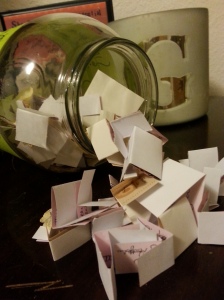
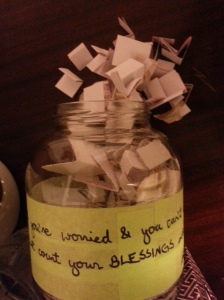
I was on a roll until I got to my nightstand.  One of the Random Things that had come to rest in obscurity right next to my bed was a pickle jar with the label peeled off and many slips of multicolored paper inside.

2016-01-19 19.37.17

My Blessings Jar.

I’d forgotten about it, failed to keep up the habit, since last year when Bird gave me the idea (which I think she got from Pinterest).  As I swiped the dust rag over it, I thought now might be a good time to empty it, start fresh, swear to myself that I would chronicle at least One Good Thing each night from now on.  Settling criss-cross-applesauce on the floor, I poured out the tiny scraps and began to read.  Some made me chuckle, like liquid dishwasher soap from when the Commodore and I finally ran out of that awful powdered stuff and bought a gallon of the liquid we preferred.

Some, like Bird’s smile when she saw me in the chapel after her retreat, made me cry.

It amazes me, sometimes, the magnitude of things that can be tethered in tiny characters inked on paper.  The moments I had found worth recording were instances of love, support, and shared strength from my parents, my sister, the Commodore, the Southern Belle, the Engineer and his family, my friends from church, and my coworkers.  All the people in my life had contributed to these scribbly bits of paper showing me how many families I have looking out for me.

So often it’s easier to remember the one bad thing that happened at the end of an evening, or late in the afternoon, and let it erase all the silliness and contentment of the morning and lunchtime.  A whole day can be colored by just one negative thing.  But when I force myself to think of just One Good Thing, it’s funny how more Good Things start to come out of the shadows, shyly raising a hand to say, “Remember me?  You didn’t have such a bad day after all.”

I tucked the old blessings away in a box and set the empty, hopeful jar on my freshly dusted nightstand.

I think this is a habit worth attempting again.2016-01-19 19.38.25