Book Hangover

This state of mind makes me think there must be something to the idea that there are imperceptible veils between worlds that prevent certain kinds of Creatures, Spirits, and Sundry from completely inhabiting one universe or another – veils that leave you drifting, not unpleasantly, just above the surface of your proper world, before allowing you to emerge completely from the novel you have just put down.

Good writing does that, good books – no, good stories – in particular.  The words sweep you off your conscious feet, twitch aside the veils, and deposit you firmly In The Story.  There’s a reason some fanfictions are labeled AU for Alternate Universe (I’m a child of the Internet/Tumblr.  Sorry.) – wherever your physical body may be, your essence, if the writer does their job, is far away and unreachable.

It may not seem like it.  Family members, roommates, concerned colleagues can all reach out and tap your shoulder, jolting you from The Story to ask you something, but sudden as the tug was, you’re not really back.  The Story is still hovering, hazing a more current reality.  You submerge yourself again as quickly as you can.

But oh.  When you finish the book.

When you finish the book you float for a while.  You drift.  Neither your own world nor the novel’s can quite pull you down to the ground again so you’re nudged this way and that by memories of both – on the one hand you have chores to do, but on the other you have a character death to deal with.  There’s a plot twist you still haven’t quite processed, and a meal to eat, but neither has any weight because you’re still somewhere between the veils, uncertain as to the anchor for your perceptions.

It takes a bit to come back down to earth.

The longest time I spent in that In Between Space was after devouring The Fault in Our Stars in one day, huddled in my lower bunk in my freshman dorm room, barely speaking to either of my roommates and only stopping for one meal.  The Engineer and I had only been dating for two months at that point, so he hadn’t yet experienced my Book Hangover State.  To his credit, he took my silent, somewhat somber expression in stride, only occasionally squeezing my hand for reassurance that I was okay.

I know how it looks to outsiders, to non-readers – I must be angry, or upset, or at least annoyed about something.  I must not be feeling social, or, when I tell them a book did this to me, it must have had a terrible, terrible, ending.  But that’s not the point.  The point is feeling my way back from The Story I’ve been immersed in for the past several hours, and reconciling it with my own reality.

Cringe-Worthy Jewelry Choices

Moving back into my mom’s house yesterday, I went on a cleaning spree as I attempted to cram all my belongings into the room that I only inhabit on vacations.  And boy, did I dig deep.

I found Every Single Homecoming T-shirt from high school.  I found pajamas I haven’t worn since 8th grade.  I found my Nintendo DS (and promptly sat down to conquer the world in Civilization Revolution, which was still in the game slot).  I found the hardcover notebook in which I wrote my very first spy novel, a twenty-page, painstakingly handwritten epic about a neighborhood society of dogs, who uphold the age-old feud between felines and canines, and a turncoat kitten.  I found the watch I borrowed from my mom for an AP test four years ago.

And I found a box full of jewelry I used to love.

These included such gems as a tattered peace sign bracelet; a necklace with fake silver, gold, and bronze links; another necklace with one of those homemade pendants from a repurposed Scrabble tile; another necklace with some kind of giant fake amethyst that frankly probably made me look like I thought I belonged in a fantasy novel (which, to be fair, would have made high school a hell of a lot more fun); and a truly hideous flower pendant choker.

I could remember loving every one of these pieces, planning entire outfits very carefully around the grayish white peace sign bracelet or the weird flower pendant.  I could remember the heady feeling of no longer having to wear a uniform (#CatholicSchoolKid), the awkwardness of trying to figure out my own style, and the terror of having my Then-Best-Friend, who I idolized, look me up and down and say, “Really?”

My style, of course, has evolved over the years.  I stopped looking to others for the final say.  I got addicted to Pinterest and all its inspirations.  I figured out what actually looked good and what didn’t.

But I remember what it felt like to be that awkward, shy, please-God-don’t-anybody-look-at-me-too-closely girl who hoped that the jewelry would help me pretend I knew what I was doing.  It was one of those moments I think a lot of people have where we want to give our past selves some reassurance that they’re going to turn out okay.

The nostalgia was not quite strong enough, though, to save these beauties from the Donate Pile.

Dead Time

A week is a weird amount of time. It’s both too long and too short. Too long to feel like it’s okay to take an entire seven days off. Too short to feel like there’s enough time to truly accomplish anything.

At least, that’s how I feel as I try to decide how many t-shirts to unpack in my wispy peach colored bedroom for the next week before I move up to the Engineer’s grandparents’ house to start my internship.

I dislike teetering on the cusp of things. I dislike the buildup to the downward plunge. (As you might guess, I also hate roller coasters.)  I dislike anticipating change for so long that all I can do is sit around making plan after plan.  Don’t get me wrong – I dislike sudden change, too, but at least I can spring into action and deal with it.  It’s far worse in my mind to have to simply, as someone once put it to me, sit with the uncertainty.

So this feels more like spring break than summer, which means I feel like I should have homework and be living out of a suitcase instead of unpacking and catching up on Once Upon A Time.  It seems as though this is simply the waiting room, and I have yet to be ushered into my actual summer.  Any routines I establish this week will be upended on Saturday when I leave again anyway.  And yet, if I get into that vacation mindset, I’m worried I’ll lose my momentum for productivity.

Part of me is simply eager to get started on an amazing new job.  Part of me is impatient to have a routine I can stay comfortably ensconced in for the next three months.  Part of me is frustrated that, like the month and half of last summer spent preparing for the Big Exciting Thing, I am once again simply drifting in a kind of limbo.

Why can’t I just rush through it in a peppy montage and let the music fade as I drive into the town where I’ll be spending the summer?

Of course I love spending time at home with my family.  Of course I love getting to have some time to recharge after a semester of craziness.  Still, it’s difficult for me, as I’ve admitted before, to slow down for too long.  (And I really am excited about this internship.)

When Furniture Moves in the Night

My dad used to come home in the middle of the night sometimes from work trips.  Trying to be considerate of his sleeping wife and daughters, he would tiptoe through the house – only to bang his shin and nearly take off a toe on the furniture that had moved since the last time he walked through the living room.

When we got older and Mom took it into her head to rearrange the house while Dad was on a trip, Bird and I had to help.

“Why,” we asked, wedging our shoulders under the arm of the couch while she lifted the other end like Wonder Woman, “can’t this wait until Dad is home to help?”

Mom shook her head at us, the upended couch swaying slightly in her grip.  “Girls, if we can do it ourselves – and we can – why wait?  Now, lift with your legs.”  We sighed.

To be fair, two generations of women in my family before her had repositioned furniture while their husbands were away – it was an inherited habit, one that sneakily followed me to college.  Last year, when the Commodore and I were sharing a room, we grew tired of the bunk bed arrangement and decided to unstack the beds.  I texted the Engineer to ask him to come help us move furniture while the Commodore paced out the new arrangement of our room.  The novelty of a fresh room arrangement (and the idea of no longer hitting our heads every time we got in or out of bed) was exciting.

Except the Engineer couldn’t make it.  Maybe this weekend he might be free.

The Commodore and I looked at each other.  And then we started shoving smaller furniture aside to make room for us to lift the upper bunk down from its perch.

Our third roommate’s boyfriend insisted on helping us, because he heard the scraping and sliding from the living room and, as he told his girlfriend, “I want to make sure these two don’t kill themselves.”  But the point was that, regardless of whether or not a Male Personage miraculously appeared to assist us, we felt like moving the furniture, so dammit, we were going to move the furniture.

When we settled down in our newly un-bunked (debunked?) beds that night, I told the Commodore about my parents and my grandparents and rearranging the house in the absence of one’s spouse.  She laughed.

“Of course your mom would do that,” she said.  “Still, it was nice to have help.”  She sat up straighter in her bed and declared, “We are Strong, Independent, 21st Century Women…who are quite happy to let guys do the heavy lifting if they feel so inclined.”

And that’s just what I love.  The lesson that I learned from my mother was not to reject a friend’s help, be they male or female, but rather to not put my life on hold until someone bigger or stronger can come and help me take the next step.  When Dad was home, of course he was roped into helping.  But if the mood struck while he was away, she made my sister and I feel that we didn’t necessarily need a man’s physical strength to get things done.  She showed us how to put towels under the feet of the couch to slide it across hardwood floors, how to come up with innovative ways to take a burst of inspiration and run with it despite potential obstacles.

And, of course, always lift with your legs.

Feminism and Texting Family Members

“Take your boyfriend with you.”

I had just texted my dad that the teeny-tiny cracks spidering up the side edge of my phone, which hadn’t been a problem up until now, had left a snowflake of glass in the flesh between my forefinger and my thumb yesterday.  He said that the Phone Store should replace it, no problem.  Then my screen flashed again with a second text.

“Take your boyfriend with you.”

Now why should I have to do that?  Why should I have to drag the Engineer along as a buffer so the Phone Store Employees won’t sneer at me and patronizingly tell me that the only way I get a new phone is with a new contract that will (obviously) cost my father millions?

The Engineer, as much as I love him, is useless when it comes to my phone.  He can’t figure out touchscreens to save his life.  He has a flip phone with a QWERTY keyboard and is quite happy with it.  But the Phone Store Employees will not know that.  They will know only that he is a man, and therefore automatically more knowledgeable of technology and money-handling in general and less likely to be trifled with than me, a woman.

Grr.

I don’t blame my dad for this.  Honestly, I’ve never particularly enjoyed going in to try to get someone to replace or repair something for me without an adult there.  But I’ve also grown up around my mother, who can make a grown man turn pale in the face of her righteous indignation when she is dissatisfied.  Not that she flies into a rage if her soup is tepid, but she also isn’t one to back down if something needs to be made right.  As I tentatively step into adulthood, I’m slowly learning to hold my ground and evenly ask for decent treatment and service, the way my mom has my whole life while my dad was off on trips for the airline.  I may be a daddy’s girl in some cases (if I were at home, I would probably barely look up from my laptop long enough to hand Dad my phone to go get it fixed, but that’s mostly because I’m lazy), but here at school, I do have to run my own errands, fill up my own car, take care of my own apartment, etc.  And why shouldn’t that independence of school life extend to getting a warrantied phone replaced?

Furthermore, it’s a sign of a deeper societal issue that Dad didn’t even have to explain why he thought I should take my knight in shining armor with me.  He wasn’t suggesting it as a date idea – our family has some weird ideas about love, but getting a phone replaced is not exactly a typical couples activity – nor was he saying that the Engineer should tag along to learn the ropes of getting Phone Store Employees to listen to him.  The implied subtext, the only underlying message that makes sense as Society has taught us, is that I needed the Engineer, the man in my life in a protective role, to accompany me the same way my other friend did to the mechanic’s last semester, and for the same reason: that I would not be taken seriously on my own.

ADDENDUM: According to the Commodore, the acceptable reason that you should ever have to have a male accompany you anywhere is just in case you need someone to sacrifice in Trial By Combat.  Obviously, since we are Strong, Independent, 21st Century Women, we could handle such a challenge on our own, but it’s much more convenient bringing someone to sacrifice in our stead.  These things happen.

Hell Hath No Fury Like a Perfectionist in a Group Project

I have trust issues.  More specifically, I have trust issues when it comes to group projects.

You see, the trouble with group projects is that in my formative years, everyone in the group got the same grade regardless of the amount of work they had put in.  I learned very quickly that if I let most of my classmates half-ass our posterboards and say “I don’t care” the whole time, the end result would be a posterboard I was embarrassed to stand in front of while we presented to the class.

So I took over.  The way 5th grade me saw it, they didn’t want to do the work, and I didn’t want them to do the work, so everyone was happier if I just made everything just the way I wanted it.

But then high school came, and even though I still ended up taking over most of my group projects, I had a new weapon at my disposal: evaluations.  Secondary education, apparently, was not quite so idealistic in its assumptions of how children would divide the labor.  These new teachers knew perfectly well that the nerds and perfectionists (and believe me, I stand proudly at the intersection of that Nerdy Perfectionist Venn Diagram) would end up doing all the work if the slackers had no carrot or stick to move them along.  Suddenly I had power; instead of being the group workhorse or overachiever, I was the taskmaster.  With a gleam in my eye that was the precursor to my Soul Burning Glare, I quietly but significantly jotted down notes of who was and was not working during group meetings.

I was usually a benevolent dictator, or at least I tried to be.  After all, I only wanted what the rest of the group wanted: to get a good grade.  But it was often difficult not to wish that I could just do the whole thing myself and only have to worry about my own time management.

Of course, group projects have taught me some valuable skills, though probably not the teamwork and collaboration my teachers hoped I would get out of them.  More accurately, I learned that most of the other kids actually didn’t mind pitching in but were afraid to try to wrest control from me.  (To be fair, I probably wouldn’t have responded well to an outright coup.)  I learned to delegate, to reluctantly relinquish little bits of the project, and to pretend to be okay with relying on other people.  And I found allies in unexpected places.

Sophomore year of high school, we had to draw a map of the Odyssey, including quotes from the book.  My group sat around on the floor of the hallway, staring at the markers and the terrifying expanse of blank butcher paper in the center of our circle.  They all claimed not to have a mental picture of Odysseus’ journey.  Conscious by then of my domineering tendencies, I had been trying to bite my tongue, but at that I pulled out a pencil and started sketching the islands as I had envisioned them the whole time we’d been reading.  After I placed the islands, my group members followed behind with the markers to color them in and add some scenery.  That night I went home and compiled a list of short quotes we could write next to each island and showed up to the next class ready to write and draw, feeling as though I hadn’t done much.  At the end of that meeting, as we divvied up the remaining labor for the weekend, I volunteered to take the poster home and finish it.

“I think,” a boy named Will said, looking at the printed list of quotations in my eager hands, “that since Grace has done pretty much everything so far, she shouldn’t have to do anything else.”  A murmur of agreement ran through the group, and I blushed down at the poster.  He didn’t say it meanly, as though he thought I had steamrolled all over everybody.  He simply acknowledged my work and kindly pointed out that they could take it from there.  It was a nice moment.

But then I had to keep six people on task for an entire semester-long government project senior year, and my exasperation with group projects was cemented.

I understand that they have their place.  Really, I do.  I’ve learned from having to deal work with other students and communicate with them.  But college is so busy already that I would rather not have to track down five other people and twenty disparate pieces of the project just so we can pass the class.

As for the basic argument that we’ll need to work in groups in our careers?  Just one more reason I want to be a happily introverted writer tucked away in my garret.

Everyone Thinks I’m Graduating

“Wait. You’re going to be here next year?”

I had just told one of my coworkers about my plans to apply for a slightly elevated position (think Supervising Student Employee instead of just Student Employee) at our job next semester when utter confusion clouded her face.

“Ye-es…” I said, equally confused.  “I’m a junior.”

“Oh my God!  We all totally thought you were leaving this year!”

My boss had the same reaction when I popped my head into her office to ask when the applications would be out.  I mean, she seemed excited that I’ll be sticking around for another year, but she definitely thought I was leaving in May.

When I asked another coworker, she said, “Yeahh, I thought you were a junior because you’re the same year as the Commodore, but everyone else seemed so sure you were graduating.”

This is all very strange to me.  First off, it’s always weird to find out other people discuss you when you’re not around.  I suppose the fact that I’m well-known at work bodes well for my plan to take on more responsibility there.  And it’s not like they’re all rooting for me to leave.  It’s just strange to think of myself being referred to in the third person in my own absence, a little like realizing that all the people you pass by briefly and think of as extras or one-dimensional characters in your own life in fact have their own three-dimensional lives in which you are merely an extra passing through the background too.

Secondly, this idea of me graduating anytime soon, though terrifying, is quickly becoming a theme in people’s assumptions.  “You’re a senior, right?”  Um, no.  “But you’re graduating early, right?”  Again, no.  “Are you gonna get an internship for next year?”  Maybe I just give off Almost Done With College vibes or something.  Or I just appear incredibly mature for someone who is only in her third year (yeah, right).  Or somehow, because I was always the Smart Girl, finishing school in the traditional time span of four whole years seems too long, too commonplace to people looking in on my life.  But I’m happy here.  I’m good at this.  So yes, I will be here another year, which puts me graduating right on time – for me.

Conversation About Conversation

I like to joke that typical dinner conversation at my house delves into the Big Questions, discussing Life, The Universe, and Everything.  It’s true that what Bird and I consider normal mealtime chat includes the stigma on mental illness, the treatment of women throughout history, the state of the education system in the US, and so on.  I never knew this kind of thing wasn’t necessarily typical until I began having dinner at friends’ houses and learned that when they talked about their day, they stopped there.  They literally just talked about their day, and maybe what they had planned for the next day, or the weekend, and maybe a funny story from last summer when they all went inner tubing and the youngest dropped her sunglasses and cried.  I mean, we had those conversations too.  (Believe me, there are plenty of stories we love to bring up at the slightest provocation.  Remind me to tell you about the time Dad got a speeding ticket.)

But we also enjoyed going off on extended tangents about abstractions and Important Concepts while our dinners cooled in front of us.

And I am so grateful for that.

My family’s tendency to engage in abnormally esoteric dialogue gave me a foundation for extracting themes from the literature I read in All the English Classes Ever.  It gave me a vocabulary for identifying abstract concepts.  It gave me practice for listening to others and having a Real Discussion as opposed to a shouting match.  And it gave me the mindset that led me to the Writing Center.

My university’s Writing Center became my haven during a semester when things were pretty rough for me.  I found an affirmative place where like-minded people weren’t afraid to have conversations about their enthusiasm for language.  Even though the required job trainings take chunks of valuable Netflix  time out of my evenings, I love them.  I love getting to talk about the importance of body language while working with a student and our desire to change the campus perception of us as a personification of spell check.  It almost feels like spending an evening at home again.

The environment that encourages these conversations is slowly helping me figure out what I want to do with my life.  Not the answer to the perpetual question of What I Want To Do, as in a job, but the values I believe the world needs to see more often and how those should influence my own choices.  If I never talked with anyone about these things, I would probably be facing those looming Life Decisions with even more paralyzing terror than I currently have.  As it is, I am buoyed by the knowledge that somewhere out there are other people who like to have conversations about conversation.

others

The Flowers on My Kitchen Table

images (2)

I got flowers yesterday.

My boyfriend, the Engineer, knows very well that my favorite flowers are sunset colored roses.  I don’t know why, exactly, I love these particular blooms so much, but they bring me a specific kind of joy.  Their subtle scent, their soft, smooth petals, their paleness tinged with fire – seeing a bunch of them on my kitchen table just makes me smile.

And yet, they’ll be gone, drooping and withered, within a few days.

In the Internet frenzy recently leading up to Valentine’s Day, I saw an image of a girl with about five bouquets of a dozen red roses.  The caption, emblazoned in large white print over her, asked, “Am I the only one who would rather have something useful than this?”  I used to agree (even though everyone in my family and friend group says I’m impossible to shop for) that I wanted something that would last.  I took a utilitarian approach to gift giving and receiving.  Books I could keep for years, coffee I could use to power through the day, a gift card I could use to fund the purchase of something I needed or wanted.  Other than looking pretty for a few days and maybe making for good Instagram pictures, what purpose did flowers serve?

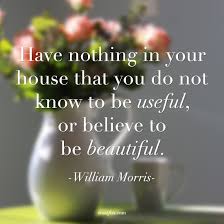
But for the few days they survive in their vase on my kitchen table, I truly can’t help smiling every time I walk past my roses.  So maybe I’m allowed to have something with no purpose beyond that of making me happy.  After all, that William Morris quote doesn’t say that the things in your house must be both useful and beautiful – only that they should be one or the other.  If both, so much the better.  If only one of the two, well, the human spirit needs Beauty to survive as much as it does the Plain Jane Useful Things.

As for their transitory nature, their fleeting existence, the roses are perhaps all the sweeter for it.  There’s something about knowing they aren’t a permanent new fixture in my house, that I won’t become accustomed to their presence and hardly notice them at all in a few months like I do with my artwork and other Useful And Beautiful Things, that makes the short time I do have them around all the more special.  They make me smile precisely because they are new and beautiful and their beauty will not cease to be new to me by the time they wither.

Tired

1. exhausted, as by exertion; fatigued or sleepy
2. weary or bored

When did this become our default setting?

It seems that nearly every time someone follows the polite convention of asking another someone how they are, the answer ends up being, “Tired.” Or some less blunt variation: “Oh, I’m okay. Tired.” “Pretty good. Tired.” “Great! But also tired.”
Is there something in the water here that makes it impossible to get enough sleep? Is coffee not actually all we need to function? (Just kidding. #CoffeeIsLife) Are we all just lagging in our efforts to maintain the breakneck speed of college life?
Heyyy…wait a minute…

Someone told me last week to take a moment and see how my body felt when I tried to push away a negative thought – not my mental discomfort, just my body. Weirdly enough, it takes physical energy to put up a roadblock for distracting/insecure/negative/angry/inappropriate thoughts, so I can only imagine how physically draining my homework load must be. Not only carrying around the textbooks (I pulled something in my elbow this week picking up my backpack!), but carrying around the mental load of an ever-shifting To Do List takes its toll.
Add this to the fact that we are going going going 12+ hours a day, then have to go home and do homework, and yeah, we’re going to be tired.

Bird read somewhere that the average high-school student these days has the anxiety level of an average mental patient from the 1950s.  She told me this in the same phone conversation where she informed me that she had done homework for more hours than she slept the previous night.  I remember being tired all the time in high school too, and how I thought being able to focus on the things I’m passionate about in college would make me at least a little less exhausted.  But now we’re expected to be adults while still adhering to school standards, making huge life decisions (Shall I become one of Those People with an Advanced Degree?  What if I Graduate Early?  What if there’s a Major Upheaval in my life in the next few years?) in between classes and completing job and internship applications in the little time we have left over from homework.

I love school.  School is what I am good at.  I value my education highly.  But I also think it says something, not necessarily a good something, that the default State of Being for my friends and I is “tired.”  I can’t help looking forward to a time in my life when someone can ask how I am and I can say, “Good, thanks” and leave it at that.