Senseless

destitute or deprived of sensation; unconscious
lacking mental perception, appreciation, or comprehension
stupid or foolish, as persons or actions
nonsensical or meaningless, as words

We use this word a lot to describe horrific things.  “A senseless tragedy.”  “Senseless violence.”  And usually we take it to mean that there is no sense to this, that is it nonsense, this thing that has happened, we cannot make sense out of it because to any sensical person it is impossible to think this way.  Justifying it is meaningless.  You might as well try to argue that the world is flat.  We cannot make heads or tails of it.  Senseless.

But I think in the immediate aftermath of tragedies, we also mean that we are numb, that we are “destitute or deprived of sensation,” because sometimes the best way to handle such news is to shut down, at least for a moment.  Even worse, the hits just keep on coming.  Syria.  Beirut.  Paris.  After a while, the pain deadens the nerve endings rather than awakening them.  The sensation, the hopeless, helpless sensation, is there, but it is lessened with time and repetition.

Do we mean, perhaps, that our sense of outrage is limited?  That it is senseless to maintain a sense of anger because these things happen so often and the world is so dark?

I hope not.

I hope, instead, that we mean that we need to take a breath to ready ourselves for the feelings that accompany the confusion.

I hope we mean that we cannot make sense of these things because there is no sense behind them.  I hope we mean that it does not make sense to warp faith into violence, and that it does not make sense to blame the whole for the sins of one part.

And because we can recognize that, because we can say that we do not think that way and we will not think that way, we can do something.  We can change something.

It will be slow, and it will be hard, but we can make the world make sense again.

A Thought on Mailbox Disappointments

I like getting mail – real mail, the kind with my name lovingly written in a familiar hand with a sticker on the back holding the flap down even though it has that special glue.  One of my favorite little moments of the day is checking our mailbox, jiggling the key back and forth until it relents and lets me open our tiny metal door.  The possibility of getting mail, even a postcard, is exciting.

But more often than not, all that tumbles out are circulars with fruits and vegetables printed on newspaper, proclaiming the grocery store’s LOW, LOW PRICES.  They don’t even have coupons to clip, just advertisements listing the products for sale.

Two things bother me about these fliers:

  1. They waste paper.  Each one uses at least two sheets of newspaper, and I see the other tenants’ copies tossed carelessly in the laundry room trash (because who wants to carry it all the way across the parking lot or back to one’s apartment to recycle it?).  No one is even opening them, much less reading or using them, so why waste the materials?
  2. There is no way to stop them coming.  On unwanted email advertisements, I can hit “unsubscribe.”  On magazines, I can cancel my account or simply wait until it runs out.  But these aren’t even addressed to me – they’re sent in bulk to “Resident” at each apartment number, and probably in every other apartment complex in town.  I don’t know how to stop them, except to write some strongly worded letter to the Grocery Store Powers That Be to explain that all they’re doing is wasting paper and no one (or at least no one at this address) wants their unsolicited circulars anymore.  But what good would that do?  They’d probably forget to take us off the list, and they wouldn’t stop printing them.  At best I wouldn’t have to feel guilty for only recycling my own copy anymore.

Something I ponder frequently on my way from the laundry room to the recycling bin.

Too Loud to Be Heard

Walking down the mall to work this past week, I had to veer around a medium-sized clump of people ringed around a shouting man.  The man shouted about damnation, Jesus, and sin.  Sometimes he stood on a milk crate.  Sometimes people shouted back.  Mostly they just laughed.

But then I got to work and I heard the conversations inspired by this man and his shouting.

“Christians are so judgmental.”  “They’re all just a bunch of hypocrites.”  “This is why I hate religion.”

“Would you say I’m judgmental?” I wanted to ask.  “Would you assume that I condemn all those who don’t share my beliefs?”

In my fantasy, they answer, “Of course not.  You are tolerant and good.”

“Well,” my imaginary self responds, standing to make a dramatic exit, “I must not be a very good Christian then, since you say they’re all so awful.” The less charitable part of me wants to leave them spluttering, awkward, wishing they hadn’t made assumptions about their audience, ashamed of drawing such broad conclusions about a large group of people the same way they say Christians do.

But instead I bit my lip, because I had a shift in five minutes and not enough time to explain how they shouldn’t judge the whole from the part, viewing all of us in the same way as the yelling fundamentalist.

Catholics, traditionally, shy away from street corner evangelism.  We are not comfortable with tabling in the student union, or even handing out candy in front of our own church door.  But I wear my cross necklace, and if someone notices and wants to have a respectful discussion of belief systems with me, I will gladly sit down with them.  I seek more to understand, and to allow the other person to understand my own beliefs, than to convert them.

And this is the problem I have with people who shout one the mall.  They are not fostering discussion.  They are not leaving their audiences musing to themselves that perhaps there’s something to this whole God thing after all.  There is nothing productive about the conversations stemming from seeing this shouting man because those conversations only reflect the judgment that people feel from him.  His content may be solid, but the method of transmission is off-putting to say the least.

So, if anyone cares, I’m open to discussion.  But please: no shouting.

Doodling Gives Me a Sense of Power

I’m facilitating four 1-credit English classes this semester.  These are meant to be workshop times, a space for students to bring their writing in and get peer feedback, with a slightly more trained supervisory peer (me) keeping track of attendance and offering clarification along with the general class discussion.

Which means that when students are determined to remain taciturn, I struggle a little for something to fill our 50 minute sessions.

It doesn’t seem that hard to me to talk about writing for 50 minutes, but I recognize that not everyone is quite as obsessed enthusiastic with words as I am.

So I usually end up doodling on the board.

At the beginning of the summer, I bought a pack of Expo markers specifically for these classes.  I keep them separate from my workplace’s other, dried-up, capless, mismatched markers.  I encourage my students to write on the board, to color code, to use more visual representations of their ideas if words aren’t working for them.

“I don’t know about you guys,” I say, “but writing on whiteboards always gives me a feeling of power.”  They nod, smile a little, and sometimes it works.  Sometimes they write one word and then sit back down, but sometimes it works.

And sometimes I end up just writing on the board so they’ll see the fruits of their discussion, the growth of the list, the effects of the edits we recommend to each other.

Or I just doodle while they read.  (I’m a speed reader.)  And I end up with things like this:

2015-10-16 11.59.17

If I’m lucky, this leads to even more discussion, with everyone swapping organizational ideas and sharing how they get from prompt to polished paper.

Or, “Can we play Hangman?”

But even when I think class hasn’t been terribly productive, one of the students will toss out an absolute gem of a sentence, or just a quiet, “Thank you,” as they walk out the door.  That, even more than the chance to write on a whiteboard, makes it worth it.

Hell on Heels (Apparently)

My dad got married this weekend!  It was lovely; he cried adorably, my sister and I cried rather less adorably, and the whole thing was just wonderful.

But lovely and adorable and wonderful do not make for good stories.

What does make a good story?  A passive-aggressive bed and breakfast hostess cornering girls to make them take off their high heels.

I first caught her attention by walking a little loudly down the hall.  Swiftly taking in my peep toe heels, she stepped uncomfortably close to my face and asked, “Didn’t anyone tell you?”  Before I even had a chance to answer, she went on, “I had requested that there be no spiky or tall heels.”  I began to explain that no one had told me of any such request, and I was pretty sure my heels didn’t qualify as “spiky,” being only about 3 inches tall, but she barreled onward.  “So if you could just take them off after all the pictures are done,” she said, smiling sweetly, “that would be wonderful.  Everyone will just think you’re getting comfortable!  But they really do leave bullet holes in my floor.”

I was unaware that I had shotguns in my shoes.  Whoops.

Now, I was raised to respect both adults and old houses, and this mansion-turned-B&B was nearly 100 years old.  Of course I didn’t want to damage the floors, but I figured if I stuck to the rugs and refrained from flamenco or tap dancing, it would be fine. Besides, more than half the women there were wearing heels too, and I didn’t see the hostess whispering warnings of bullet holes to any of them.

What I did see was Bird and her friend coming back from the buffet with plates in one hand and shoes in the other.

“She cornered us!” Bird said.  Apparently the hostess hadn’t bothered with the sweet smile this time.  She just stood there and made them take their shoes off after asking if anyone “remembered” her original request at all.  While, like me, Bird and her friend certainly didn’t want to cause any damage to the floors, they felt somewhat attacked.

“I don’t see her going up to anyone else,” I mused, glancing at the still-shod feet around us.  Some of those could definitely be classified as spiky, and yet the hostess chose to continue targeting the three youngest women wearing high heeled shoes.

The last straw came when we made our way into the living room to watch our dad and his new bride cut the cake.  I noticed that the hostess had literally cornered my poor sister and was hovering, watching her remove her shoes again.  Bird told me later that she demanded, “Do you have a problem with removing your shoes?  Other people don’t mind taking off their shoes!” – and pointed to a pile of flipflops that did not belong to anyone in our party.

I can bite my tongue.  I can be civil with people being unfair toward me.  I can even brush it off, if it only affects me.  But if you make my little sister uncomfortable?  Watch out.

“Excuse me,” I cut her off, putting on my best Southern Belle smile, “with all due respect, if this is going to be a problem, you should probably make a general announcement or put a sign up, since I can’t help but notice you’ve only been talking to the three of us.”

“Well, yes, there should have been a sign up,” she said, “but the smaller heels don’t make as much of an impact, so really…I mean, it’s just that I had requested…”

Honestly, I was not going to miss my dad cutting the cake to listen to that woman repeat her line about bullet holes.  So I smiled just as sweetly as she had earlier and turned away.

Once the cake cutting and toasts were over, I turned to the Engineer.  “I have a physics question for you,” I said.  “Does the height of the heel on my shoe increase the force I am exerting on the floor?”

“No,” he said, “force has more to do with the surface area.”  (I’m paraphrasing because I don’t remember exactly what he said, but the explanation was very helpful, particularly since it proved me right.)

Our conversation had caught the attention of a family friend nearby.  Once we filled her in on the situation, she asked, “Is that her?” and sauntered straight over to the hostess.

We found out later that she had quite politely asked why the groom’s daughters, whom she knew to be two classy ladies, were not wearing shoes.  The hostess repeated her line about bullet holes and heels, to which our friend asked, “Oh, do I need to remove my shoes?”

“Oh, I didn’t even notice those!  No, no, you’re fine.”

Our heels were exactly the same height.

The family friend then politely pointed out that we were paying for the use of the venue and would be posting a review later on about the experience, so she was going to go ahead and tell Bird and me to put our shoes back on.

The hostess, in my opinion, had quickly crossed the line into unprofessional behavior.  She consistently made discriminatory judgment calls in her attempts to protect the floors, insisting that our heels were more damaging than anyone else’s.  It was pretty obvious that she was unwilling to treat the “adult” guests this way, as evidenced when our family friend asked if she needed to take her shoes off.  Even if Bird and I were not the daughters of the groom, we were still guests in a venue that was being used by paying customers.  Yet the hostess became hostile every time she approached us, particularly Bird and her friend.  Addressing us respectfully, regardless of our apparent age or connection to the bride and groom, would probably have yielded far more favorable results than attacking and scolding us for not immediately complying to her demands.

Still, this by no means ruined the evening, and I finally did kick off my shoes (when damn well felt like it!) to swing dance a little with the Engineer.

The next morning, as we were saying goodbye, the hostess bustled up to shake hands and say how nice it was to meet us, and, turning to me, added, “And weren’t you so much more comfortable after you took off your shoes?”

I blinked, withdrew my hand, and went to hug my dad goodbye.  There were just too many comebacks to choose from.

Things I’m Trying to Be Better About

Praying.

Calling home.

Making healthy dinners.

Awareness of how much I’m spending on coffee.

Awareness of how much I’m drinking coffee.

Posting on this blog.

Posting on Changeling Scribbles (actually no don’t go read it because I haven’t posted anything in weeks).

Reading for pleasure.

Working on my own writing.

Doing laundry before the basket overflows.

Not overscheduling myself.

Eating a real breakfast, not just a protein bar on the way out the door.

Leaving the Engineer’s at a reasonable hour because he gets grumpy when he doesn’t get to bed before 11.

Leaving the Engineer’s at a reasonable hour because I cannot actually replace sleep with coffee.

Pulling myself out of stress spirals about what to do with my life post-graduation.

Going out and doing things occasionally.

Loving myself.

Don’t Scare Me Like That, or Why I Hate Halloween

I hate Halloween.  I hate the stress of trying to figure out a suitably clever (and appropriate – why is it impossible to find a female costume consisting of more than a square yard of fabric?) costume for the church party, and I hate the creepy hunchbacked butlers with shriveled green skin that spring up at the ends of Safeway aisles, and I hate the sheer number of decorations with motion sensors cackling every time someone walks past, and I hate people trying to get me to go to haunted houses, and I hate that there’s an entire holiday centered around scaring other people because it’s “fun.” It is not fun.  Not to me.

Okay, I don’t really hate Halloween that much.  But living on a college campus means my general indifference gradually hardens into spite over the course of October as I come up against invitations to haunted houses and scary movie marathons, not to mention the fact that everything I buy suddenly has to be black and orange in honor of All Hallows’ Eve.  (How many of the scare enthusiasts and costume shoppers even know that’s where Halloween came from?)  It’s just such an aggressive holiday, from the costumes to the ABC Family marathons to the people who think it’s okay to practice their scares on random passersby.

I’ve never liked being scared.  I don’t think it’s fun, and I don’t understand how, exactly, it is supposed to change my mind on this score to go into scary places and “see that it’s not that bad.” I have been scared before, in fun and in earnest, and I do not enjoy the feeling.  The rest of you can go creep through darkened rooms while employees in creepy masks lurk to jump out at you.  As I keep pointing out to my friends, if I’m not having fun, you won’t have fun.  No one will enjoy having to physically carry me back to the car as I sob because I barely made it two steps into the creepy house before I decided it was too much.

Sidebar: I also dislike rollercoasters.  Once, when my friends and I went to Wild Waves, they got me all the way up to where you get into the seats – and then they let go of my arm and I ran down the wheelchair ramp.

And then there’s the fact, as my mother has points out, that this is the one day of the year when we actually encourage children to take candy from strangers.  Who decided that was a good idea?  I prefer to buy my own candy and consume it at home, on the couch, watching something cute and not at all scary, without having to put on some kind of costume.

But then again, it was after the church Halloween party freshman year, watching drunken bumblebees and sexy nurses and a few vampires stumble by, that the Engineer and I started dating.  And it was a friend’s Halloween party the next night that became our first activity as a couple.  (I, nerd that I am, was Schrodinger’s cat in a sparkly black dress and mask.  We arrived separately and grinned like idiots at each other all evening until he walked me home and put his arm around me.)

So maybe there are a few good things about Halloween.

After all, all the dark chocolate goes on super sale the first day of November!

When Your Worst Fears Don’t Come True

Occasionally I have nightmares where Bird or the Engineer or some other loved one is hurt, or even killed, and I can’t get there.  I am on the other side of the country in these dreams, or even in another nation entirely, and all I can do is cling to my phone and rush around demanding that someone, anyone, help me get there.  Even if I can’t actually do anything, even if the person is comatose in this nightmare and probably won’t make it, just being physically near them somehow makes me better able to handle the situation.  But, since this is a nightmare, I never quite reach them.  I just struggle against unreasonable transportation until I wake up.  Then I lie back, heart racing, and remind myself that it’s not real.

Until it happened when I was awake.

About six weeks ago, I got a phone call from an unfamiliar number.  The person on the other end seemed to know a bit about me, introducing himself as a friend of the Engineer, who was down in California for the weekend.  We exchanged brief pleasantries, then:

“He’s okay, but he was in a car accident.”

Only a few words made it through after that.  Everyone’s fine… hospital now… let you know more… he’s talking… asking about you…

“Did you call his mom yet?” I managed to ask.  No, he hadn’t, she was his next call.  (Actually, as it would turn out, he wouldn’t be able to get through and I would have to call her and tell her the news myself – a call I never want to make again!)

I hung up and walked into the living room, where Bird – at least in this nightmare-come-true she was safe – jumped up from the couch at the look on my face.  When I told her what had happened, I think I just kind of dissolved.  “Do we need to get you to LA?” she asked, hugging me.  “I will get you on a plane, I will buy you a ticket myself.  I don’t have any money, but I will get you on a plane.”

I knew, logically, that that wasn’t feasible.  There was no reason for me to go down and sit around with a bunch of strangers waiting to hear more.  It would make much more sense for his mom to go, if anyone needed to.  He might still be home in a few days – hadn’t his friend said he was talking?  Talking was good, I thought.  So I walked around the house and refused to put my phone down for a moment, just in case.

Even after I talked to the Engineer himself later that day, and again that evening, I still felt on edge.  The worst had happened, I thought, and yet it hadn’t.  He was (mostly) fine, no broken bones, no internal bleeding, no measurable concussion – none of the horrors from my nightmares, besides the accident itself, had come true.  So I was left waiting for the Real Worst Thing to descend.  His head injury would take away his feelings for me, I thought, or some overlooked complication would leave him clinging to life a few days later.  Somehow I couldn’t let myself believe that the nightmare had come, had passed, and hadn’t manifested my worst imaginings.  I couldn’t believe life was letting me off so easy.

Now, I don’t mean to downplay this.  The accident did take its toll on the passengers in both cars; the Engineer took a few weeks to recover fully.  But he was home the next day, walking and talking, acting normal, if a bit tired.  And in the days afterward, everyone involved kept saying how fortunate they had been to escape with comparatively minor injuries between them.  A slightly different angle, a few feet farther, a little faster – it all could have been so, so much worse.

As it was, life went on.  Stiffly, perhaps, and with a slight twinge occasionally, and maybe a few more naps, but it went on.

I still fear harm coming to people I love.  I still hate that helpless, hand-wringing feeling I get when all I can do is carry a cell phone from room to room, waiting for news.  I still plan out what I would do in some broadly hypothetical worst-case scenario.  But I’ve come to realize – slowly, painfully – that the worst-case scenario isn’t the only scenario possible.  It’s as if God was saying, “You see?  It happened.  One of your greatest fears happened, and you came through it.  That can happen too – it doesn’t have to turn out for the worst.” I don’t believe God sends bad things our way, but I do believe He uses them to shape us a little more into the person He wants us to be.  In this case, I think He was helping me to be less fearful, more hopeful.  Somewhere down the road, one of my nightmares will probably come true, in partial or full form, again.  And it will be scary and awful and I will wish it hadn’t happened.

But unlike my dreams, unlike wrenching myself desperately into consciousness, that situation will have a resolution – and it might even be, with His help, for the better.

Really Really Quiet Workouts

I hate having people I know witness me exercising.

Surprisingly, this is not due to my general clumsiness or lack of physical acumen.  I’m not nearly as awkward at exercising as I used to be in high school (I actually had to convince a skeptical PE teacher that no, I wasn’t holding back, yes, I was putting in every effort, and yes, I was really just that terrible at sports – she raised my grade after I nearly passed out trying to run faster).  I can make it through a Zumba class with zeal, and the Southern Belle has gotten me better at strength training too.

But I do all this semi-secretly, waiting until my mom is out of the house in the morning and making sure Bird is either asleep or going to join me.  I just don’t like having bystanders.  (The Southern Belle is an exception.)

I get the same uncomfortable feeling of being under a microscope when people (well, most people) ask how my writing is going.  If I don’t have anything super impressive to tell them, or if in fact it’s kind of at a difficult point and I’ve been stuck on the same scene for 2 weeks, I don’t really want to talk about it.  Even if I just hit an awesome word count milestone, or I finished a scene that I’m proud of, there’s something about sharing that part of my internal process with others that just makes me cringe.

I would often prefer to simply present my finished product (manuscript, weight loss, whatever) to the world and say, “Look at this thing I made.” The process of getting that finished product, however, feels too imperfect and messy, too personal, to willingly share with more than a few people at a time.

Some of this could be from academic pressure spilling over into the rest of my life.  We are well past the point of turning in an outline, then a draft, then a revised draft, then a peer review, then at long last the final draft.  My professors don’t want the process – they want the results.  In so much of academic life, the interest lies in the polished version of whatever you’re supposed to accomplish.  So maybe I want to present the same perfect face in other areas.

Or maybe it’s to do with responsibility.  Goodness knows I have plenty of obligations filling up my color-coded planner already; I neither need nor want to be accountable to anyone but myself in any more parts of my life.

Or maybe it’s like when I was learning to drive and it made me incredibly nervous to even go to the grocery store because every trip of a few blocks felt like a huge test.  I knew my parents were watching everything I was doing, which made me overthink it, which made me wonder if I had gotten something wrong, which is not a good thought to be having when you are directing a two-ton metal object along a road filled with other people in other two-ton metal objects.  The mere fact of observation, even when we got home and I sat shaking behind the wheel in the garage while my mom told me what a good job I’d done, made the whole ordeal ten times worse.

I don’t actually have an answer for this.  That’s okay, though – I’m pretty content to continue working out and writing as quietly and unnoticeably as possible.

Some Assembly and Yoga-Like Contortion Required

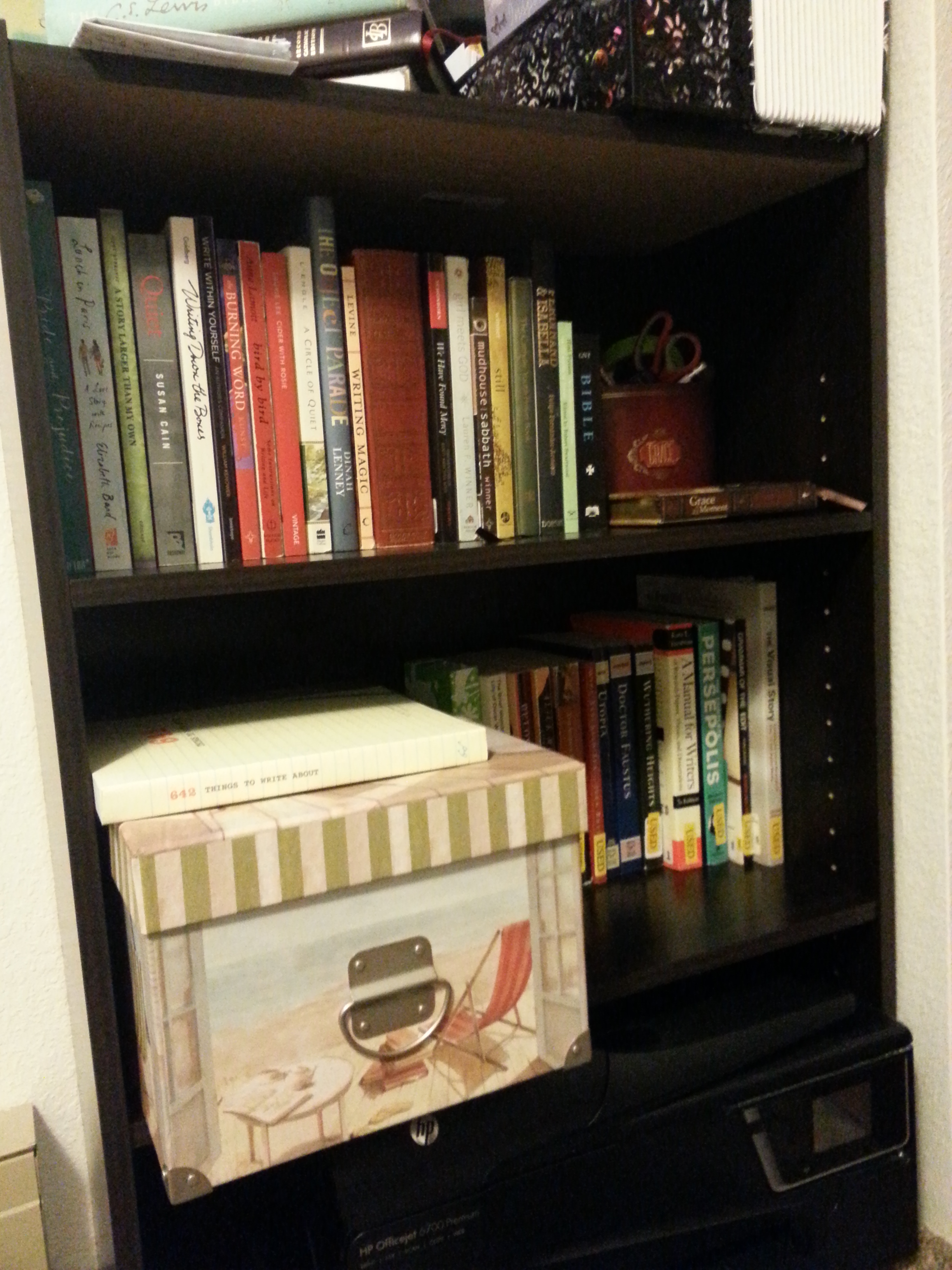
I sat on the floor of my room, curled like an apostrophe around a bookcase lying prone on the infuriatingly un-level carpet.  Holding the side of the bookcase against my knees, I clamped the shelf under my arm and twisted the screwdriver painfully with my right hand (I’m left-handed, so this took a fair bit of coordination).  It was nearing dinnertime, and I had a meeting to go to, but I was absolutely determined to get this thing put together.  Before I had to go anywhere, before I ate, before the Engineer came back from whatever he’d been doing all day, this bookcase would be upright and my books would be rescued from their homelessness.

This corner of my room had been driving me crazy for weeks.  My printer was perched precariously on a wobbly table with spindly legs.  My books were stacked as neatly as possibly in various corners of my room.  My papers were strewn in heaps under the printer and on the ledge running under my window.  Clearly, I needed a bookshelf.

What I had envisioned was a bookcase already assembled, perhaps one from a garage sale or a family member’s guest room, or even Goodwill.  Nothing fancy, of course, but already possessing nails and screws in all the vital places.

I found myself instead with this pressboard, “coffee cherry” finish kit from Shopko and a familiar stubborn voice in my head telling me I didn’t need anyone else to help me put it together.

And I was right.  I may have attached the bottom slightly crooked and had to redo it.  I may have had red lines that purpled into bruises on my legs from holding the pieces tightly together while I twisted the screws through.  I may have nailed the cardboard backing on so that it bubbles out a little bit at the bottom.  But it stands, and it holds my books, and I am happy.

My mother (who, as you may recall, also likes to rearrange furniture at times) put together the table and chairs in our breakfast nook at home all by herself.  She wrestled with the legs and heavy top, chased screws across the floor out of the cat’s reach, and threw a tablecloth over the finished product with a proud flourish.

I suspect I get some of my independence from her.

I’ve been fortunate enough to always have people to call if I need something moved, or built, or fixed.  But it’s nice to know that, should the need arise, my bright pink toolbox and I can probably figure things out.2015-09-08 16.24.20