Sexism and Smoothies

“Do I want a smoothie?” I mused aloud.  One of my coworkers looked up from the couches in our hangout area.

“Is that even a question?  Smoothies are always a good idea,” he said.

I laughed.  “You’re right.  I do want a smoothie.  The real question,” I said, waving my wallet at him, “is whether I want to spend the money.  Because that would make my wallet very sad.”

He shrugged.  “Why would you pay for the smoothie?”

For a moment I thought he was suggesting I somehow blend and steal my own fruit drink, but after a moment he added, “Just ask people for the money.”

I raised an eyebrow.

“No, seriously,” he said, leaning forward, “just tell people you forgot your wallet or you don’t have any money and you’re thirsty and can they spare you any change for a drink.  Now, if I tried to do that it would take me all day.  But you – you could probably find someone offering to buy you a coffee within – ” he thought for a moment ” – fifteen minutes.  Tops.”

Incredulous, I just stared at him.

“Oh yes,” he said, seeing my expression, “sexism is alive and well, and you can exploit it!”

I laughed.  We didn’t know each other well yet, this coworker and I, but I knew enough to realize that he was merely commenting on the sorry state of our collegiate society, not being sexist himself.

As I walked to the student union, I half-wanted to try out the experiment, just to see what would happen.  My coworker, however joking his tone, had a point.  I’ve joked with the Engineer before about using such tactics; whenever he worries that I won’t know how to put chains on my tires going over the pass for winter break, I just bat my eyes and say sweetly, “I’m cute and helpless.  Someone will stop.”  In reality, of course, the thought of playing Damsel in Distress makes my eyes want to roll out of my head.

But here, on the same campus where I’ve had male classmates say they don’t hold the door open for girls anymore because “they might get mad,” I could probably have flirted my way to a smoothie.

We females are still thought of as Damsels, just with varying degrees of receptiveness to Manly Heroics swooping in to save the day.  Many boys don’t let girls do things for themselves because they see us as equals, but because they’re afraid of us snapping at them.

Can’t we all just hold doors and lend money for smoothies regardless of gender, because we’re all humans trying to navigate the madness that is college life?
I am Unikitty

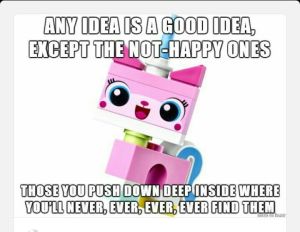
Princess Unikitty is the embodiment of positivity.  (If you don’t know who I’m talking about, drop everything and go watch/rewatch the brilliance that is The Lego Movie.  I’ll wait.)  In her beloved Cloud Cuckoo Land, Unikitty leads a life of carefree, rainbow-colored chaos, where anything goes – as long as there are no frowny faces.  Her commitment to thinking happy thoughts runs deep, even when the bad guys show up and Cloud Cuckoo Land turns less rainbow and more explosive.

bd74bcda5e98a5c9d683de753d200473Obviously, this is not the healthiest emotional habit, and it doesn’t sustain Unikitty for long.  Even as she explains the motto above, her face becomes red and angry.  Though she tries her best to suppress negativity, it’s still there, lurking just beneath the surface.  By the end of the movie, Unikitty’s anger at seeing her friends attacked overpowers her obsessively positive mindset, and she busts out some fantastic animated karate to take down her fair share of bad guys.  Plus it’s funny to watch someone go from determinedly cheerful to Hulk-smash furious in 5 seconds.

Isn’t it?

Though moviegoers recognize that Unikitty should not be dealing with her emotions this way, she still presents a fair picture of the emotional facade our society expects of us.  We place a great deal of emphasis on BE HAPPY! without sufficient focus on the methods we use to get there.  We encourage people to “let go” of negative emotions as quickly as possible, to “shake off” experiences and feelings we deem “toxic” due to their Not-Happy nature.  In effect, a lot of us really do push those thoughts “down deep inside where you’ll never, ever, ever, EVER find them.”

Unfortunately, this is not the same as feeling them.

I haven’t talked about this yet on this blog, but my own Unikitty-esque emotional habits led me into a serious struggle with depression about a year ago.  All of my emotions, Happy and Not-So-Happy, completely shut down.  I went numb.  And at first I couldn’t figure out why.  I thought depression and anxiety needed some kind of trigger, but I hadn’t had any traumatic event in my life.  Eventually, my counselor traced it back to the Really Big Conflict, as I’ve referred to it, from The Internship sophomore year.

I thought, like Elsa from Frozen, I had just let it go.

In reality, I was more like Unikitty, pretending Cloud Cuckoo Land wasn’t crashing down around my ears.  I shoved the anger, hurt, and confusion deeper and deeper down until finally the Happy Thoughts shut off too.

Something my counselor told me: You can’t feel things selectively.  You can’t just ignore negative emotions without eventually turning off the positive ones too.

As Unikitty shows us, if Not Happy Thoughts are simply shoved aside in favor of Happy Thoughts, there comes a breaking point.  Either you explode, like Unikitty, or you go numb, like I did.  Being happy All! The! Time! is all well and good if you’re just that kind of person, but I’m learning the importance of truly moving on – feeling the negative feelings and making space in your mind for them before taking that deep breath.

So maybe I won’t identify so strongly with Unikitty anymore.  But she’s a good reminder of my old habits – and why they won’t sustain me any more than they did her.


UPDATE: The original title of this post was “Unikitty is My Spirit Animal,” but having learned of that term’s importance to native peoples and cultures, I’ve decided not to use it here. I have edited the post accordingly. (2019)


Some articles about this:

Beyond Happiness: The Upside of Feeling Down from Psychology Today

Negative Emotions are Key to Well-Being from Scientific American

The Importance of Negative Emotions from Huffington Post

Doodling Gives Me a Sense of Power

I’m facilitating four 1-credit English classes this semester.  These are meant to be workshop times, a space for students to bring their writing in and get peer feedback, with a slightly more trained supervisory peer (me) keeping track of attendance and offering clarification along with the general class discussion.

Which means that when students are determined to remain taciturn, I struggle a little for something to fill our 50 minute sessions.

It doesn’t seem that hard to me to talk about writing for 50 minutes, but I recognize that not everyone is quite as obsessed enthusiastic with words as I am.

So I usually end up doodling on the board.

At the beginning of the summer, I bought a pack of Expo markers specifically for these classes.  I keep them separate from my workplace’s other, dried-up, capless, mismatched markers.  I encourage my students to write on the board, to color code, to use more visual representations of their ideas if words aren’t working for them.

“I don’t know about you guys,” I say, “but writing on whiteboards always gives me a feeling of power.”  They nod, smile a little, and sometimes it works.  Sometimes they write one word and then sit back down, but sometimes it works.

And sometimes I end up just writing on the board so they’ll see the fruits of their discussion, the growth of the list, the effects of the edits we recommend to each other.

Or I just doodle while they read.  (I’m a speed reader.)  And I end up with things like this:

2015-10-16 11.59.17

If I’m lucky, this leads to even more discussion, with everyone swapping organizational ideas and sharing how they get from prompt to polished paper.

Or, “Can we play Hangman?”

But even when I think class hasn’t been terribly productive, one of the students will toss out an absolute gem of a sentence, or just a quiet, “Thank you,” as they walk out the door.  That, even more than the chance to write on a whiteboard, makes it worth it.

A Truly Congenial Pen

2015-10-20 20.43.34When you find a truly congenial pen, you don’t just let it go.  You mustn’t fling it around carelessly, let it ride barely held in by the mesh pockets of your backpack, allow it to sink to the bottom of the jumbled pile in your desk drawer.  You keep track of it, digging frantically through your room whenever it’s lost for a day.

But neither do you use it for just any purpose, like jotting down grocery lists – or maybe you do.  Maybe it’s that sort of pen, the sort that lends itself to making ordinary life flow a little smoother like ink from a perfectly poised ballpoint tip.  So its ink spreads over your life, through your planner and the torn-off bits of paper on which you write notes to yourself and your family, across the margins of newspapers where you doodle while you try to think of that last crossword answer.  Maybe it’s that sort of truly congenial pen.

Or perhaps it’s the kind that you store right next to your journal, because your thoughts just seem to write out better, even the tangled ones, when you have it in your hand.  It makes your darkest daydreams more palatable, your most confusing stressors more bearable.  Fond memories, written in its ink, become golden tinted.  It never runs out in the middle of a paragraph, never abandons you while you’re ranting to the page about your job or your crush or the people who live above you who stomp around like elephants in a Conga line.  Perhaps it’s that kind of pen.

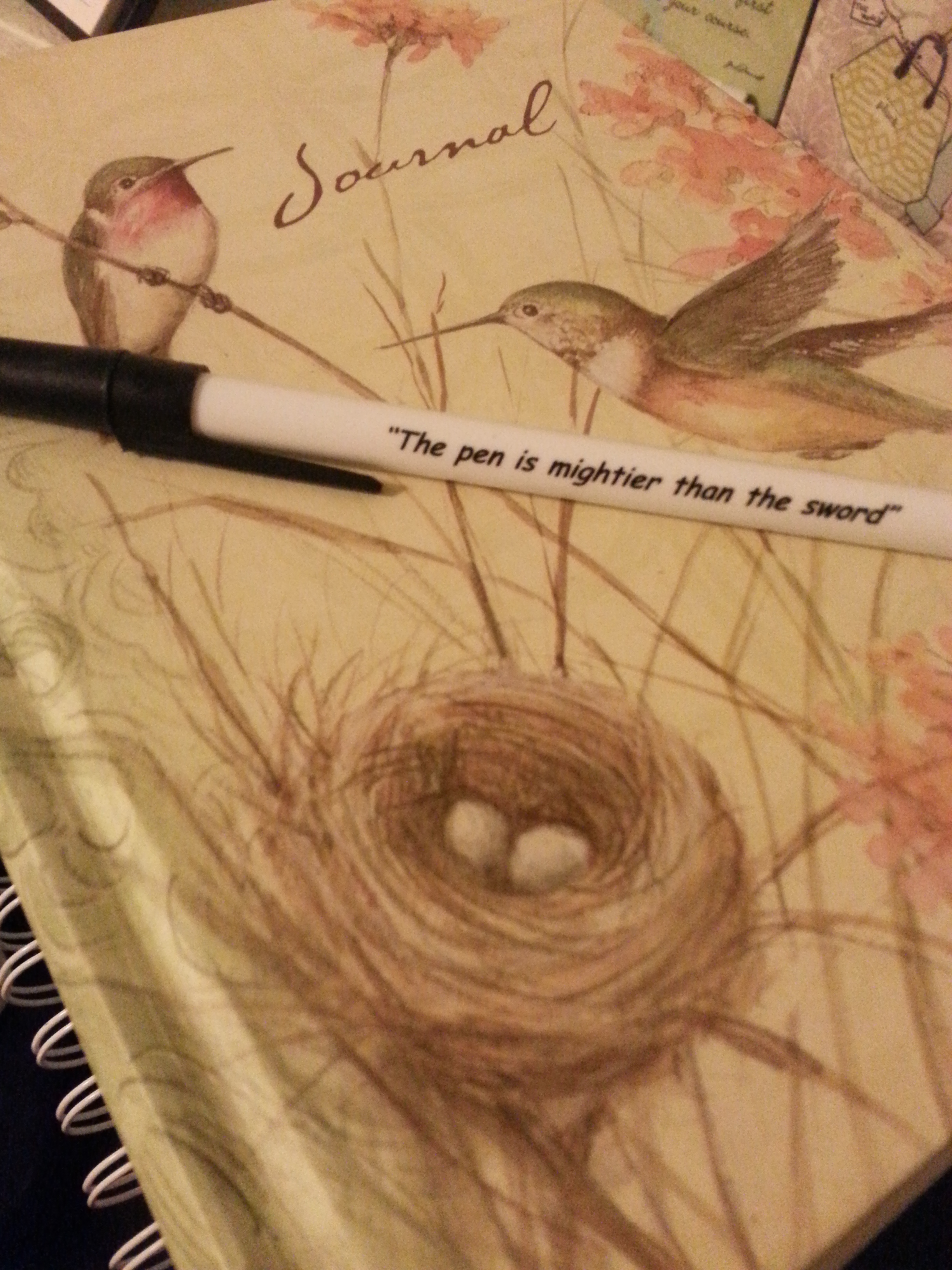
Those who think this sort of attachment to a writing utensil is ridiculous have obviously not found a truly congenial pen of their own.  Those who agree with me know, as the Bard said, that pens are mightier than swords – so just the right one, in the right (or left) hand, is a formidable weapon indeed.

Things I’m Trying to Be Better About

Praying.

Calling home.

Making healthy dinners.

Awareness of how much I’m spending on coffee.

Awareness of how much I’m drinking coffee.

Posting on this blog.

Posting on Changeling Scribbles (actually no don’t go read it because I haven’t posted anything in weeks).

Reading for pleasure.

Working on my own writing.

Doing laundry before the basket overflows.

Not overscheduling myself.

Eating a real breakfast, not just a protein bar on the way out the door.

Leaving the Engineer’s at a reasonable hour because he gets grumpy when he doesn’t get to bed before 11.

Leaving the Engineer’s at a reasonable hour because I cannot actually replace sleep with coffee.

Pulling myself out of stress spirals about what to do with my life post-graduation.

Going out and doing things occasionally.

Loving myself.

My Life in Books, Part 3: Writing Guides

I love books, and I love writing.  It follows that I would have several books about writing.

1. Writing Magic by Gail Carson Levine

writing_magicMy parents bought this for me at a Scholastic Book Fair in elementary school and I had read it by the time we got home.  So I promptly read it again.  Already a fan of Gail Carson Levine’s Ella EnchantedThe Two Princesses of Bamarre, and The Princess Tales series, I wanted to learn how one of my favorite authors made her books come alive.  It might be written for 4th graders, but I’ve revisited the prompts and advice in this book time after time, even now that I’m in college.  This was the book that instructed me never to get rid of anything I write – and, cringe-worthy as some of my early “stories” are, I’ve followed that mandate ever since I read it.

I think reading this was also a step in taking ownership of my writing process.  At one point, Levine writes that to her, revision is a relief: “When I’m working on a first draft, I feel like a prisoner…I notice a bit of moisture condensing on the walls, four or five beads of water.  Each bead is an idea. I scrape them off and write feverishly till I use them up.  Then I wait for more moisture.  But when I finish my first draft, the walls come down…No more waiting for condensation.  All I have to do is make the book better.”  I feel the opposite way.  I hate revising.  It feels like I’m penned in, cut off from the excitement of finding out where the story goes.  But that, Levine acknowledges, is just as legitimate a process as her own.

2. Bird by Bird by Anne Lamott

download (5)Part memoir, part writing advice book, part general life advice book, this is another one I reread over and over.  I just love the way Lamott writes, the anecdotes she tells, and the brutal honesty she displays about writing.  It sucks sometimes, trying to be a writer.  Lamott doesn’t romanticize it, but she also understands that it’s not about fun (or at least, not entirely).  It’s that you have to write, or go crazy.  Or maybe a little bit of both.

Lamott gives advice more episodically than anything else, but that makes her relatable as another writer.  When I discovered Levine’s writing guide, I was looking up to an idol; this was my introduction to Lamott’s writing, so I took the advice differently.

Best of all, the stories she tells and the people she quotes send me running to look them up.  I actually bought another book on this list purely because Lamott quotes from it a few times.

3. Do Story by Bobette Buster

do storyThis one has a bit of a back story.  I found it originally in a bookshop down an alley in Nottingham, UK, but didn’t have enough cash on hand.  When I went back, the last copy had been sold – a trial run of only 5 copies, the proprietor said.  But if I emailed him, he’d let me know when he got another order in.  Which turned out to be the day I went home.  So instead he put me directly in touch with the publisher so I could order my book, regardless of whether he ever saw a penny.  I think I love the book more for the story of obtaining than for any advice it gave me.  (So by the way, if you’re ever in Nottingham, go find Ideas On Paper down an alley from Market Square – it’s worth it!)  Although this little book is more about storytelling in general than writing specifically, I liked what it had to say.  It emphasizes the idea that everyone has a story to tell, and everyone’s story is valuable.  It also plucks examples from history, showing how our ever-shifting global culture depends on stories like ours, and on telling those stories well.  “And, why should you do this?  Risk your vulnerability?  Because…someone is telling a story all the time…it is necessary for us to harness our own stories, and tell them well.  If not, then someone else will come in and wallpaper our culture with their stories…In the end, all you have is your story.  Tell us your story.  Do.”

4. Writing Down the Bones by Natalie Goldberg

writing down the bonesAfter reading excerpts from various bits and pieces of this book in numerous creative writing classes, I figured I might as well go ahead and read the whole thing.  Specifically, I loved the chapter/section/essay on living twice.  I loved the idea that being a writer makes you experience the world differently, and not always at the same pace as everyone else.  This is also a book that can be read in fits and starts, depending on how much time one has.  I haven’t read all of it, but I read the sections I need when I need them.

Really Really Quiet Workouts

I hate having people I know witness me exercising.

Surprisingly, this is not due to my general clumsiness or lack of physical acumen.  I’m not nearly as awkward at exercising as I used to be in high school (I actually had to convince a skeptical PE teacher that no, I wasn’t holding back, yes, I was putting in every effort, and yes, I was really just that terrible at sports – she raised my grade after I nearly passed out trying to run faster).  I can make it through a Zumba class with zeal, and the Southern Belle has gotten me better at strength training too.

But I do all this semi-secretly, waiting until my mom is out of the house in the morning and making sure Bird is either asleep or going to join me.  I just don’t like having bystanders.  (The Southern Belle is an exception.)

I get the same uncomfortable feeling of being under a microscope when people (well, most people) ask how my writing is going.  If I don’t have anything super impressive to tell them, or if in fact it’s kind of at a difficult point and I’ve been stuck on the same scene for 2 weeks, I don’t really want to talk about it.  Even if I just hit an awesome word count milestone, or I finished a scene that I’m proud of, there’s something about sharing that part of my internal process with others that just makes me cringe.

I would often prefer to simply present my finished product (manuscript, weight loss, whatever) to the world and say, “Look at this thing I made.” The process of getting that finished product, however, feels too imperfect and messy, too personal, to willingly share with more than a few people at a time.

Some of this could be from academic pressure spilling over into the rest of my life.  We are well past the point of turning in an outline, then a draft, then a revised draft, then a peer review, then at long last the final draft.  My professors don’t want the process – they want the results.  In so much of academic life, the interest lies in the polished version of whatever you’re supposed to accomplish.  So maybe I want to present the same perfect face in other areas.

Or maybe it’s to do with responsibility.  Goodness knows I have plenty of obligations filling up my color-coded planner already; I neither need nor want to be accountable to anyone but myself in any more parts of my life.

Or maybe it’s like when I was learning to drive and it made me incredibly nervous to even go to the grocery store because every trip of a few blocks felt like a huge test.  I knew my parents were watching everything I was doing, which made me overthink it, which made me wonder if I had gotten something wrong, which is not a good thought to be having when you are directing a two-ton metal object along a road filled with other people in other two-ton metal objects.  The mere fact of observation, even when we got home and I sat shaking behind the wheel in the garage while my mom told me what a good job I’d done, made the whole ordeal ten times worse.

I don’t actually have an answer for this.  That’s okay, though – I’m pretty content to continue working out and writing as quietly and unnoticeably as possible.

Seniority

2012-11-09 13.45.17
The Senior Bench upon which I may now sit with impunity by virtue of completing 3/4 of my undergraduate education.

I had this weird thought as I walked past the Senior Bench the other day that I am now a senior and therefore may sit on the Senior Bench without fear of breaking some Long-Dead-But-Potentially-Resurrectable Tradition about not graduating on time or incurring the wrath of Actual Seniors.

It’s not like I was ever afraid to sit on the Senior Bench before – actually, Bird and I have a tradition of getting a picture together on the bench every time she visits me at school, and she doesn’t even go to college yet, much less this college.  There were never any passing Actual Seniors who snarled at me or threatened to drum me out of the student body.  I’m pretty sure half the people sitting on that bench at any given time are freshmen and sophomores, just because upperclassmen are too busy.

But it’s odd to think that that’s who I am now.  An Actual Senior myself.  I find myself with a case of nostalgia for the experience I am still in the middle of.  Mourning the coffee shops I still have months to visit.  Hugging my friends just a little too tight.  Grasping at the familiar walkways with curled toes inside my shoes as though I’m trying to make them stand still when I’m the one moving.

College is coming to a close.  Slowly, yes, and not unexpectedly, but still.

Candle Shopping with the Commodore

Some people decorate their homes visually, strewing fake leaves around for fall, some posies for springtime, and maybe a snowman or two in the winter.

The Commodore and I prefer to seasonally scent our apartment.

We go to the so-called mall just over the state border every few months to jointly purchase our new candles.  We take these shopping trips very seriously, solemnly marking them down on our Thomas Kinkade Disney calendar.  They are not without their hazards; Bath & Body Works, for starters, is in itself a dangerous place for our wallets.  Rarely do we make it out without purchasing some other item unrelated to our original goal.  But the important thing is that we never leave without at least two new candles for the season ahead.

20150902_191413Of course, there’s the sniff test.  Ranging from tried-and-trues like Fresh Linen and Sea Island Cotton to bakery-themed like Maple Pecan Waffles to cologne-ish like Black Tie, we sample pretty much everything.  We both have to like the scent.  It can’t be too sweet, or too sharp, or too fruity.  And the candles have to be the squat, heavy, three-wick ones, big enough to last at least half the season (we usually buy two).

This takes at least an hour.  Sometimes longer.

Then there was that time we dropped one of the candles while reaching for a bottle of lotion.

And then when we finally get the candles (and, if we’re being honest, a bunch of other fall/Christmas/spring/summer-y smelling stuff we don’t need) home, the hazards do not cease.  Once, I was blowing out the Sundress candle in our living room when a spark flew up and burned a hole through my shirt!

The Southern Belle later gave me a candle snuffer, “for your own safety,” as she put it.

I don’t really enjoy playing with fire (certainly not as much as the Engineer does…).  But it’s soothing to come home and let the smell of Harvest Gathering turned my mood autumnal.

Hermione Did It, Why Can’t I?

I quit something!

Normally I’m not the type of person who shouts this from the rooftops, or even whispers it across a table in a noisy coffee shop.  But in this case, having gotten overwhelmed and exhausted and emotional and angry and just generally drained on the second day of school, not to mention having three separate friends ask if there was any way I could cut back on my activities – well, something had to go.  I didn’t have many options; most of my time is taken up by classes, which qualify me as a full-time student, and work, which brings me a little money and which I also happen to love.  One of my internships is technically being taken for credit, and I only need 5 more hours to earn it.  So that left the newest internship, the one only a few days old.

I felt like a traitor, because I had pursued this opportunity myself.  I felt like a slacker because I had only completed one task (she had only given me one task, but that didn’t make me feel any better).  I felt like I always do when I have to make a perfectly legitimate excuse for bowing out of something, which is to say that I was certain my professor would think I was flaky, irresponsible, and ungrateful.  It took me a full five minutes of staring at the email I’d written her, analyzing its professionalism, to work up the guts to hit send.

And you know what I felt?

Relief.

This internship thingy had to do with organizing writers’ visits to my university campus throughout the year.  Now I didn’t have to worry about sporadic weeks of hectic stress cutting into my already packed routine, nor did I have to shove aside activities to make room for writers who may or may not have even worked in my preferred genres.

But even though I knew it was the smartest decision for me and my mental health, I still found myself justifying to all my friends who asked about it.  “Oh, yeah, I just didn’t have room for it in my schedule,” I would say, hastening to add that I was still very busy, not slacking off, not flaking out on all my other obligations.

My friend wrote a wonderful column in our university newspaper today about the problem with perfectionism, particularly in college students.  She points out that many of us strive for perfection in order to avoid shame; if we’re perfect, no one will chastise us.  The size of the failure doesn’t matter because the shame is always looming, gargantuan, disproportionate to most of the ways we fear “failing.” I thought pulling out of the internship would undo all the good work I had done in that prof’s class last semester.  Even as I happily marked down the hours I could now spend relaxing or doing, I don’t know, the homework I hadn’t had time to do, doubt poked at the back of my mind.  What if she got mad?  What if my thesis advisor thought I’d flake out on him too?  What if this was the beginning of my new slacker lifestyle?

I realize this is illogical.  The thing is, when it comes to shame and perfectionism, logic has very little to do with it.  Hermione took All The Magic Classes Ever in Harry Potter and the Prisoner of Azkaban, I tell myself.

Yes, the more reasonable part of my brain answers, but she needed a magical Time Turner to do it.

As it happens, I got an email from my professor a few days ago.  She said that my schedule did look demanding, and she hoped that I could join the group for dinner with one of the writers anyway as a thank-you for the work I had already done.

I think I can pencil that in.  But if I can’t… it’s no big deal.