Drive

energy, ambition, or initiative

a trip or journey in a driven vehicle

I have trouble slowing down sometimes.  I am an avid multitasker, despite numerous studies that tell me it’s a lie and I would be better off focusing on just one thing at a time.  It makes me feel busier, which is something society approves of.  I reach for words like ambitioushardworkingdriven – they look good on resumes.  I’ve never been one to enjoy drifting aimlessly for more than a week or two.  I start getting restless during summer vacations.  And I always thought this was a good thing.

The Engineer and I went north the past two weekends to visit his family.  It’s only an hour and a half journey, nothing too taxing, through rolling hills and around gentle curves.  We passed windmills, which some people say ruin the view but which remind me of three-armed swimmers practicing their strokes.  I used to be able to read in the car when I was younger, but now it makes me carsick to read more than a quick text, so we talk and sing along to the radio or just sit in comfortable silence, remarking occasionally on a pretty farmhouse or a couple of deer in a field.

I never used to see a point in leisurely drives (nor did I enjoy driving in general – my learner’s permit expired twice and I put off getting my actual license until I was 17), but the Engineer takes us on a back road that winds through picturesque, tiny towns and the fields between them.  I want to stop and explore them, tease out the stories hidden here out of sight of the main highway.

This drive is so different from the definition I usually value.  My drive requires action and decisiveness.  A journey, however, requires only that you eventually reach a destination.  It doesn’t matter whether we take the usual route or explore a new one and get hopelessly lost.  Even the past participles take on different meanings: to be driven as seen on a resume is to be catapulted forward through life by one’s own energy.  It’s grammatically passive, but since the push comes from oneself, driven-ness retains agency.

To be driven in a car, however, is truly passive.  It means trusting the driver and relinquishing a certain amount of control over the journey.

Sitting in the passenger seat, good music on the radio, the sun setting outside, and the Engineer next to me, it occurs to me that perhaps I could stand to make a little more room for that second definition of drive in my life.

Review: Daring Greatly

The Southern Belle introduced me to Brene Brown’s work our sophomore year.  She showed me Brown’s TED Talk on the power of vulnerability after a long talk about how we both deal with our emotions (spoiler alert: on my end, usually not well).  Ever since then, I’ve been on the lookout for more of Brown’s work.  When the Commodore and I finally made it to a local bookstore she’d been telling me about for ages (where I promptly set up a frequent buyer account and spent far too much money), I scooped up my own copy of Daring Greatly: How the Courage to be Vulnerable Transforms the Way We Live, Love, Parent, and Lead.

Like Susan Cain’s Quiet: The Power of Introverts in a World That Can’t Stop Talking (a book that changed my life), Daring Greatly brings devalued parts of our thinking to light.  Brown takes readers through the various strategies we use to avoid vulnerability, many of which were familiar to me (especially numbing).  And then she explains how dodging vulnerable moments adversely affects us.  It turns out, frustratingly, that while we avoid vulnerability out of fear of disconnection, vulnerability is necessary to truly connect with those around us.  We’re stuck, then, between the exposure of being vulnerable and the isolation of the very disconnection we were trying to escape.

Even as Brown outlines this uncomfortable truth, she admits that she’s frustrated with it too.  Which is comforting.

The title comes from a Theodore Roosevelt quote about being all in, about the arena of life and who really wins and why, about the people who “strive valiantly.”  Roosevelt says that “there is no effort without error and shortcoming,” which is something we don’t like to think about.  We’re supposed to make everything look effortless – our makeup, our fitness level, our accomplishments at work, our homes.  But when we’re vulnerable, we can admit that we’re actually “daring greatly” and that life is scary, but it’s worth it.

Brown describes years of conducting research and interviewing people who live “Wholeheartedly,” as she puts it, identifying trends in their behavior and attitudes that allow them to recognize the importance of being vulnerable.  She even gives examples from her own life, times when she shied away from vulnerability and times when she embraced the discomfort in order to live more Wholeheartedly.

My academic brain, trained as it is in editing and workshopping, wished for a bit more flow to the general style (the writing was sometimes choppy and the organization unclear), but other than that it was a thoroughly enjoyable read.  There were several parts that made me set the book down and stare at the wall as I absorbed the truth of what I had just read, parts that made me think, “me too.”  Teetering as I am on the edge of a new phase of life, I think this will be a book worth revisiting.

4/5 stars on Goodreads


Have you read Daring Greatly?  What did you think?  Do you think Brown’s work will change anything about the way you live your life or try to interact with others?  Share your thoughts below!

The Importance of Fluff

I had been reading nonstop, thanks to my all-English class schedule.  In my freshman frenzy of enthusiasm for focusing on my favorite subject, I had neglected to allow my brain some breathing room that first semester of college, electing instead to fill it with literature, articles, and essays.  All of these made for good reading that I waded into with a will.  But in my down time, I found myself unable to focus on the old standby novels I usually reread to relax.

One evening, the Southern Belle brought over a striped beach tote filled to the brim with paperbacks.  All their covers had images of flipflops and nail polish or a title in a swirly pink font.  I grinned.  It was a tote bag of fluff.

Fluff books are guilty pleasure books, the type of thing we hope our intellectual friends don’t catch us reading, the ones we might even pretend we read in high school rather than just last week.  Their plots are predictable, their characters often underdeveloped, and their overall style unpolished.  But fluff can overlap wonderfully with more stimulating reading matter.

I tore through that tote bag in four days.  It gave my brain a break from thinking critically about every written word I saw – reading was relaxing again.

Even now, post-graduation, I like to devour a fluff book like Royal Wedding every once in a while.  As much as I love thought-provoking literature, I never want to drown myself in it to the point that reading becomes a chore.

Sifting Through

Tidy as I have always believed myself to be, sorting through my belongings at my parents’ houses as I prepare to move to my Small College Town full-time has resembled an archaeological dig.  Each layer of stuff reveals a piece of someone I used to be.

There are the comics, only four panels long, because I didn’t realize how much longer drawing took than writing and it turns out I can’t really draw anyway and the jokes really weren’t that funny.  Bird laughs at one Cast of Characters list, where I have drawn passable cats and labeled them with their names: Ringo, Fluffy, Sophistikitty…and Tracey.  Which she thinks is hilarious.

There is the blue dolphin lamp on its springy stand.  It probably came from Limited Too, where all the cool kids shopped among the clashing neon colors and dyed fake fur.  In middle school, dolphins were cool.  I remember the texture of its almost sparkly, rubber skin under my fingers and I can picture the room I wished I could build around this one piece of décor, one that would have bead curtains and one of those bowl chairs.  It would have been the epitome of coolness.

There are the meticulously labeled sketches and stories in fits and starts that never got fleshed out because I lost them until this moment.  One is about elk with bizarre sounding names.  According to the date, I was 11 years old when I wrote this double-spaced paragraph.  My keysmash phase for coming up with names, where my strategy was to pick something cool-sounding out of gibberish.

There is the pass to the front section of the football game where the Engineer saved me a seat freshman year, before we were dating.  I forgot I had saved it, but I remember now, how I tucked it away before he ever asked me out, just to savor the giddy feeling of having a cute guy sit next to me at a football game.  (Bird says I have to keep this forever and starts making a pile of Engineer-related memorabilia.)

There is an absurd amount of fuzzy slipper-socks stuffed in a drawer, ones I’m not certain I ever wore.  I set these aside to keep my feet warm in the Small College Town winters, which are unforgiving on that side of the state.  And there are the t-shirts from my Jesuit high school homecomings and special events.  Bird holds up the one from our Candyland-themed dance, the one with “Welcome to the Candyshop” across the chest.  “I still can’t believe they let you guys make this,” she says.

There are the letters I wrote, filled with too much angst to fit in my normal journal, speckled with capital letters and places where I wrote so heavily the pen made holes in the paper.  Skimming some of these, I want to go back in time and give my past self a hug.  She had no idea how things were going to turn out.

I don’t keep all of it.  I remember, looking through all of it, how big everything felt.  Yet, “You don’t necessarily need to feel those emotions again,” Bird points out.  I won’t try to gloss over the unpleasant stages of becoming who I am now – but I won’t get bogged down in them either.

I’ve quoted William Morris before: “Have nothing in your house that you do not know to be useful, or believe to be beautiful.”  At this point, as I start to build my own life beyond school, I get to choose to keep only the things that are useful in reminding me how far I’ve come, and beautiful in showing me that some part of myself has always been good.

All the Cool Honors Grads Sing WonderPets

I was home sick one day in high school, lying miserably on the couch wishing I could try one of those nifty out-of-body experiences and leave my suffering behind.  Too sick to sleep but also too sick to do anything requiring much mental capabilities, I searched for something to watch on TV.  Since it was midmorning, a time when the viewing audience primarily consists of preschoolers and stay-at-home parents, it was either infomercials or kids’ shows.

As I flipped through the channels, I came across a gerbil, turtle, and duckling singing together: “There’s a cowww!  Stuck in a treeeee!  We have to help it!”

OK, I thought.  Now I have to know.  How the heck did a cow get stuck in a tree?

Within a few seconds, the pets were flying (in their toy sailboat) to rescue the baby cow, which had been deposited in the tree by a passing tornado.  Their chirpy dialogue referenced lyrics from the musical Oklahoma! and the gerbil was now wearing a cowboy hat.

And that’s how I got hooked on WonderPets.  Naturally I shared the wonder with Bird.

This past weekend we were cutting up pound cake for the graduation party (because by the way, my little sister is officially a high school graduate!) and I had to hold the cutting board down while Bird sliced.  So we started singing: “What’s gonna work?  Teeeeeamwork!  What’s gonna work?  Teeeeeamwork!”  And then the theme song.  Because we had to.

Review: The Girl Who Saved the King of Sweden

*Note: This is a review of a book I have already finished and therefore contains spoilers.  Proceed with appropriate caution.

When I was younger, I went through a phase where my storytelling strategy largely consisted of taking a set of ridiculous characters, throwing them together in an absurd situation, and seeing what happened.  (This may have been triggered by my first reading of Douglas Adams’s The Hitchhiker’s Guide to the Galaxy, in which I mostly focused on the Improbability Drive and the falling whale it generated.  Also the depressed robot.) Since this was middle school, the dialogue was primarily one-liners and bad puns, and most of these plots ran out of steam after a few pages.  I was a novice writer who hadn’t yet discovered the process or genres that worked for me, so these bits and pieces of stories just sort of haunt my Documents folder and provide occasional hilarity when I rediscover them.  (My personal favorite is ambitiously entitled, “The Story of a Forwarded Letter, a Post Office Worker, and a Mailbox.”  The mailbox decides to break as many laws of physics as it can.  It’s a gem.)

Though my own attempts at this sort of thing have (mercifully) fallen by the wayside, I still have a special place in my heart for books that truly test the limits of fiction with style and absurdity, like the masterful Hitchhiker’s Guide.  In this vein, Jonas Jonasson’s The Girl Who Saved the King of Sweden is one of the most recent additions to my library, and a phenomenal read.  It’s not quite magical realism or fantasy, because it doesn’t contain anything that couldn’t physically happen in our world, but definitely includes plot points that set it apart from mere contemporary fiction (I mean, how many other books about South Africa’s nuclear arms development include the king of Sweden being kidnapped in the back of a potato truck with a bomb and a twin, neither of which officially exist?).  But I could believe every word of it, because it was the sort of book where I wanted the delightful characters (and even the irritating ones) to be real.

The eponymous girl, Nombeko, is definitely going on my list of Heroines I Want To Be When I Grow Up.  She reads everything she can get her hands on and actively seeks out knowledge about anything and everything.  This intelligence serves her well, whether it’s letting a bumbling engineer think he’s running things or negotiating a nuclear arms exchange with two agents who want to kill her.  In confrontations, she behaves exactly as I always pretended I would: shrugs and pours the bad guy some tea, thoroughly discomfiting him.  Nombeko is also snarky, compassionate, and hardworking.  She’s not perfect, of course, but her distrust of happiness is not only understandable, it made me relate to her more.  She is unwilling to make plans for the future, no matter how much she and her companions want them, until their current problem (the itty bitty matter of the bomb in the potato truck) is solved; Nombeko does not skip ahead.

Though I obviously took its representation of historical events with a grain of salt, I also enjoyed the way the book expanded my cultural horizons.  Nombeko is born in a slum in South Africa, a country I know almost nothing about.  Her adventures bring her (and the reader) into contact with such people as the prime minister, an ambassador from China, and engineers in charge of building nuclear bombs for South Africa.  The book spans some thirty years, touching on events I’ve heard of but never really learned about, and describing international relationships I had never considered before.  Recently I’ve realized how Eurocentric my reading tends to be (especially given my penchant for old English novels and the depths of academic English literature), which has left me with a disproportionate understanding of world cultures, so fiction like this might be a good way to start learning more.

I gasped, laughed, and mumbled, “Nonononono” – causing the Engineer a little concern.  An excellent book, from style to character development to plot.

5/5 stars on Goodreads


Have you read this?  Share your thoughts!  Or go read it and tell me what you think!

Binge-Reading

Ever since my graduation a week and a half ago, I’ve been staying up way too late.  Not partying.  Not playing videogames.  Not even as a mild form of continued celebration that I no longer have to get up for class in the mornings.

No, I’ve been staying up late to read.

I’m reading old-fashioned books filled with madcap hi-jinks, nonfiction books about introversion and vulnerability, contemporary fiction that makes me think, fluff that requires no thinking at all, and old favorites that I’ve already read a few dozen times.

It seems that my brain, overexcited by the realization that I am allowing it to read whatever it pleases, instead of using up all its energy on schoolwork, is getting carried away.  Even if a book isn’t really that exciting, I can’t put it down until the words are swimming before my eyes.

I don’t really mind this.  During the school year, I felt as though the “reader” part of my identity was only active when I sped through novels assigned in class.  I missed being the sort of person who had a book in her purse, and another one waiting at home, and a third one for reading at bedtime.

I won’t be able to read a book a day forever.  But for now I am a happy little bookworm.

Gonfalonier

When Saturday dawned, though I’d slept poorly from nerves, I was honestly more anxious and emotional about my friends’ graduations than my own.  I was proud of them, and excited for them, and a little bit sad, but my own arrival at this academic pinnacle didn’t quite seem real.  I got up early to see the Southern Belle and the Commodore (who carried the gonfalon!) at the 8 a.m. ceremony.  I teared up several times, and I clapped and cheered wildly when my two best friends walked across the stage to receive their diploma covers, and I took many blurry, zoomed-in pictures from my faraway seat because I was determined to capture the moment.

I met up with the Engineer and his family, who were in town for his brother’s graduation (having earned a master’s degree) at the next ceremony.  I walked back to my apartment in the sun, meeting soon-to-be graduates in their regalia going the other way, and I still couldn’t quite think, “Me too.  I’m graduating.”

For most of the day, Bird and I read quietly at my apartment, with brief flurries of activity when the Commodore’s and my own family descended for visits and hellos between events.  Rather than wrapping my head around my own reality, I escaped into the adventures of The Girl Who Saved the King of Sweden (highly recommended, by the way).

Then it was time to start getting ready.  Rented gown, a stolen stole (borrowed from the Commodore, signifying that I had studied abroad; I didn’t get my own because I never bothered to get my Fancy Summer Institute in Nottingham credits transferred to my own university), honors cords for my major, honors cords for a national honors society, a medallion from the Honors college, and the rented yoke.  Cap pinned in place (I had finally decided on a C.S. Lewis quote the day before – appropriately, the Commodore’s hat featured a J.R.R. Tolkien quote…in Elvish).  Tassel draped to the right.

Dad drove us to the coliseum and dropped us off, where I headed in through the behind-the-scenes passageway because I was carrying the Honors gonfalon.  What exactly is a gonfalon, you may ask?  Basically, it’s a banner.  A flag.  The standard behind which I will amass my armies as we ride forth into battle.  By virtue of my carrying this 10-foot-tall piece of fabric on a stick, my family was seated in the VIP section.  Bird, Mom, and my cousin all took pictures when they spotted me standing in the back.  I looked around the coliseum, all decked out in university colors, and took pictures with the deans in their regalia as my co-gonfalonier and I stood next to our banners.

When the band played “Pomp and Circumstance,” the Engineer caught my eye and made a swimming turtle with his hands.  “My turtle swims sideways, your turtle swims upside down…” were the lyrics he and his brothers sang to the graduation march.  Naturally it was stuck in my head all day.

Once all the other graduates had filed in, we hoisted the gonfalons overhead and strode down the center aisle.  I had expected, seeing as it was the whole College of Arts and Sciences graduating, that I would barely know anyone in the graduating class.  Instead, my friends and coworkers shouted out to me as I walked by with the gonfalon.  They made me smile, a realer smile than the one I had directed at the cameras lining the aisle.

The ceremony proceeded apace, with speakers and applause and occasional technical difficulties.  We gonfaloniers stood to be recognized and tried not to smile too awkwardly while the cameras stayed on us.  Eventually, an usher pulled us out of the front row to join our respective groups, and I squeezed in between two of my friends from English.

Had my picture taken with the prop diploma cover.  Handed my name card to the announcer.  Smiled into the camera as he said my (thankfully phonetically simple) name.  Walked forward.  Shook with my right hand, took the diploma cover with the left.  Walked across to the center.  Shook hands with the university president, who wished me luck.  Slipped out of the receiving line to return to my front row seat.  Smiled and posed for the Commodore, who had gotten a great seat and was snapping pictures.

When I got back to my seat, I held the diploma cover in my lap.  Never mind that it was empty, that I will get the real thing in the mail a few weeks from now.  All of a sudden it hit me.  College was over.  I did the Thing, the Accomplishment toward which roughly three quarters of my life had been aimed.  It was finished.  All done.DSC_6072
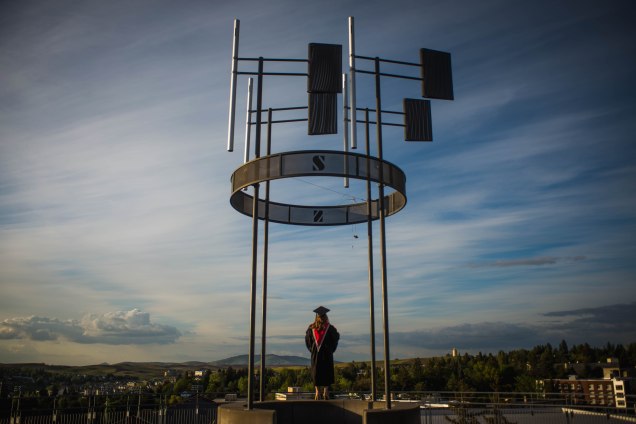
When I took this picture, I stepped up onto a cement barrier (in heels, no less).  Looking out over the campus, I had no visual cues to reassure me.  It seemed as though I were at the immediate edge of a cliff, even though the drop to the flowerbed below was no more than a foot and a half.  Logically, I knew I was safe.  Irrationally, I felt like I was about to fall.

But for a moment, buried in the jolt of fear, it was exhilarating.

This feeling returned as I looked down at the crimson rectangle in my hands.  But I couldn’t cry, not really, not in the front row, not as several hundred others made their way across the stage.  So I smiled, blinked away the welling emotions, and looked around for the friends I knew would be coming up in line.

Stood back up.  Moved the tassel.  Cheered as the confetti rained down.  Slipped a few pieces into the diploma cover, hoping my bittersweet tears wouldn’t dissolve it later.

IMG_20160507_191312

Things My Mother Taught Me

How to keep a house clean. How to vacuum. How to dust. How to throw open all the windows when you need air and close them up again when it starts getting cold, or hot, depending on the season.

How to wrap the stovetop protectors in tin foil to make cleaning easier. How to scrub the stove down with an SOS pad and then wipe up all the grease and grime with the blue suds.

How to make a home feel like a home.

How to fold a sweater. How to swap out your wardrobe every season so that it makes it seem like new things are coming out of your closet every few months.  How to dress nicely and look put together even if you had a total girl morning and this is the fifth outfit you even tried on and there is positively nothing in your closet.

How to fold bath towels – in third lengthwise, then in half. How to empty the trash before company comes over because it looks nicer. How to make meals everybody will enjoy.  How to write thank you notes.

How there’s no substitute for talking face to face.  How to come back to family and friends and pick up where you left off. How to keep in touch. How to give someone space. How to smile at strangers and be polite to everybody, especially the receptionist and the cashier because they don’t make the rules and you don’t need to make their day any harder just because you’re unhappy with an institutional thing.

How it feels to rediscover an old favorite song. How to sing along to Broadway while you cook dinner. How to softshoe with a kitchen towel to “My Blanket and Me” from You’re A Good Man, Charlie Brown. How to work a record player, to set the needle down oh so gently into the groove and smile at the scratching noise as it finds its place and begins to play. How to wake up with a smile.  How to shift seamlessly from one good morning song to another, from “Oh What A Beautiful Morning” (Oklahoma) to “Good Morning” (Singin’ in the Rain).

How to be quiet. How to be assertive. How to save your swear words for what really matters so that everybody will know how mad you really are. How to put your hands on your hips and stare down a fractious two-year-old.  How to distract said two-year-old when his mother leaves. How to entertain him until she comes back. How to call people out of the blue just when they need it most.

How to get rid of telemarketers.

How to make tea. How to make cookies. How to follow a recipe. How to put the Tupperware in the bottom drawer for the child to play with, even if you don’t have a child in the house, because there very well might be soon. How certain things are two-in-the-afternoon decisions, not two-in-the-morning decisions.

How there are very few things a Boo Boo Bunny can’t fix. How to bribe your children with Beanie Babies when they have to get shots at the doctor’s office.

How to care for candles. How to care for animals. How to care for others. How to give to those in need every little tiny seemingly insignificant chance you get, whether it’s a can of soup for a church drive even though you just helped with the Thanksgiving baskets last month, or spending a Saturday painting Tacoma beautiful.

How to pull on your big girl panties and deal with it. How to hold it together until you get home and then how to let yourself cry, and maybe eat some chocolate and curl up with an understanding cat if you feel like it. How to be the bigger person. How to stand up for yourself. How to stay young at heart. How to learn from your elders. How to show respect. How to command people’s respect. How to multitask. How to enjoy doing nothing.  How to take care of yourself.  How to love God. How to struggle with Him.

How books stay with us. How reading transports and transforms us. How reading together teaches us to be a family. How families don’t have to include just the traditional members. How families can stay together even when they fall apart.

How beauty is always available in the world, no matter how crabby and out of sorts we feel.


tulips-glossary_110603Some of these I never wanted to learn. Some of these I never knew she was teaching me. Some of them she may never have known she was imparting.

If I’m lucky and I keep working at these, I may just manage to turn out something like her. Wouldn’t that be something.

Mortarboards and “Mischief Managed”

I’m having the hardest time deciding what quote to put on my graduation cap.  It’s the only part of the regalia I get to keep, the tassel and the mortarboard, so I figured why not personalize it a little?  The Commodore has a LOTR quote (in Elvish because she is awesome) and the White Tree of Gondor, and the Southern Belle decorated hers in a nod to her future grad school.  I’ve seen Disney themes, puns on student debt, gaming metaphors, etc.

I looked up C.S. Lewis quotes and found “There are far better things ahead than any we leave behind.”  But that kind of sounds like college sucked and I’m happy to be leaving, and that’s not my attitude.

Then there’s an Augustus Waters quote from John Green’s The Fault in Our Stars: “You are going to live a good and long life filled with great and terrible moments that you cannot even imagine yet!”  But that’s kind of long.

Or there’s Disney, something from Beauty and the Beast, but “I want adventure in the great wide somewhere” doesn’t quite seem to fit when I’m staying in my college town for the immediate future.

I considered a lyric from Hamilton, something like “I am indomitable, I am an original” or “Write day and night like you need it to survive.”  Those are still kind of obscure, though, as popular as the musical is.

Maybe a Bible verse?  “God is within her; she will not fail”?  Something literary, from Harry Potter or Arabian Nights?

I have so many options my friends have joked that I should just put a notebook on my cap that includes all the quotes, with the tassel for a bookmark.  I feel like I’ll know the right quote when I hear/read it – but I only have 8 more days to find it!