We were replacing the victims of our murderous goldfish, Dotty. The other fish just kept…vanishing. The little frog got caught in the filter – shoved in, we were certain, by our resident cannibal. When Dotty finally died, only one little fishy was left, the one I’d dubbed Shadow for his ability to lurk behind the plastic plants and avoid his friends’ fate. I thought he’d like having the tank to himself, having been traumatized by Dotty, but Dad said we should get him some more friends. So off we went to the pet store.
And there were kittens.
Two of them, one gray tabby and his dark, smoky gray brother, mewling from behind the glass. (I seem to remember a story about the litter being found on the side of the road in a cardboard box, but that could just be me combining Homeward Bound 2 with my own memories. I was mostly focused on the adorable bundle of wriggly fuzziness.) Dad said we could hold them, a fatal mistake, because Bird and I had already telepathically agreed that we were taking these kittens home. The only problem was how to convince our father that we needed both of them.
“Here, Daddy,” I said, handing him the gray one that resembled a little bear. “He likes you.”
“Here, Daddy,” Bird said, handing him the stripey one. “This one’s so soft!”
Dad could tell we weren’t leaving without a feline, so he sighed and asked which one we wanted.
“Oh, you pick, Daddy!” we chorused.
He looked at us. He looked at the kittens. “Well,” he said resignedly, “it’d be a shame to split up brothers.”
So now we have Sitka (the striped one) and Kodiak (the little gray bear, Kodi for short) because Dad’s one condition was that he get to name them.
This set a precedent for Bird to get a dog two years ago. After visiting the Humane Society, she set her sights on a Husky mix. So she sent Dad pictures of the dog with the caption “Dickens says good morning…from his cold, lonely cell…If only someone would take him home…”
The next time I came home from school, we had a dog.
I was vaguely aware that there was probably something wrong. My friend and I had sat on one of the lower bunks in our somewhat crowded retreat cabin for almost half an hour, talking. She kept asking me questions – how was I eating, sleeping, focusing in class, feeling about spending time with the Engineer?
“Just one more thing,” she said. “Are you reading?”
I shook my head.
“That,” she said, looking me in the eye, “does not sound like you.”
I hadn’t felt like “me” for weeks, but I was slogging through, wasn’t I? I was still helping lead this retreat. I was still maintaining my grades. I was still fun to be around at our weekly church dinners, even if I did sometimes hang out quietly in a corner or slip out early. But I was probably just tired. Everyone gets tired.
These were the thought processes that kept me from telling anyone, from thinking about it too much, from pushing too hard against the curtain that had fallen between me and the rest of the world. Because that’s what it felt like. I was just numb, all the time. Nothing really seemed worth the effort of pushing through that.
Besides, I was probably just tired, or maybe not getting enough vitamin C. I didn’t want to make a mountain out of a molehill, even in my own head. Why make a big deal about something I was “handling” just fine?
Somewhere, in my two decades on this planet, I had picked up social habits that informed the way I thought about my own mental health. These habits led me to believe that as long as no one could tell anything was wrong, there wasn’t anything wrong. Furthermore, these habits led me to fear others’ reactions when I admitted to this “fault” of mine, this depression. Every time I told a friend or family member my shameful secret, I flinched at the words, preparing myself for the comments I’d already heard so much from myself.
“I’m sure it’s not that bad. Just cheer up.”
“Focus on positive things.”
“You’re just having a bad week. It’ll pass.”
“Wow, overdramatic much?”
I had only told my friend about my feelings on a whim – something she’d said about her own experiences in counseling had stuck with me despite the numbness, and I just wanted to see if there were any similarities between our cases. Or rather, if I was being honest, I wanted to know that she saw those similarities too, that I wasn’t just making it up.
But even though she asked every day for the next week if I’d made an appointment with a counselor, even though the Southern Belle said I didn’t seem like myself lately and the Engineer expressed his worry for me, it took me another two weeks to actually go in.
And when I did? “If I had the textbook open in front of me to Depression,” the counselor said, “it would say all the things you’re telling me.”
“But nothing’s happened,” I wanted to say. “No one died. I didn’t get fired. There’s no trauma that should have caused this.” Apparently, my brain didn’t care about my need to legitimize my depression to others. This was just what was happening, regardless of events in my life.
Not one of my friends or family members said anything dismissive when I finally opened up to them. They gave me nothing but love and support.
But I still dismissed my mental health. I compared my own numbness to what I thought of as “real depression,” the struggles of people suffering from physical illness or devastating loss. I felt like an impostor, and, despite overwhelming evidence to the contrary, I thought others would see me that way too.
I worried I was talking about it too much – that the Engineer or Bird or any of my friends might secretly be rolling their eyes and thinking, “This again? Isn’t she over it by now?”
Our society does not do well with mental health. For one thing, it’s invisible – I can’t count the number of times someone has said (in the nicest possible way) that I “always seemed so happy.” And the stigmas surrounding mental health issues encourage us to keep it invisible. As John Green said in a recent video (which I highly recommend you go watch – the relevant part starts at about 1:00), “The central way we imagine sickness, as a thing that we must conquer and then put behind us, doesn’t really apply to chronic illness.” I don’t blame anyone for wanting to assume I’m “better,” but every time I have to re-admit to having depression, it opens me up to that fear of disappointing them, as though I’ve failed to attain something, even though that something is actually out of my control.
This is why I want to talk about my depression – because those stigmas and those fears stemming from them make me so angry. The way our society deals with mental health is preventing people from admitting to themselves that something might be wrong. It’s preventing the friends and family of people with mental health issues from finding the best ways to help.
And this fear of talking about it isn’t helping any of us.
Some food for thought:
“Explaining My Depression to My Mother” by Sabrina Benaim (an excellent poem about an experience I was blessed enough not to have)
HPWritesBlogs, especially her post “Depression is a Liar”
I’m trying something new this year. Well, multiple new things, really. In looking at my schedule, taking on all 27 or so of my proposed resolutions at once just isn’t going to happen. For one thing, I have zero free time until the end of February, when I present my undergraduate thesis (further freakouts regarding the state of this ginormous project will be forthcoming, I’m sure). For another, trying to implement a billion new pieces of a routine simultaneously just doesn’t work. I’ve tried it. It’s like carrying an armful of cats. You want to hold onto all of them, but one or two are bound to wriggle out and go scampering off somewhere. And you end up with a lot of claw marks from the ones that are left.
So my theory is that gradually adding clusters of new habits every two weeks or so might be easier to manage, particularly since my schedule is already going to drastically change about halfway through the semester. My loose idea for this organizational tactic is as follows:
Immediate
The daily changes I want to make right away – drink a full water bottle daily; get outside once a day; journal every evening; read for pleasure; write literally anything, even just a sentence, for my own personal manuscript
New Semester
The stuff that will be easier to start when I get back to school and therefore has been pushed back until then – cut out mindless snacking; don’t skip Zumba classes; set up a real workspace instead of just sitting on the couch with Netflix on in the background; do homework the day it is assigned; incorporate daily Bible readings into my new semester routine; block out specific times to work on my thesis; don’t forget about meals
Post-Thesis Haze
The bigger picture things that will undoubtedly nag at the back of my mind but that I physically cannot spend time on until my thesis is done – start applying for post-grad jobs; devote an hour minimum each day to my own manuscript; get certified as a Zumba instructor; seek out freelance editorial and authorial work, even unpaid internships; focus on online professional development
Post-Grad
Honestly, I haven’t really dared to think this far ahead. But if I’m still not skipping Zumba and I’m eating healthy and staying hydrated and working on my manuscript and feel like I’ve got my job situation sort of under control for the moment, then I’ll probably focus on my general theme for the year: be present.
I’ve fallen down many a stress spiral before, particularly this past semester, and these are frequently brought on by focusing too hard on the future. I will never be completely happy-go-lucky or loosey-goosey with my schedule (I love my planner too much!) nor do I think that thinking about and planning for the future is a bad thing. But when it makes me forget about how happy I am in the moment with the Engineer or how much I’m enjoying this particular sentence in my book or how great this writing session is going, it does become a problem.
And, as stressful as it may be at times, I really am looking forward to the year ahead, so I want to hold onto that and appreciate where I am in the life I’m building for myself.
Well, I survived my penultimate undergraduate finals week. And now I sit in our living room across from the Christmas tree, surrounded by festive Yuletide decorations and books (seriously – we have four bursting plastic totes of Christmas books alone) and it still doesn’t feel like The Most Wonderful Time of The Year.
I’m still in that dazed letdown phase that follows a period of intense stress. Relieved as I may be to have finished up my classes, going-going-going for two and a half weeks straight leaves me a little bewildered when I get home and there’s not as much to do. I sit here casting around for the assignment or project I’m certain I forgot about, too used to having Something To Do hanging over my head. The Engineer once “assigned” me coloring pages to do over the summer so I wouldn’t stress out about not having anything to stress out about.
This year, of course, I do have something to do – my thesis project. Which is due at the end of February. Which I’m trying not to freak out about just yet. After all, the vacation is young. And I do love my topic (the Arabian Nights), so the reading will probably go faster than I think it will.
But stress is not exactly conducive to the magic of Christmas.
So I suppose it couldn’t hurt to give myself a few days to breathe – and watch my favorite Christmas movies from childhood.
I make lists. I run a pencil down the edge of a ruler and divide my cardstock into two columns, one Pro, one Con. I begin jotting, neatly at first, then scribbling as it becomes a stream of consciousness, leaping from one side to the other like a Highland sword dance.
I ask advice. I gather opinions like berries, examining each one for ripeness, letting them dye my fingers and adding my stained fingerprints to the already constructed lists.
I consider myself, my own head and heart. I still have trouble with this one – for a long time, emotions had very little to do with my major choices, unless it was to tip a balanced scale at the last minute. Choosing a high school came down to academic reputation. Picking my college came down to finances. Making a decision based on feelings didn’t seem “smart,” and I was all about making the “smart” choice.
Which is probably why I was so stuck. Why I couldn’t articulate to my friends, my family, even to myself what I wanted. Why my heart still beats a little faster when I say it out loud, much less type it out.
I’ve decided to stay in my college town for the next year after graduation. I can keep my apartment and my job, both of which I love. I can be near the Engineer while he finishes up his last year of undergrad (switching majors sophomore year throws things a little out of whack). And I can work on my own writing so the next time I pitch a manuscript to someone and they want to read it, I’ll actually have something to send them.
“Do I want a smoothie?” I mused aloud. One of my coworkers looked up from the couches in our hangout area.
“Is that even a question? Smoothies are always a good idea,” he said.
I laughed. “You’re right. I do want a smoothie. The real question,” I said, waving my wallet at him, “is whether I want to spend the money. Because that would make my wallet very sad.”
He shrugged. “Why would you pay for the smoothie?”
For a moment I thought he was suggesting I somehow blend and steal my own fruit drink, but after a moment he added, “Just ask people for the money.”
I raised an eyebrow.
“No, seriously,” he said, leaning forward, “just tell people you forgot your wallet or you don’t have any money and you’re thirsty and can they spare you any change for a drink. Now, if I tried to do that it would take me all day. But you – you could probably find someone offering to buy you a coffee within – ” he thought for a moment ” – fifteen minutes. Tops.”
Incredulous, I just stared at him.
“Oh yes,” he said, seeing my expression, “sexism is alive and well, and you can exploit it!”
I laughed. We didn’t know each other well yet, this coworker and I, but I knew enough to realize that he was merely commenting on the sorry state of our collegiate society, not being sexist himself.
As I walked to the student union, I half-wanted to try out the experiment, just to see what would happen. My coworker, however joking his tone, had a point. I’ve joked with the Engineer before about using such tactics; whenever he worries that I won’t know how to put chains on my tires going over the pass for winter break, I just bat my eyes and say sweetly, “I’m cute and helpless. Someone will stop.” In reality, of course, the thought of playing Damsel in Distress makes my eyes want to roll out of my head.
But here, on the same campus where I’ve had male classmates say they don’t hold the door open for girls anymore because “they might get mad,” I could probably have flirted my way to a smoothie.
We females are still thought of as Damsels, just with varying degrees of receptiveness to Manly Heroics swooping in to save the day. Many boys don’t let girls do things for themselves because they see us as equals, but because they’re afraid of us snapping at them.
Can’t we all just hold doors and lend money for smoothies regardless of gender, because we’re all humans trying to navigate the madness that is college life?
Princess Unikitty is the embodiment of positivity. (If you don’t know who I’m talking about, drop everything and go watch/rewatch the brilliance that is The Lego Movie. I’ll wait.) In her beloved Cloud Cuckoo Land, Unikitty leads a life of carefree, rainbow-colored chaos, where anything goes – as long as there are no frowny faces. Her commitment to thinking happy thoughts runs deep, even when the bad guys show up and Cloud Cuckoo Land turns less rainbow and more explosive.
Obviously, this is not the healthiest emotional habit, and it doesn’t sustain Unikitty for long. Even as she explains the motto above, her face becomes red and angry. Though she tries her best to suppress negativity, it’s still there, lurking just beneath the surface. By the end of the movie, Unikitty’s anger at seeing her friends attacked overpowers her obsessively positive mindset, and she busts out some fantastic animated karate to take down her fair share of bad guys. Plus it’s funny to watch someone go from determinedly cheerful to Hulk-smash furious in 5 seconds.
Isn’t it?
Though moviegoers recognize that Unikitty should not be dealing with her emotions this way, she still presents a fair picture of the emotional facade our society expects of us. We place a great deal of emphasis on BE HAPPY! without sufficient focus on the methods we use to get there. We encourage people to “let go” of negative emotions as quickly as possible, to “shake off” experiences and feelings we deem “toxic” due to their Not-Happy nature. In effect, a lot of us really do push those thoughts “down deep inside where you’ll never, ever, ever, EVER find them.”
Unfortunately, this is not the same as feeling them.
I haven’t talked about this yet on this blog, but my own Unikitty-esque emotional habits led me into a serious struggle with depression about a year ago. All of my emotions, Happy and Not-So-Happy, completely shut down. I went numb. And at first I couldn’t figure out why. I thought depression and anxiety needed some kind of trigger, but I hadn’t had any traumatic event in my life. Eventually, my counselor traced it back to the Really Big Conflict, as I’ve referred to it, from The Internship sophomore year.
I thought, like Elsa from Frozen, I had just let it go.
In reality, I was more like Unikitty, pretending Cloud Cuckoo Land wasn’t crashing down around my ears. I shoved the anger, hurt, and confusion deeper and deeper down until finally the Happy Thoughts shut off too.
Something my counselor told me: You can’t feel things selectively. You can’t just ignore negative emotions without eventually turning off the positive ones too.
As Unikitty shows us, if Not Happy Thoughts are simply shoved aside in favor of Happy Thoughts, there comes a breaking point. Either you explode, like Unikitty, or you go numb, like I did. Being happy All! The! Time! is all well and good if you’re just that kind of person, but I’m learning the importance of truly moving on – feeling the negative feelings and making space in your mind for them before taking that deep breath.
So maybe I won’t identify so strongly with Unikitty anymore. But she’s a good reminder of my old habits – and why they won’t sustain me any more than they did her.
UPDATE: The original title of this post was “Unikitty is My Spirit Animal,” but having learned of that term’s importance to native peoples and cultures, I’ve decided not to use it here. I have edited the post accordingly. (2019)
We use this word a lot to describe horrific things. “A senseless tragedy.” “Senseless violence.” And usually we take it to mean that there is no sense to this, that is it nonsense, this thing that has happened, we cannot make sense out of it because to any sensical person it is impossible to think this way. Justifying it is meaningless. You might as well try to argue that the world is flat. We cannot make heads or tails of it. Senseless.
But I think in the immediate aftermath of tragedies, we also mean that we are numb, that we are “destitute or deprived of sensation,” because sometimes the best way to handle such news is to shut down, at least for a moment. Even worse, the hits just keep on coming. Syria. Beirut. Paris. After a while, the pain deadens the nerve endings rather than awakening them. The sensation, the hopeless, helpless sensation, is there, but it is lessened with time and repetition.
Do we mean, perhaps, that our sense of outrage is limited? That it is senseless to maintain a sense of anger because these things happen so often and the world is so dark?
I hope not.
I hope, instead, that we mean that we need to take a breath to ready ourselves for the feelings that accompany the confusion.
And because we can recognize that, because we can say that we do not think that way and we will not think that way, we can do something. We can change something.
It will be slow, and it will be hard, but we can make the world make sense again.
I like getting mail – real mail, the kind with my name lovingly written in a familiar hand with a sticker on the back holding the flap down even though it has that special glue. One of my favorite little moments of the day is checking our mailbox, jiggling the key back and forth until it relents and lets me open our tiny metal door. The possibility of getting mail, even a postcard, is exciting.
But more often than not, all that tumbles out are circulars with fruits and vegetables printed on newspaper, proclaiming the grocery store’s LOW, LOW PRICES. They don’t even have coupons to clip, just advertisements listing the products for sale.
Two things bother me about these fliers:
They waste paper. Each one uses at least two sheets of newspaper, and I see the other tenants’ copies tossed carelessly in the laundry room trash (because who wants to carry it all the way across the parking lot or back to one’s apartment to recycle it?). No one is even opening them, much less reading or using them, so why waste the materials?
There is no way to stop them coming. On unwanted email advertisements, I can hit “unsubscribe.” On magazines, I can cancel my account or simply wait until it runs out. But these aren’t even addressed to me – they’re sent in bulk to “Resident” at each apartment number, and probably in every other apartment complex in town. I don’t know how to stop them, except to write some strongly worded letter to the Grocery Store Powers That Be to explain that all they’re doing is wasting paper and no one (or at least no one at this address) wants their unsolicited circulars anymore. But what good would that do? They’d probably forget to take us off the list, and they wouldn’t stop printing them. At best I wouldn’t have to feel guilty for only recycling my own copy anymore.
Something I ponder frequently on my way from the laundry room to the recycling bin.
Walking down the mall to work this past week, I had to veer around a medium-sized clump of people ringed around a shouting man. The man shouted about damnation, Jesus, and sin. Sometimes he stood on a milk crate. Sometimes people shouted back. Mostly they just laughed.
But then I got to work and I heard the conversations inspired by this man and his shouting.
“Christians are so judgmental.” “They’re all just a bunch of hypocrites.” “This is why I hate religion.”
“Would you say I’m judgmental?” I wanted to ask. “Would you assume that I condemn all those who don’t share my beliefs?”
In my fantasy, they answer, “Of course not. You are tolerant and good.”
“Well,” my imaginary self responds, standing to make a dramatic exit, “I must not be a very good Christian then, since you say they’re all so awful.” The less charitable part of me wants to leave them spluttering, awkward, wishing they hadn’t made assumptions about their audience, ashamed of drawing such broad conclusions about a large group of people the same way they say Christians do.
But instead I bit my lip, because I had a shift in five minutes and not enough time to explain how they shouldn’t judge the whole from the part, viewing all of us in the same way as the yelling fundamentalist.
Catholics, traditionally, shy away from street corner evangelism. We are not comfortable with tabling in the student union, or even handing out candy in front of our own church door. But I wear my cross necklace, and if someone notices and wants to have a respectful discussion of belief systems with me, I will gladly sit down with them. I seek more to understand, and to allow the other person to understand my own beliefs, than to convert them.
And this is the problem I have with people who shout one the mall. They are not fostering discussion. They are not leaving their audiences musing to themselves that perhaps there’s something to this whole God thing after all. There is nothing productive about the conversations stemming from seeing this shouting man because those conversations only reflect the judgment that people feel from him. His content may be solid, but the method of transmission is off-putting to say the least.
So, if anyone cares, I’m open to discussion. But please: no shouting.
 This set a precedent for Bird to get a dog two years ago. After visiting the Humane Society, she set her sights on a Husky mix. So she sent Dad pictures of the dog with the caption “Dickens says good morning…from his cold, lonely cell…If only someone would take him home…”
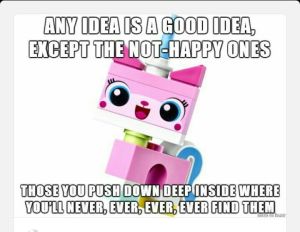 Obviously, this is not the healthiest emotional habit, and it doesn’t sustain Unikitty for long. Even as she explains the motto above,
  The Grammar Changeling