Things I Used to Imagine at Night

On the nights I couldn’t seem to fall asleep, I used to employ my favorite “Imaginings.”

I used to pretend that the walls to my bedroom expanded out and out and out into a vast dormitory with rows and rows of old fashioned hospital beds, the kind with metal bars and headboards like the backs of folding chairs.  In this dormitory lived a hundred other girls, all the cliques one would expect from high school, and we were in the charge of at least one surly matron and occasionally her kinder, younger helper.  I would whisper to the other girls in the beds surrounding me until we had to hush because the matron was walking by.  The circumstances surrounding the dormitory changed.  Sometimes it was a camp for training us to be servants to the upper classes.  Sometimes it was an orphanage.  (It really depended what books I’d been reading lately.)  But that didn’t matter so much, because I only played this game at night, so I only imagined the dormitory itself.

I used to pretend that the ground below my bedroom window dropped away to a moat far below my tower, because I was a queen tucked up in her castle.  Except I was no orthodox queen – I had privateers with whom I could only meet at night for fear of tipping my hand to the sleazy ambassadors at my court.  I imagined a trusted maidservant showing the fierce pirates up to my sitting room, where we pored over battle plans until the wee hours of the night.  Sometimes I even held audiences with thieves from all over the provinces, gleaning evidence of treason by sending them to steal from my nobles.

I used to pretend that mine was the nicest room the boardinghouse had to offer, a respite from my long, secretive journey.  But I couldn’t rest just yet.  I had to listen for suspicious murmurs from the hostess downstairs, who looked at me sidelong when I paid for the room (a girl traveling alone?) and who might this very moment be disclosing my whereabouts to my pursuers – for a pretty penny, of course.

I used to pretend I was a favored servant in the palace of a sultan (particularly after I discovered the Arabian Nights), keeping tabs on court intrigue from my strategically placed room at the center of the harem.  My true loyalties shifted from night to night – sometimes I would pass on information to the sultan, and sometimes I would bide my time.

On the nights I couldn’t seem to fall asleep, I used to pretend a lot of things.  And even though I always woke up as myself again, I think the Imaginings – especially the ones I revisited over and over and over – left their mark.
My Life in Books, Part 2: Rereading Runaways

Elementary school was a time of reading and rereading for me as I discovered the escapism of my favorite books.  Several of my favorites tended toward children cleverly making their own way in the world – with a lot of detailed lists of the chores and tasks involved in their survivalist adventures.

1. From the Mixed-Up Files of Mrs. Basil E. Frankweiler by E. L. Konigsburg

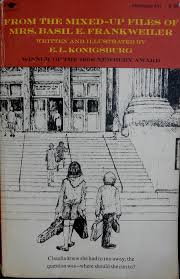
download (4)This was the best runaway book ever.  Claudia spends the first several chapters of the book preparing extensively for her escape from her boring suburban life – saving her tiny allowance, choosing a sibling to accompany her, selecting a destination.  Needless to say, I identified with this level of forethought; I was never one to just take off in anger.  I also loved the idea of living in a museum, having it all to myself at night, and investigating a mysterious statue.  And then, when Claudia and her brother meet Mrs. Basil E. Frankweiler?  I wanted to be her too, this little old lady living in a house full of her own personal collection of artifacts with a secretive filing system that makes sense only to her.  She was great!  But more than that, the characters seemed to understand the escapism I was seeking in the very books I read.  It wasn’t about anything specifically bad in everyday life.  It was about “coming home different,” as Claudia puts it, having something to assuage the ordinariness of home life.  It was about having a piece of adventure to hold onto while one quietly assumed one’s daily duties – precisely the reason I read.

2. Julie of the Wolves by Jean Craighead George

9780064400589_custom-0dc27ef1292bfe782c935e615a12b66a172f4107-s6-c30Like Claudia, Julie is realistic about her plans.  She wants a change of life, not just to make a scene.  Escaping a fairytale-esque step-family situation (in other words, not good), Julie ends up living on the Arctic tundra and befriending a pack of wolves.  She lives by the same rhythms of nature as the animals she follows, from lemmings to caribou to the wolves themselves.  Even though the book was full of detailed technical descriptions (e.g., Julie makes her own winter clothes out of caribou skin…after making her own needle and thread from other parts of the caribou), I pored over it as a kid.  I think I liked the idea of being self-sufficient, of filling my day with simple but useful things.  There wasn’t much dialogue, except between Julie and her imagined voices for the wolves, but it reassured me that I wasn’t the only one who imagined conversations in her head.

It was also one of my first books with a bittersweet ending; the wolves move on.  So does Julie, who goes to live with her father.  As much as I wished she could go with the wolves every time I reread the book, Julie’s sense of self was more important than a happy ending for the sake of happy endings.

3. My Side of the Mountain by Jean Craighead George…again.  Hmm.  Honestly never knew that.

JacketAnother self-sufficient, outdoorsy runaway book, I think I mainly loved this one because of the falcon.  I wasn’t planning to burn my home out of a hollow tree, or make snares, but falconry?  That’s just cool.  Minus the part about stealing a nestling.  However, in case I ever did decide to dash off to the forests of Washington (and goodness knows there are plenty to choose from), this book would have provided a wonderful manual.

This was another unsatisfying ending, at least for me.  Sam’s family shows up, agreeing that they could all “get away” from society.  But I wanted Sam to live happily ever after in his solitude.  It frustrated me that his family caught up with him, even if he was lonely.  I liked the idea of carving out a life (literally) alone somewhere.  It appealed to my introversion.  So I kept rereading it, despite the ending.

4. Mandy by Julie (Andrews) Edwards

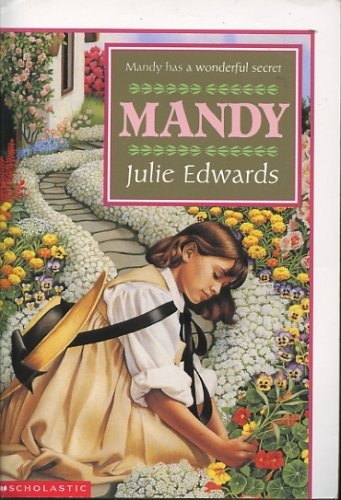
mandyEven before I became familiar with the flawless Queen of Everything Julie Andrews, I loved this book.  I actually recommended this book to my kindergarten teacher’s daughter (she was in 4th grade at the time, so this made me very proud).  Although not exactly like the other runaways on this list, Mandy also has a secret escape from her everyday life.  Again, this appealed to my introverted side; I preferred my books, imagined experiences of my own or shared with Bird, to playdates or sports.  Mandy climbs over the orphanage wall (what young reader doesn’t love a good orphan story?) and discovers an abandoned cottage on the neighboring estate.  She begins fixing it up.  She figures out how to budget for supplies, schedules her visits when she knows no one will be looking, and works until her fingers blister.  Weirdly, I enjoyed the lists of her chores.  It was like vicarious cleaning pleasure, and as a kindergartener I wished I could find my own little house to fix up just right.  This may sound as though it goes against my feminist grain, but it was more about creating a world, a haven of one’s own (Mandy only wants something that’s hers, rather than something charity or the orphanage gives her) than just following some kind of societal norm.

My Life in Books, Part 1: The Formative Favorites

I can divide up my life by books: epochs of reading indicated by the particular volume that served as my security blanket, my favorite refuge, for that period.  These are the formative few that found me at exactly the moment I needed them.

1. Angelfish by Laurence Yep

41LEKDC-oYL._SX343_BO1,204,203,200_The W-Z shelf in my elementary school library formed a corner with another, lower shelf that, when I settled criss-cross onto the nubbly carpet, made me feel safe – walled up in a castle.  The books at eye level when I situated myself this way included Angelfish, which I checked out so many times throughout the years at St. C’s that the librarian gave me that copy as a graduation present at the end of 8th grade.  She said it was clearly mine.  I called it my Belle book, after the scene in Disney’s Beauty and the Beast when the bookseller gives Belle her favorite book free of charge.  The reason I read it 17 times in a single year is that Angelfish is a love story about a girl and dance.  Robin, the narrator, loves ballet so much she declares she will always find some way to be a part of it, even if it means just sweeping the stage.  “That’s the way you love something when you’re young,” her teacher responds.  The plot involves Robin helping a victim of the Chinese Revolution rediscover his own art – originally dance as well, now painting – and reaffirm the value of having that joy in one’s life.  Having quit my own ballet lessons years before, I probably couldn’t have told you in 8th grade why I loved this book so much.  Now I think I needed it to give me an example of how to hold on to your passion despite the naysayers.

2. Dealing With Dragons by Patricia Wrede

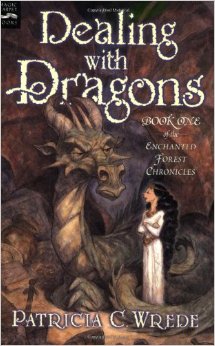
51eC4uO6deL._SY344_BO1,204,203,200_This must have been one of my first feminist books.  The stubborn, witty heroine, Cimorene, gets bored being a princess, so she runs away to serve a dragon.  Although irritated by the conventions that bind her (dealing with all those princes trying to rescue her against her will, for instance), Cimorene also frequently uses her society’s stereotypes of silly princesses to her own advantage (e.g., getting an evil wizard to let slip a few details of his plan).  She finds a way of life that makes her happy and fulfilled even though few people originally understand her desires.  Beyond the quips and amusing dialogue that appealed to me as a sarcastic teenager, Dragons showed me that if you persist in chasing your dreams, you’ll find people who will listen to you.  The dragon she serves, for instance, believes Cimorene when everyone else wants to write her off as just another hysterical princess.  Plus there’s swordfighting.  Who doesn’t love swordfighting?

3. Girl Meets God by Lauren Winner

41unxgoV6iL._SY344_BO1,204,203,200_I gave up reading anything but religious books for Lent one year, and it led me to this memoir of a Jewish girl turned Episcopalian.  Nearly every page held a turn of phrase that made me think, “Yes, exactly,” or “I thought that was just me!”  In a section on Lent, the author’s priest asks her to give up reading for the liturgical season, and I nearly dropped the book in surprise.  I just saw so much of myself and my own questions and confusion about faith (and life in general) in this book, even though I was raised Catholic and intend to remain in the Church.  I love the honesty about the difficult parts of belief and the self-awareness the author demonstrates in her writing.  Once I finished the book, I immediately turned to the first page again, this time with a pencil to underline and annotate the parts that spoke to me the most.  Since then, I’ve read it nearly a dozen times, at least once a year, each time making new notes and looking back on my past self’s questions and scribbles about faith and life.

4. The Disreputable History of Frankie Landau-Banks by E. Lockhart

6a00d8345169e469e2016760e64a3f970bFrankie does not get the guy.  Her friends and family don’t accept her as she is.  But that’s not the point.  When I started high school, I could identify with Frankie’s sense of confinement within others’ perceptions of her.  Her family doesn’t deem her smart enough to use her cell phone when she gets lost or attend a prestigious boarding school without a nice boyfriend to “look after her.”  The boyfriend is not much better; although most of Frankie’s schemes are designed to earn his respect, she soon discovers that he preferred it when she was arm candy in need of his protection.  But she keeps going, realizing that she actually wants to prove something to herself more than to her boyfriend.  After that, others’ opinions don’t matter so much.  By the end, no one quite knows what to do with Frankie, except Frankie herself.  In my freshman year of high school, when I discovered this book, I had just been frozen out by the group of girls I used to rely on for approval.  I needed the self-discovery role model that Frankie provides.  And I needed the honesty of the last chapter: “She might go crazy…They do sometimes go crazy, these people, because the world is telling them not to want the things they want…another possibility – the possibility I hold out for – is that Frankie Landau-Banks will open the doors she is trying to get through.  And she will grow up to change the world.”

Reclaiming Blue

I’m something of a pen thief.  If someone hands me a really awesome pen, the kind of pen that rolls smoothly across the page without smearing and seems to suggest beautiful things will come naturally to one’s head when one uses it, I’m liable to slip it into my purse without thinking and only later realize my transgression.

And then keep that pen for five years.

One such pen is a light blue ballpoint that has lasted me since study hall my senior year of high school when I accidentally stole it from Ashleigh H.  (I’ll probably apologize to her at our five year reunion.)  It’s lived in my pencil case ever since, usually employed to note important events in my beloved planner (which, as we’ve established, I love to color code).

Freshman year of college, I designated this blue pen for events pertaining to the Catholic student center where I spent most of my free time.  Dinners, movie nights, youth group, etc. were all recorded in light blue ballpoint, next to the green fountain pen reserved for work and the orange highlighter that means something horrible like a test or a huge paper is about to happen.  Through the beginning of sophomore year, I associated blue with this student center, and because this place was such a huge part of my life, blue showed up a lot in my planners.

Then, midway through sophomore year, a Really Big Conflict arose.  The details are a story for another time, as is the extent of the fallout, but it involved A Certain Person from the student center, and led to me pulling away from some of that involvement.

I fought with a lot of mental murkiness following this Really Big Conflict.  I fought to regain my faith, and I fought to maintain friendships, and I fought to keep the community that had become central to my college life.  Things have gotten better – a lot better – in the year and a half since.

But I realized that I stopped using blue.

The events I still went to at the center were labeled in plain black.  Even my blue highlighter was getting far less use.  Green, which now represented a job I love, made me happy, but when I flipped a page in my planner and found an event I’d written months earlier in blue, I flinched.  I was avoiding a color I’d chosen originally for its calming qualities!

So I’ve made an Executive Decision.  I am reassigning blue.  Blue is now for things that are good for me, things that help me with self care, things that make me happy.  My anniversary with the Engineer, for instance, or my dad’s wedding, or a girls’ weekend with the Southern Belle.  (I might even put some dinners at the Catholic student center in blue again.)

I am reclaiming blue.  And it does feel good to write with that wonderful pen again.

To Whom Much is Given

Mom, Bird, and I said grace before our meal in the food court at the mall last night.  No one shouted at us, threatened us, or asked us to leave.

We were at the mall to shop for dresses for a friend’s wedding later this summer.  Bird and I have never had to worry about whether or not our eventual marriages will be legally recognized in our home state.

I’ve been fortunate enough to live most of my life in a relatively tolerant community in one of the country’s most tolerant states.  I’ve been even more fortunate not to need this tolerance for my own sake, because I was born a white, middle-class, heterosexual female who identified as her biological gender.  I fell into pretty much every category of “majority” you can think of.  Admittedly, I didn’t realize just how blessed I was until I started college and the bubble of my existence dramatically widened (with the help of the internet, particularly Tumblr).

When the Supreme Court made its decision on marriage equality, I was overjoyed for my friends who could now plan the weddings of their dreams.  When I heard about the Charleston shooting, I mourned the victims – and got angry about the ignorance displayed by those who tried to dismiss the racist implications of the massacre.  I was still seeing these things from the outside, and I was not directly affected, but that does not excuse me from working to change things for the better.

I’m still learning, still developing my worldview (and I pray it won’t become as rigid and cemented in ignorance or partial knowledge as some of the people giving out their opinions like candy from a stranger’s van), still figuring out what I can do from here to help – or at least not make it worse.  I don’t know.  Sometimes it feels too big.

014b868afc10c6e19990969f956e90f6And I’m realizing that the best thing I can do is listen.  I don’t say this as if I can somehow validate others’ experiences simply because I, a privileged person, take the time to listen to them, people who have been denied something (or several somethings) that I have been blessed enough to have.  Their humanity validates their experiences.  We are all people no matter how many variables we can or cannot check off on a list of too-easy identifiers.  Yes, we are different, but that does not negate the intrinsic personhood or value of those different from me.

And my privilege or luck or whatever you want to call it does nothing if I let it drag me into complicity with the current value system that wrongs so many other people.  I guess what I’m working on is finding not the role that society tells me I should take up by virtue of all these things out of my control (ethnicity, sexuality, etc.), but a role in helping all of us crawl a little bit further out of that society’s reach to where we can start building and changing things.

To do that, I’m going to have to learn.  And to learn, I’m going to have to listen.

It doesn’t feel like enough.  I wish I had more ideas, more answers, more words.  But at least I can demonstrate my respect for my fellow human beings and remain open to educating myself and others.

One of the most sincere forms of respect is actually listening to what another has to say.

~Bryant McGill

Book Hangover

This state of mind makes me think there must be something to the idea that there are imperceptible veils between worlds that prevent certain kinds of Creatures, Spirits, and Sundry from completely inhabiting one universe or another – veils that leave you drifting, not unpleasantly, just above the surface of your proper world, before allowing you to emerge completely from the novel you have just put down.

Good writing does that, good books – no, good stories – in particular.  The words sweep you off your conscious feet, twitch aside the veils, and deposit you firmly In The Story.  There’s a reason some fanfictions are labeled AU for Alternate Universe (I’m a child of the Internet/Tumblr.  Sorry.) – wherever your physical body may be, your essence, if the writer does their job, is far away and unreachable.

It may not seem like it.  Family members, roommates, concerned colleagues can all reach out and tap your shoulder, jolting you from The Story to ask you something, but sudden as the tug was, you’re not really back.  The Story is still hovering, hazing a more current reality.  You submerge yourself again as quickly as you can.

But oh.  When you finish the book.

When you finish the book you float for a while.  You drift.  Neither your own world nor the novel’s can quite pull you down to the ground again so you’re nudged this way and that by memories of both – on the one hand you have chores to do, but on the other you have a character death to deal with.  There’s a plot twist you still haven’t quite processed, and a meal to eat, but neither has any weight because you’re still somewhere between the veils, uncertain as to the anchor for your perceptions.

It takes a bit to come back down to earth.

The longest time I spent in that In Between Space was after devouring The Fault in Our Stars in one day, huddled in my lower bunk in my freshman dorm room, barely speaking to either of my roommates and only stopping for one meal.  The Engineer and I had only been dating for two months at that point, so he hadn’t yet experienced my Book Hangover State.  To his credit, he took my silent, somewhat somber expression in stride, only occasionally squeezing my hand for reassurance that I was okay.

I know how it looks to outsiders, to non-readers – I must be angry, or upset, or at least annoyed about something.  I must not be feeling social, or, when I tell them a book did this to me, it must have had a terrible, terrible, ending.  But that’s not the point.  The point is feeling my way back from The Story I’ve been immersed in for the past several hours, and reconciling it with my own reality.

Cringe-Worthy Jewelry Choices

Moving back into my mom’s house yesterday, I went on a cleaning spree as I attempted to cram all my belongings into the room that I only inhabit on vacations.  And boy, did I dig deep.

I found Every Single Homecoming T-shirt from high school.  I found pajamas I haven’t worn since 8th grade.  I found my Nintendo DS (and promptly sat down to conquer the world in Civilization Revolution, which was still in the game slot).  I found the hardcover notebook in which I wrote my very first spy novel, a twenty-page, painstakingly handwritten epic about a neighborhood society of dogs, who uphold the age-old feud between felines and canines, and a turncoat kitten.  I found the watch I borrowed from my mom for an AP test four years ago.

And I found a box full of jewelry I used to love.

These included such gems as a tattered peace sign bracelet; a necklace with fake silver, gold, and bronze links; another necklace with one of those homemade pendants from a repurposed Scrabble tile; another necklace with some kind of giant fake amethyst that frankly probably made me look like I thought I belonged in a fantasy novel (which, to be fair, would have made high school a hell of a lot more fun); and a truly hideous flower pendant choker.

I could remember loving every one of these pieces, planning entire outfits very carefully around the grayish white peace sign bracelet or the weird flower pendant.  I could remember the heady feeling of no longer having to wear a uniform (#CatholicSchoolKid), the awkwardness of trying to figure out my own style, and the terror of having my Then-Best-Friend, who I idolized, look me up and down and say, “Really?”

My style, of course, has evolved over the years.  I stopped looking to others for the final say.  I got addicted to Pinterest and all its inspirations.  I figured out what actually looked good and what didn’t.

But I remember what it felt like to be that awkward, shy, please-God-don’t-anybody-look-at-me-too-closely girl who hoped that the jewelry would help me pretend I knew what I was doing.  It was one of those moments I think a lot of people have where we want to give our past selves some reassurance that they’re going to turn out okay.

The nostalgia was not quite strong enough, though, to save these beauties from the Donate Pile.

So I Got Fired

This is an entirely new experience for me.  Sure, I’ve failed at stuff before; I’ve failed to meet expectations, I’ve disagreed with an authority figure’s decision regarding my penalty, I’ve gotten in trouble.

I hate getting in trouble.

And I hate feeling embarrassed and rejected.

And getting the termination email for my internship out of the blue brought on the worst combination of embarrassment, rejection, and frantically flailingly wanting to set things right.

Now that it’s a week or so after the fact, the heart-pounding-oh-God-I’m-getting-sent-to-the-principal’s-office feeling has mostly subsided, and the main thing I wish I could change is the fact that I had no idea I was failing to meet expectations until I got the email saying things were not working out.  All the feedback I got was positive.  All the communication with my boss seemed normal and friendly.

This is a trend I’ve seen before.  I had an internship sophomore year that turned very toxic, in part because I received little direct feedback and discovered at one point that my supervisor had told another intern to “help out” because rather than talking to me, apparently, they decided that I could not or would not improve my performance if asked to do so.

I’m a writer, guys.  I like to think I can take constructive criticism.  I like to think that if someone called my attention to the fact that I needed to step up my game, I’d do it.  Maybe, in some cases, I wouldn’t.  Maybe I’d decide I couldn’t invest any more time and needed to walk away.  But I’d like to have the choice.

So here’s what I’m thinking: perhaps the responsibility is, at least partially, on me to ask for feedback and make sure , rather than assume, that the supervisor/boss/overlord and I are on the same page.  Perhaps I need to develop a formula for requesting this kind of communication in future jobs, internships, what-have-you.  (Advice in the comments would be appreciated!)  And perhaps I need to start developing this habit of requesting feedback now, early, before I get stuck in the passive-aggressive stream of the work world as a Full Fledged Adult.

After all, now I’ve got plenty of time on my hands to think about this stuff.  My summer is now wide open.

Why Yes, You Can Sit With Us

A follow up to yesterday’s post.

As my more reasonable readers could have probably predicted, my visits to the gym and the writing group did not, in fact, result in me getting chased out of the building.  Despite my apprehensions, it actually went rather well.

There was one employee at the gym who looked at me askance, but I just chalked that up to the fact that I sidled in wearing street clothes and not carrying anything that looked remotely like gym equipment.  The girl who ended up helping me was perfectly nice and answered all my awkward questions.

Similarly, the writing group greeted me warmly (I’d even met one of them before, even though my boss wasn’t there) – the proprietor of the coffee shop where they hold it noticed my laptop and asked if I was here to write.  When I said yes, the others looked up, asked what I was working on, and scooted over to make room for me.  The atmosphere was great, and I managed to get a decent amount of work done on my own stories for two whole hours!  There wasn’t much talking, but it didn’t feel oppressive – rather, we were all there to accomplish a similar goal, and that tacit support helped me make progress.  (My story is actually starting to look like a novel!)

Even though I slept through yoga this morning, and even though I probably won’t remember all the other writers’ names next week, it was reassuring to be accepted.

Now I just have to stop being so nervous about the writers’ conference coming up in July.  Sighhh…

Walk Into the Club Like Wait, I Can’t Dance

I didn’t get invited to parties in high school. I don’t say this for sympathy, or to complain; honestly, I didn’t even know there was a party scene at my school because my circle of friends all hung out at the coffee shop at the bottom of the hill and didn’t care much for loud music and mind-altering substances. So it’s not like I ever really felt left out. I had my crowd, and the partiers had theirs. You do you.

Rather, I bring this up because that’s the only social situation I can really think of that might have helped me suppress my introversion to the point that I wouldn’t feel so supremely uncomfortable walking into a room where I don’t know anyone and where I am not completely certain that I’m welcome.

Cartoon from the fabulous Hyperbole and a Half
Cartoon from the fabulous Hyperbole and a Half which you should check out because it’s perfection.

For instance, I signed up for a gym membership on the island where I’ll be living this summer, so as not to negate all the progress the Southern Belle and I had made in Zumba during the school year.  But joining the classes means walking into the gym.  By myself.  Where people, stronger and fitter and taller people, are also working out.  And judging me.  Probably.  I feel like that would happen, anyway.  The employees will probably be perfectly happy to have me there – I did give them my money, after all – but the social situation of trying to improve myself while also being acutely aware that I’m in a group of complete strangers doesn’t exactly put me at ease.

And then tomorrow, my boss invited me to a writing group at the coffee shop on the end of the pier.  Now, I’ve never been part of a writing group before.  And I will know someone there (my boss) and I have been explicitly invited (again, by my boss).  But I can just picture myself walking in, laptop in hand, pulling up a chair to the corner of the table because of course there won’t actually be room for me, so right away I’ll be inconveniencing the people who have probably been coming there forever, and then I’ll have such bad writer’s block that I’l end up just rereading that horrible, horrible mystery story I tried to write in 5th grade and slink out at the end of the meeting, aware of my own utter lack of talent and convinced that everyone else could tell I didn’t deserve to be there.

Yeah, even as I write that it sounds ridiculous and a little paranoid.

The fact is, everyone at the gym will probably be in their own little world, just like me, and some of them might even be encouraging.  And the people at the writing group will probably be perfectly welcoming and eager to hear what I’m writing about and want to motivate everyone in the group to just get writing, no matter how terrible the first draft might be.

But this is how I feel anytime I walk into an unfamiliar place, like a gym or a writing group, on my own.  I can’t seem to shake the idea that I am somehow lacking, that I will be intruding if I ask for guidance or friendship, that I am annoying the one person I do know by sticking so close to them but also will commit some kind of social sin if I try to branch out on my own.  I feel like I stick out like Elle Woods in her bunny costume at her first Harvard party.

I may be faking it pretty well.  I may even be socializing even better than I think I am.

But all I really want to do is go home and read with a cup of coffee.  It’s so much easier to introduce my awkward self to the world through the written word, like this blog.  Socializing is hard, guys.