Still Alive, Just FYI

Sorry about the radio silence lately, but my undergraduate thesis is due tomorrow so I’ve spent the past few weeks alternately crying, tearing my hair out, complaining a lot  to the Engineer (he is a saint and a far better human being than I deserve in my stress spirals), and occasionally hitting a great writing streak and slamming out a dozen pages at once.  At the moment, I’m trying to write my precis (basically an abstract, but I can’t use any “jargon,” which I didn’t realize was a thing that happened when you’re just talking about storytelling, but apparently it is) and then format my final draft.

And then I turn it in.

Eek.

So anyway, once that’s turned in and I give my presentation in 2 weeks, I’ll have more brain space to write blog posts, so there will be a regular(ish) schedule again after that.

Pinky swear.

Rejecting a Resume Builder

I might have done something dumb.  Or I might be getting the hang of self care.  The line between the two, at least for me, is occasionally hazy.

The email came from out of the blue, with Congratulations! in the subject line next to the name of the University Lit Journal.  I’ve been published in this journal before (2 stories in one issue, actually), and submitted to it multiple times…but not this past semester.  I hadn’t had time to work on anything I felt confident submitting.

Confused, I clicked.

They had accepted my piece for publication, pending revisions, and needed a bio and headshot of me by Friday.  I didn’t recognize the title of the piece they mentioned, but the girl who had emailed me knew me from previous classes and one of my other friends was the managing editor, so it probably wasn’t a case of mistaken identity.  I texted Editor Friend.

“Um, it’s the piece you wrote for Professor C’s class,” he said.  “Last spring?  Here, I’ll email it to you.”

Vague memory dawned.  It was a creative nonfiction piece about my time abroad the summer before, but I was thoroughly “meh” about how it turned out.  Professor C, though, loved it.  He had encouraged me to submit it to University Lit Journal and, when I wasn’t sure, asked if he could at least use it as an example for his creative nonfiction editors.  I said that was fine, and maybe I would revise and submit it for publication eventually.  I never got around to it – had forgotten all about it, actually.

And now University Lit Journal was offering to publish it.

I remember how it felt getting the email saying that not one but both of my previous (fiction) pieces had been accepted.  I was exhilarated.  Over the moon.  Skipping down the sidewalk (well, I do that anyway because I’m basically a 5-year-old pretending to be a college student, but you get the picture).  The meeting with the editors to go over revisions was one of the best workshopping experiences I have ever had, and I was truly proud of the product when it came out in print.

This time around, all I felt was panic.

I did not have time budgeted for this.  I did not have a spare hour to meet with the editors again, much less several afternoons to devote to revising the piece to a point where I would be happy to see it in print (again, this was not my favorite thing I’ve ever written, and though when I reread it I could see some potential, it would take a while).  And I had no desire to carve out that time.  I didn’t want to rush to a meeting where my own writing would make me feel harried and inconvenienced.  I didn’t want to spend energy that I needed for class, work, thesis, feeding myself.  I didn’t want to pick up a project that someone else had started on my behalf.

“How much would you hate me if I said no?” I texted Editor Friend.

Some people might think I’m crazy for retracting my piece.  “How much time could it really have taken?” they might cry.  “You should have jumped at the chance to get published again!  I’m sure if they wanted to print the story it would have been fine no matter how you felt about it.” And maybe, being a young almost-graduate who’s hoping to get an entire book published eventually, I should have been grateful for the chance to have another printed piece on my resume.

But I just wasn’t.  And I have enough of a sense of ownership of my writing that I wanted to be excited if I was going to have something printed.  I didn’t want it to feel – well, like this.

So I retracted my “submission” and immediately breathed a sigh of relief.  Now I could focus on the stuff I want to write – like my thesis, my manuscript, and this blog.  Maybe it wasn’t the best choice for my resume, but it was what I needed to do for myself right now.  And I’m okay with that.

The Blessings Jar

I can’t work in clutter.  My room, in the upheaval and un-routine-ness that accompanies a new semester, had been in an Uneasy State of Chaos for a while, and I was sick of it.  So, working counterclockwise around my room from the door, I Cleaned – and yes, the capital is warranted, because it was no mere 10-second tidying up.  I dusted and organized and rearranged and adjusted until everything fit Just So.

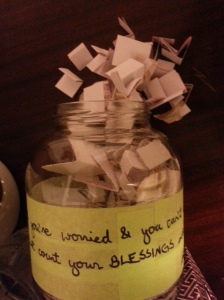
I was on a roll until I got to my nightstand.  One of the Random Things that had come to rest in obscurity right next to my bed was a pickle jar with the label peeled off and many slips of multicolored paper inside.

2016-01-19 19.37.17

My Blessings Jar.

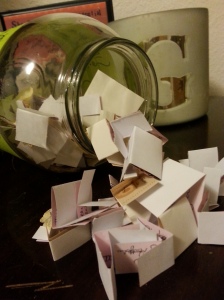
I’d forgotten about it, failed to keep up the habit, since last year when Bird gave me the idea (which I think she got from Pinterest).  As I swiped the dust rag over it, I thought now might be a good time to empty it, start fresh, swear to myself that I would chronicle at least One Good Thing each night from now on.  Settling criss-cross-applesauce on the floor, I poured out the tiny scraps and began to read.  Some made me chuckle, like liquid dishwasher soap from when the Commodore and I finally ran out of that awful powdered stuff and bought a gallon of the liquid we preferred.

Some, like Bird’s smile when she saw me in the chapel after her retreat, made me cry.

It amazes me, sometimes, the magnitude of things that can be tethered in tiny characters inked on paper.  The moments I had found worth recording were instances of love, support, and shared strength from my parents, my sister, the Commodore, the Southern Belle, the Engineer and his family, my friends from church, and my coworkers.  All the people in my life had contributed to these scribbly bits of paper showing me how many families I have looking out for me.

So often it’s easier to remember the one bad thing that happened at the end of an evening, or late in the afternoon, and let it erase all the silliness and contentment of the morning and lunchtime.  A whole day can be colored by just one negative thing.  But when I force myself to think of just One Good Thing, it’s funny how more Good Things start to come out of the shadows, shyly raising a hand to say, “Remember me?  You didn’t have such a bad day after all.”

I tucked the old blessings away in a box and set the empty, hopeful jar on my freshly dusted nightstand.

I think this is a habit worth attempting again.2016-01-19 19.38.25

A New Year’s Post

I’m trying something new this year.  Well, multiple new things, really.  In looking at my schedule, taking on all 27 or so of my proposed resolutions at once just isn’t going to happen.  For one thing, I have zero free time until the end of February, when I present my undergraduate thesis (further freakouts regarding the state of this ginormous project will be forthcoming, I’m sure).  For another, trying to implement a billion new pieces of a routine simultaneously just doesn’t work.  I’ve tried it.  It’s like carrying an armful of cats.  You want to hold onto all of them, but one or two are bound to wriggle out and go scampering off somewhere.  And you end up with a lot of claw marks from the ones that are left.

So my theory is that gradually adding clusters of new habits every two weeks or so might be easier to manage, particularly since my schedule is already going to drastically change about halfway through the semester.  My loose idea for this organizational tactic is as follows:

Immediate

The daily changes I want to make right away – drink a full water bottle daily; get outside once a day; journal every evening; read for pleasure; write literally anything, even just a sentence, for my own personal manuscript

New Semester

The stuff that will be easier to start when I get back to school and therefore has been pushed back until then – cut out mindless snacking; don’t skip Zumba classes; set up a real workspace instead of just sitting on the couch with Netflix on in the background; do homework the day it is assigned; incorporate daily Bible readings into my new semester routine; block out specific times to work on my thesis; don’t forget about meals

Post-Thesis Haze

The bigger picture things that will undoubtedly nag at the back of my mind but that I physically cannot spend time on until my thesis is done – start applying for post-grad jobs; devote an hour minimum each day to my own manuscript; get certified as a Zumba instructor; seek out freelance editorial and authorial work, even unpaid internships; focus on online professional development

Post-Grad

Honestly, I haven’t really dared to think this far ahead.  But if I’m still not skipping Zumba and I’m eating healthy and staying hydrated and working on my manuscript and feel like I’ve got my job situation sort of under control for the moment, then I’ll probably focus on my general theme for the year: be present.

I’ve fallen down many a stress spiral before, particularly this past semester, and these are frequently brought on by focusing too hard on the future.  I will never be completely happy-go-lucky or loosey-goosey with my schedule (I love my planner too much!) nor do I think that thinking about and planning for the future is a bad thing.  But when it makes me forget about how happy I am in the moment with the Engineer or how much I’m enjoying this particular sentence in my book or how great this writing session is going, it does become a problem.

And, as stressful as it may be at times, I really am looking forward to the year ahead, so I want to hold onto that and appreciate where I am in the life I’m building for myself.

Decision

the act of or need for making up one’s mind
something that is decided; resolution
the quality of being decided; firmness
I make lists.  I run a pencil down the edge of a ruler and divide my cardstock into two columns, one Pro, one Con.  I begin jotting, neatly at first, then scribbling as it becomes a stream of consciousness, leaping from one side to the other like a Highland sword dance.
I ask advice.  I gather opinions like berries, examining each one for ripeness, letting them dye my fingers and adding my stained fingerprints to the already constructed lists.
I consider myself, my own head and heart.  I still have trouble with this one – for a long time, emotions had very little to do with my major choices, unless it was to tip a balanced scale at the last minute.  Choosing a high school came down to academic reputation.  Picking my college came down to finances.  Making a decision based on feelings didn’t seem “smart,” and I was all about making the “smart” choice.
Which is probably why I was so stuck.  Why I couldn’t articulate to my friends, my family, even to myself what I wanted.  Why my heart still beats a little faster when I say it out loud, much less type it out.
I’ve decided to stay in my college town for the next year after graduation.  I can keep my apartment and my job, both of which I love.  I can be near the Engineer while he finishes up his last year of undergrad (switching majors sophomore year throws things a little out of whack).  And I can work on my own writing so the next time I pitch a manuscript to someone and they want to read it, I’ll actually have something to send them.
And I’m pretty excited about all that.

Doodling Gives Me a Sense of Power

I’m facilitating four 1-credit English classes this semester.  These are meant to be workshop times, a space for students to bring their writing in and get peer feedback, with a slightly more trained supervisory peer (me) keeping track of attendance and offering clarification along with the general class discussion.

Which means that when students are determined to remain taciturn, I struggle a little for something to fill our 50 minute sessions.

It doesn’t seem that hard to me to talk about writing for 50 minutes, but I recognize that not everyone is quite as obsessed enthusiastic with words as I am.

So I usually end up doodling on the board.

At the beginning of the summer, I bought a pack of Expo markers specifically for these classes.  I keep them separate from my workplace’s other, dried-up, capless, mismatched markers.  I encourage my students to write on the board, to color code, to use more visual representations of their ideas if words aren’t working for them.

“I don’t know about you guys,” I say, “but writing on whiteboards always gives me a feeling of power.”  They nod, smile a little, and sometimes it works.  Sometimes they write one word and then sit back down, but sometimes it works.

And sometimes I end up just writing on the board so they’ll see the fruits of their discussion, the growth of the list, the effects of the edits we recommend to each other.

Or I just doodle while they read.  (I’m a speed reader.)  And I end up with things like this:

2015-10-16 11.59.17

If I’m lucky, this leads to even more discussion, with everyone swapping organizational ideas and sharing how they get from prompt to polished paper.

Or, “Can we play Hangman?”

But even when I think class hasn’t been terribly productive, one of the students will toss out an absolute gem of a sentence, or just a quiet, “Thank you,” as they walk out the door.  That, even more than the chance to write on a whiteboard, makes it worth it.

A Truly Congenial Pen

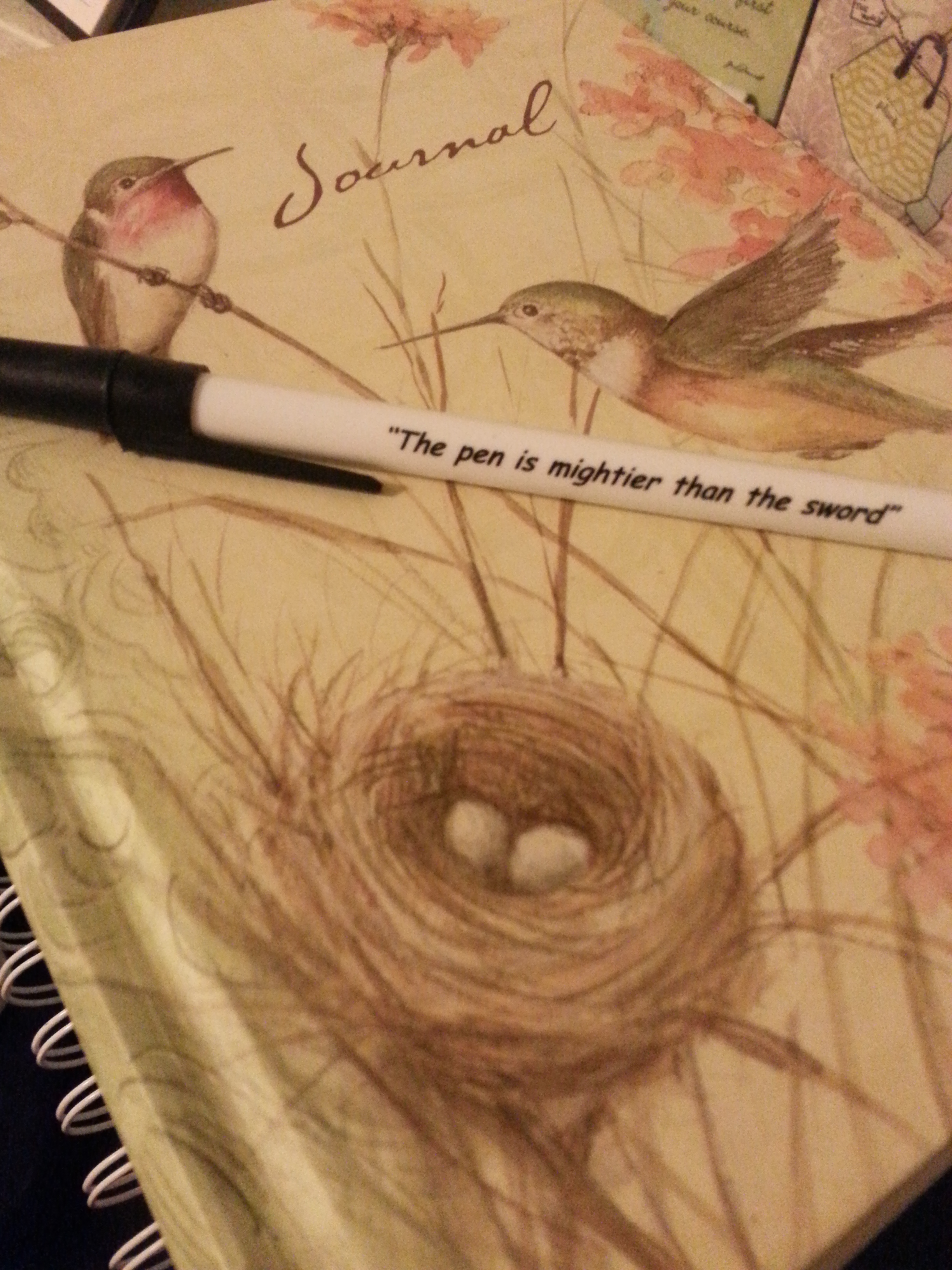
2015-10-20 20.43.34When you find a truly congenial pen, you don’t just let it go.  You mustn’t fling it around carelessly, let it ride barely held in by the mesh pockets of your backpack, allow it to sink to the bottom of the jumbled pile in your desk drawer.  You keep track of it, digging frantically through your room whenever it’s lost for a day.

But neither do you use it for just any purpose, like jotting down grocery lists – or maybe you do.  Maybe it’s that sort of pen, the sort that lends itself to making ordinary life flow a little smoother like ink from a perfectly poised ballpoint tip.  So its ink spreads over your life, through your planner and the torn-off bits of paper on which you write notes to yourself and your family, across the margins of newspapers where you doodle while you try to think of that last crossword answer.  Maybe it’s that sort of truly congenial pen.

Or perhaps it’s the kind that you store right next to your journal, because your thoughts just seem to write out better, even the tangled ones, when you have it in your hand.  It makes your darkest daydreams more palatable, your most confusing stressors more bearable.  Fond memories, written in its ink, become golden tinted.  It never runs out in the middle of a paragraph, never abandons you while you’re ranting to the page about your job or your crush or the people who live above you who stomp around like elephants in a Conga line.  Perhaps it’s that kind of pen.

Those who think this sort of attachment to a writing utensil is ridiculous have obviously not found a truly congenial pen of their own.  Those who agree with me know, as the Bard said, that pens are mightier than swords – so just the right one, in the right (or left) hand, is a formidable weapon indeed.

Hell on Heels (Apparently)

My dad got married this weekend!  It was lovely; he cried adorably, my sister and I cried rather less adorably, and the whole thing was just wonderful.

But lovely and adorable and wonderful do not make for good stories.

What does make a good story?  A passive-aggressive bed and breakfast hostess cornering girls to make them take off their high heels.

I first caught her attention by walking a little loudly down the hall.  Swiftly taking in my peep toe heels, she stepped uncomfortably close to my face and asked, “Didn’t anyone tell you?”  Before I even had a chance to answer, she went on, “I had requested that there be no spiky or tall heels.”  I began to explain that no one had told me of any such request, and I was pretty sure my heels didn’t qualify as “spiky,” being only about 3 inches tall, but she barreled onward.  “So if you could just take them off after all the pictures are done,” she said, smiling sweetly, “that would be wonderful.  Everyone will just think you’re getting comfortable!  But they really do leave bullet holes in my floor.”

I was unaware that I had shotguns in my shoes.  Whoops.

Now, I was raised to respect both adults and old houses, and this mansion-turned-B&B was nearly 100 years old.  Of course I didn’t want to damage the floors, but I figured if I stuck to the rugs and refrained from flamenco or tap dancing, it would be fine. Besides, more than half the women there were wearing heels too, and I didn’t see the hostess whispering warnings of bullet holes to any of them.

What I did see was Bird and her friend coming back from the buffet with plates in one hand and shoes in the other.

“She cornered us!” Bird said.  Apparently the hostess hadn’t bothered with the sweet smile this time.  She just stood there and made them take their shoes off after asking if anyone “remembered” her original request at all.  While, like me, Bird and her friend certainly didn’t want to cause any damage to the floors, they felt somewhat attacked.

“I don’t see her going up to anyone else,” I mused, glancing at the still-shod feet around us.  Some of those could definitely be classified as spiky, and yet the hostess chose to continue targeting the three youngest women wearing high heeled shoes.

The last straw came when we made our way into the living room to watch our dad and his new bride cut the cake.  I noticed that the hostess had literally cornered my poor sister and was hovering, watching her remove her shoes again.  Bird told me later that she demanded, “Do you have a problem with removing your shoes?  Other people don’t mind taking off their shoes!” – and pointed to a pile of flipflops that did not belong to anyone in our party.

I can bite my tongue.  I can be civil with people being unfair toward me.  I can even brush it off, if it only affects me.  But if you make my little sister uncomfortable?  Watch out.

“Excuse me,” I cut her off, putting on my best Southern Belle smile, “with all due respect, if this is going to be a problem, you should probably make a general announcement or put a sign up, since I can’t help but notice you’ve only been talking to the three of us.”

“Well, yes, there should have been a sign up,” she said, “but the smaller heels don’t make as much of an impact, so really…I mean, it’s just that I had requested…”

Honestly, I was not going to miss my dad cutting the cake to listen to that woman repeat her line about bullet holes.  So I smiled just as sweetly as she had earlier and turned away.

Once the cake cutting and toasts were over, I turned to the Engineer.  “I have a physics question for you,” I said.  “Does the height of the heel on my shoe increase the force I am exerting on the floor?”

“No,” he said, “force has more to do with the surface area.”  (I’m paraphrasing because I don’t remember exactly what he said, but the explanation was very helpful, particularly since it proved me right.)

Our conversation had caught the attention of a family friend nearby.  Once we filled her in on the situation, she asked, “Is that her?” and sauntered straight over to the hostess.

We found out later that she had quite politely asked why the groom’s daughters, whom she knew to be two classy ladies, were not wearing shoes.  The hostess repeated her line about bullet holes and heels, to which our friend asked, “Oh, do I need to remove my shoes?”

“Oh, I didn’t even notice those!  No, no, you’re fine.”

Our heels were exactly the same height.

The family friend then politely pointed out that we were paying for the use of the venue and would be posting a review later on about the experience, so she was going to go ahead and tell Bird and me to put our shoes back on.

The hostess, in my opinion, had quickly crossed the line into unprofessional behavior.  She consistently made discriminatory judgment calls in her attempts to protect the floors, insisting that our heels were more damaging than anyone else’s.  It was pretty obvious that she was unwilling to treat the “adult” guests this way, as evidenced when our family friend asked if she needed to take her shoes off.  Even if Bird and I were not the daughters of the groom, we were still guests in a venue that was being used by paying customers.  Yet the hostess became hostile every time she approached us, particularly Bird and her friend.  Addressing us respectfully, regardless of our apparent age or connection to the bride and groom, would probably have yielded far more favorable results than attacking and scolding us for not immediately complying to her demands.

Still, this by no means ruined the evening, and I finally did kick off my shoes (when damn well felt like it!) to swing dance a little with the Engineer.

The next morning, as we were saying goodbye, the hostess bustled up to shake hands and say how nice it was to meet us, and, turning to me, added, “And weren’t you so much more comfortable after you took off your shoes?”

I blinked, withdrew my hand, and went to hug my dad goodbye.  There were just too many comebacks to choose from.
Things I’m Trying to Be Better About

Praying.

Calling home.

Making healthy dinners.

Awareness of how much I’m spending on coffee.

Awareness of how much I’m drinking coffee.

Posting on this blog.

Posting on Changeling Scribbles (actually no don’t go read it because I haven’t posted anything in weeks).

Reading for pleasure.

Working on my own writing.

Doing laundry before the basket overflows.

Not overscheduling myself.

Eating a real breakfast, not just a protein bar on the way out the door.

Leaving the Engineer’s at a reasonable hour because he gets grumpy when he doesn’t get to bed before 11.

Leaving the Engineer’s at a reasonable hour because I cannot actually replace sleep with coffee.

Pulling myself out of stress spirals about what to do with my life post-graduation.

Going out and doing things occasionally.

Loving myself.

Want

to wish, need, crave, demand, or desire

to be without or be deficient in

“Tell me, right now, what you want.”

I sat in a springy armchair in a slightly musty room in a retreat center, twisted sideways to face my friend in the tweed armchair on the other side of the end table.  I had asked her advice, or her listening, I suppose, because she is my peer, in a similar place in life, and because it was a retreat.  You do things like this on retreats, I thought, even if you’re leading them.  You have these conversations with yourself.  It’s inherent.  Walking away for a weekend, leaving behind homework, shedding those surface attachments, it all leaves room.  Quiet, quiet room in my mind for those wonderings.

What I want?

There have been too many voices contributing to that conversation; my own was drowned out long ago.  I don’t remember anymore, without any outside influences, what I want.

I want my colorful planner to be already laid out for the next five years, the way it has been all my life, but it isn’t.

What I want?

I want to work on my writing, to be near those I love, to simply go to work and come home and have time to do what I love and maybe enjoy my job as well, small things, really, when I list them like this, but I cannot want them, because they are not what I have said I wanted, what I claimed for myself, what others want for me.

I want not to be found wanting.  I desire things of my own, but worry that by fulfilling my own wishes I will become deficient in outsiders’ eyes.

What I want?

I’d like to know that too.  Or be able to admit that I know it, and that I want it at all.  That I think it’s what God wants for me, too, because I wouldn’t still feel this way otherwise.

I sat in a springy armchair in a slightly musty room in a retreat center, twisted sideways to face my friend.  She wanted to know what I wanted.

And somehow, I told her.