My Life in Books, Part 2: Rereading Runaways

Elementary school was a time of reading and rereading for me as I discovered the escapism of my favorite books.  Several of my favorites tended toward children cleverly making their own way in the world – with a lot of detailed lists of the chores and tasks involved in their survivalist adventures.

1. From the Mixed-Up Files of Mrs. Basil E. Frankweiler by E. L. Konigsburg
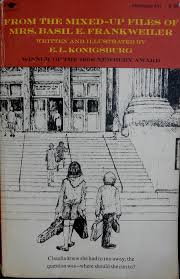
download (4)This was the best runaway book ever.  Claudia spends the first several chapters of the book preparing extensively for her escape from her boring suburban life – saving her tiny allowance, choosing a sibling to accompany her, selecting a destination.  Needless to say, I identified with this level of forethought; I was never one to just take off in anger.  I also loved the idea of living in a museum, having it all to myself at night, and investigating a mysterious statue.  And then, when Claudia and her brother meet Mrs. Basil E. Frankweiler?  I wanted to be her too, this little old lady living in a house full of her own personal collection of artifacts with a secretive filing system that makes sense only to her.  She was great!  But more than that, the characters seemed to understand the escapism I was seeking in the very books I read.  It wasn’t about anything specifically bad in everyday life.  It was about “coming home different,” as Claudia puts it, having something to assuage the ordinariness of home life.  It was about having a piece of adventure to hold onto while one quietly assumed one’s daily duties – precisely the reason I read.

2. Julie of the Wolves by Jean Craighead George

9780064400589_custom-0dc27ef1292bfe782c935e615a12b66a172f4107-s6-c30Like Claudia, Julie is realistic about her plans.  She wants a change of life, not just to make a scene.  Escaping a fairytale-esque step-family situation (in other words, not good), Julie ends up living on the Arctic tundra and befriending a pack of wolves.  She lives by the same rhythms of nature as the animals she follows, from lemmings to caribou to the wolves themselves.  Even though the book was full of detailed technical descriptions (e.g., Julie makes her own winter clothes out of caribou skin…after making her own needle and thread from other parts of the caribou), I pored over it as a kid.  I think I liked the idea of being self-sufficient, of filling my day with simple but useful things.  There wasn’t much dialogue, except between Julie and her imagined voices for the wolves, but it reassured me that I wasn’t the only one who imagined conversations in her head.

It was also one of my first books with a bittersweet ending; the wolves move on.  So does Julie, who goes to live with her father.  As much as I wished she could go with the wolves every time I reread the book, Julie’s sense of self was more important than a happy ending for the sake of happy endings.

3. My Side of the Mountain by Jean Craighead George…again.  Hmm.  Honestly never knew that.

JacketAnother self-sufficient, outdoorsy runaway book, I think I mainly loved this one because of the falcon.  I wasn’t planning to burn my home out of a hollow tree, or make snares, but falconry?  That’s just cool.  Minus the part about stealing a nestling.  However, in case I ever did decide to dash off to the forests of Washington (and goodness knows there are plenty to choose from), this book would have provided a wonderful manual.

This was another unsatisfying ending, at least for me.  Sam’s family shows up, agreeing that they could all “get away” from society.  But I wanted Sam to live happily ever after in his solitude.  It frustrated me that his family caught up with him, even if he was lonely.  I liked the idea of carving out a life (literally) alone somewhere.  It appealed to my introversion.  So I kept rereading it, despite the ending.

4. Mandy by Julie (Andrews) Edwards
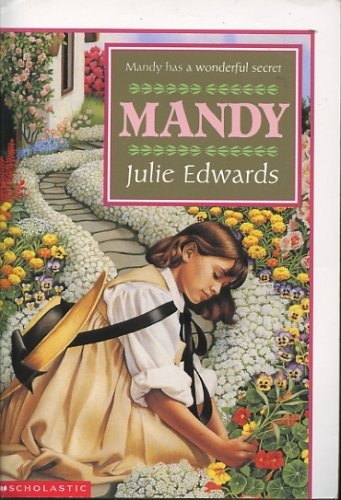
mandyEven before I became familiar with the flawless Queen of Everything Julie Andrews, I loved this book.  I actually recommended this book to my kindergarten teacher’s daughter (she was in 4th grade at the time, so this made me very proud).  Although not exactly like the other runaways on this list, Mandy also has a secret escape from her everyday life.  Again, this appealed to my introverted side; I preferred my books, imagined experiences of my own or shared with Bird, to playdates or sports.  Mandy climbs over the orphanage wall (what young reader doesn’t love a good orphan story?) and discovers an abandoned cottage on the neighboring estate.  She begins fixing it up.  She figures out how to budget for supplies, schedules her visits when she knows no one will be looking, and works until her fingers blister.  Weirdly, I enjoyed the lists of her chores.  It was like vicarious cleaning pleasure, and as a kindergartener I wished I could find my own little house to fix up just right.  This may sound as though it goes against my feminist grain, but it was more about creating a world, a haven of one’s own (Mandy only wants something that’s hers, rather than something charity or the orphanage gives her) than just following some kind of societal norm.

Manuscript

the original text of an author’s work, handwritten or now usually typed,that is submitted to a publisher
writing, as distinguished from print
I attended my first writers’ conference a few weeks ago.  For the first time in my life, I was surrounded by people who talked and thought about writing and books and reading and storytelling as much as I do – and they didn’t look at me like I’d grown a second head when I described my writing process or gushed about the diction in my favorite novels.
Being surrounded by likeminded individuals, I’m learning, is very affirming.
While there, I had the opportunity to pitch my idea for a novel to editors and agents from publishers of all shapes and sizes all over the country.  It was a rather terrifying process, but I connected with an editor and an agent who both seemed genuinely interested in reading my story and asked to see it.  Suddenly, it all felt real – this idea that I would be a writer, that I was always writing anyway, was suddenly made more corporeal by the idea that someone (outside friends and family who kind of have to like whatever I do anyway) actually wants to read my story.
!!!!!!!!!!!!!!!!
So now I’m frantically working to get my story into presentable shape so I can send it off.  Except they don’t call it a story, like I’ve been calling all my bits and pieces and fragments all these years.  It’s a manuscript (or at least, it will be).
Originating from medieval Latin for “written by hand,” manuscript to me suggests a sheaf of slightly crinkled papers covered in looping cursive and a few artistically placed ink blots, gently puffing out dust motes from the garret in which their creator scribbled down her ideas in a feverish haze.  It seems the kind of thing Jo March brought to her publishers, tied up with a ribbon.  My typed, double-spaced, Times New Roman pages seem too clean, too modern to merit such a literary term.
And yet, the painstaking work that goes into uncovering the precise language a story demands, the hours spent getting to know the characters, the effort taken to give a scene just the right effect, the feeling of giving up part of myself when I let someone else act as a beta reader (usually Bird, who is supportive but not blindly so)…yes, this is writing of my own hand, transcribed from imagination by my rapidly tapping fingers on the keyboard.  It’s the original text of my own work.
Now I just have to find a garret to hole up in until I finish.

My Life in Books, Part 1: The Formative Favorites

I can divide up my life by books: epochs of reading indicated by the particular volume that served as my security blanket, my favorite refuge, for that period.  These are the formative few that found me at exactly the moment I needed them.

1. Angelfish by Laurence Yep

41LEKDC-oYL._SX343_BO1,204,203,200_The W-Z shelf in my elementary school library formed a corner with another, lower shelf that, when I settled criss-cross onto the nubbly carpet, made me feel safe – walled up in a castle.  The books at eye level when I situated myself this way included Angelfish, which I checked out so many times throughout the years at St. C’s that the librarian gave me that copy as a graduation present at the end of 8th grade.  She said it was clearly mine.  I called it my Belle book, after the scene in Disney’s Beauty and the Beast when the bookseller gives Belle her favorite book free of charge.  The reason I read it 17 times in a single year is that Angelfish is a love story about a girl and dance.  Robin, the narrator, loves ballet so much she declares she will always find some way to be a part of it, even if it means just sweeping the stage.  “That’s the way you love something when you’re young,” her teacher responds.  The plot involves Robin helping a victim of the Chinese Revolution rediscover his own art – originally dance as well, now painting – and reaffirm the value of having that joy in one’s life.  Having quit my own ballet lessons years before, I probably couldn’t have told you in 8th grade why I loved this book so much.  Now I think I needed it to give me an example of how to hold on to your passion despite the naysayers.

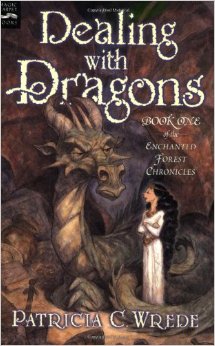
2. Dealing With Dragons by Patricia Wrede

51eC4uO6deL._SY344_BO1,204,203,200_This must have been one of my first feminist books.  The stubborn, witty heroine, Cimorene, gets bored being a princess, so she runs away to serve a dragon.  Although irritated by the conventions that bind her (dealing with all those princes trying to rescue her against her will, for instance), Cimorene also frequently uses her society’s stereotypes of silly princesses to her own advantage (e.g., getting an evil wizard to let slip a few details of his plan).  She finds a way of life that makes her happy and fulfilled even though few people originally understand her desires.  Beyond the quips and amusing dialogue that appealed to me as a sarcastic teenager, Dragons showed me that if you persist in chasing your dreams, you’ll find people who will listen to you.  The dragon she serves, for instance, believes Cimorene when everyone else wants to write her off as just another hysterical princess.  Plus there’s swordfighting.  Who doesn’t love swordfighting?

3. Girl Meets God by Lauren Winner

41unxgoV6iL._SY344_BO1,204,203,200_I gave up reading anything but religious books for Lent one year, and it led me to this memoir of a Jewish girl turned Episcopalian.  Nearly every page held a turn of phrase that made me think, “Yes, exactly,” or “I thought that was just me!”  In a section on Lent, the author’s priest asks her to give up reading for the liturgical season, and I nearly dropped the book in surprise.  I just saw so much of myself and my own questions and confusion about faith (and life in general) in this book, even though I was raised Catholic and intend to remain in the Church.  I love the honesty about the difficult parts of belief and the self-awareness the author demonstrates in her writing.  Once I finished the book, I immediately turned to the first page again, this time with a pencil to underline and annotate the parts that spoke to me the most.  Since then, I’ve read it nearly a dozen times, at least once a year, each time making new notes and looking back on my past self’s questions and scribbles about faith and life.

4. The Disreputable History of Frankie Landau-Banks by E. Lockhart

6a00d8345169e469e2016760e64a3f970bFrankie does not get the guy.  Her friends and family don’t accept her as she is.  But that’s not the point.  When I started high school, I could identify with Frankie’s sense of confinement within others’ perceptions of her.  Her family doesn’t deem her smart enough to use her cell phone when she gets lost or attend a prestigious boarding school without a nice boyfriend to “look after her.”  The boyfriend is not much better; although most of Frankie’s schemes are designed to earn his respect, she soon discovers that he preferred it when she was arm candy in need of his protection.  But she keeps going, realizing that she actually wants to prove something to herself more than to her boyfriend.  After that, others’ opinions don’t matter so much.  By the end, no one quite knows what to do with Frankie, except Frankie herself.  In my freshman year of high school, when I discovered this book, I had just been frozen out by the group of girls I used to rely on for approval.  I needed the self-discovery role model that Frankie provides.  And I needed the honesty of the last chapter: “She might go crazy…They do sometimes go crazy, these people, because the world is telling them not to want the things they want…another possibility – the possibility I hold out for – is that Frankie Landau-Banks will open the doors she is trying to get through.  And she will grow up to change the world.”

An Announcement

For a while now, I’ve been toying with the idea of incorporating my stories and creative nonfiction pieces into this blog, but thought that it might disrupt the tone and the types of posts I normally write.  So I decided to create a separate-but-linked site called Changeling Scribbles where I could publish my narratives in serial form (not serial killer form, mind you – that’s a different blog entirely – but in installments).  I think working like this will help me a) force myself to actually keep writing every day, b) finish some of the ideas that have been floating around my laptop forever, c) stick to a schedule, since hopefully people will be anticipating the next chapter, and d) start getting used to the idea of people actually reading my writing, since I’m typically very private about my works in progress.

The beauty of this arrangement is that if you’re interested in reading my stories, you can follow this other blog, but if that sounds like one of the most boring/terrible/torturous propositions in the world, you don’t have to!

My first post on the new blog, changelingscribbles.wordpress.com, will go up on Monday.

I’m kinda nervous.

But I think this will be a fun experiment, even if no one ends up reading it.

Book Hangover

This state of mind makes me think there must be something to the idea that there are imperceptible veils between worlds that prevent certain kinds of Creatures, Spirits, and Sundry from completely inhabiting one universe or another – veils that leave you drifting, not unpleasantly, just above the surface of your proper world, before allowing you to emerge completely from the novel you have just put down.

Good writing does that, good books – no, good stories – in particular.  The words sweep you off your conscious feet, twitch aside the veils, and deposit you firmly In The Story.  There’s a reason some fanfictions are labeled AU for Alternate Universe (I’m a child of the Internet/Tumblr.  Sorry.) – wherever your physical body may be, your essence, if the writer does their job, is far away and unreachable.

It may not seem like it.  Family members, roommates, concerned colleagues can all reach out and tap your shoulder, jolting you from The Story to ask you something, but sudden as the tug was, you’re not really back.  The Story is still hovering, hazing a more current reality.  You submerge yourself again as quickly as you can.

But oh.  When you finish the book.

When you finish the book you float for a while.  You drift.  Neither your own world nor the novel’s can quite pull you down to the ground again so you’re nudged this way and that by memories of both – on the one hand you have chores to do, but on the other you have a character death to deal with.  There’s a plot twist you still haven’t quite processed, and a meal to eat, but neither has any weight because you’re still somewhere between the veils, uncertain as to the anchor for your perceptions.

It takes a bit to come back down to earth.

The longest time I spent in that In Between Space was after devouring The Fault in Our Stars in one day, huddled in my lower bunk in my freshman dorm room, barely speaking to either of my roommates and only stopping for one meal.  The Engineer and I had only been dating for two months at that point, so he hadn’t yet experienced my Book Hangover State.  To his credit, he took my silent, somewhat somber expression in stride, only occasionally squeezing my hand for reassurance that I was okay.

I know how it looks to outsiders, to non-readers – I must be angry, or upset, or at least annoyed about something.  I must not be feeling social, or, when I tell them a book did this to me, it must have had a terrible, terrible, ending.  But that’s not the point.  The point is feeling my way back from The Story I’ve been immersed in for the past several hours, and reconciling it with my own reality.

Why Yes, You Can Sit With Us

A follow up to yesterday’s post.

As my more reasonable readers could have probably predicted, my visits to the gym and the writing group did not, in fact, result in me getting chased out of the building.  Despite my apprehensions, it actually went rather well.

There was one employee at the gym who looked at me askance, but I just chalked that up to the fact that I sidled in wearing street clothes and not carrying anything that looked remotely like gym equipment.  The girl who ended up helping me was perfectly nice and answered all my awkward questions.

Similarly, the writing group greeted me warmly (I’d even met one of them before, even though my boss wasn’t there) – the proprietor of the coffee shop where they hold it noticed my laptop and asked if I was here to write.  When I said yes, the others looked up, asked what I was working on, and scooted over to make room for me.  The atmosphere was great, and I managed to get a decent amount of work done on my own stories for two whole hours!  There wasn’t much talking, but it didn’t feel oppressive – rather, we were all there to accomplish a similar goal, and that tacit support helped me make progress.  (My story is actually starting to look like a novel!)

Even though I slept through yoga this morning, and even though I probably won’t remember all the other writers’ names next week, it was reassuring to be accepted.

Now I just have to stop being so nervous about the writers’ conference coming up in July.  Sighhh…

Water Water Everywhere

So I’m on an island.

Not a tropical island, the kind that shows up in clip art with palm trees and sand and maybe a coconut or two even though I’m not even sure coconuts grow on palm trees and those are the only vegetation visible in these stereotypical island illustrations.

I am on an island between the Strait of Juan de Fuca and the Puget Sound, one of those bumpy places on the map whose outline looks like the leftover dough after the cookies have been cut out.  I have a bed in a trailer in the driveway of the Engineer’s grandparents.  I have a one-cup coffee maker, and yogurt for breakfast, and my GRE prep book, and my laptop, and most of my dresses hanging from a tension rod in the shower because it’s summer, and I like to wear dresses, perhaps too many, though I sent some home with my mom because she said there was no way they would all fit.

I am on this island for the latest Big Exciting Thing: my internship with a company that actually does what I hope to end up doing (editing and publishing).  I haven’t actually gone to work yet, but I’m quite excited.  At the moment, I’m in an armchair in the public library, gazing out at the water (that’s the nice thing about an island – drive long enough and you find a spectacular ocean view!).  Now I think I’ll wander down to the wharf to try out one of the coffee shops, since I anticipate wanting to find a hang-out where I can caffeinate and read comfortably for what may be hours on end.

Yesterday I saw the most charming little bookshop.

I can smell the saltwater when I open the windows in my cozy little trailer.

I think I will be happy here.

When Furniture Moves in the Night

My dad used to come home in the middle of the night sometimes from work trips.  Trying to be considerate of his sleeping wife and daughters, he would tiptoe through the house – only to bang his shin and nearly take off a toe on the furniture that had moved since the last time he walked through the living room.

When we got older and Mom took it into her head to rearrange the house while Dad was on a trip, Bird and I had to help.

“Why,” we asked, wedging our shoulders under the arm of the couch while she lifted the other end like Wonder Woman, “can’t this wait until Dad is home to help?”

Mom shook her head at us, the upended couch swaying slightly in her grip.  “Girls, if we can do it ourselves – and we can – why wait?  Now, lift with your legs.”  We sighed.

To be fair, two generations of women in my family before her had repositioned furniture while their husbands were away – it was an inherited habit, one that sneakily followed me to college.  Last year, when the Commodore and I were sharing a room, we grew tired of the bunk bed arrangement and decided to unstack the beds.  I texted the Engineer to ask him to come help us move furniture while the Commodore paced out the new arrangement of our room.  The novelty of a fresh room arrangement (and the idea of no longer hitting our heads every time we got in or out of bed) was exciting.

Except the Engineer couldn’t make it.  Maybe this weekend he might be free.

The Commodore and I looked at each other.  And then we started shoving smaller furniture aside to make room for us to lift the upper bunk down from its perch.

Our third roommate’s boyfriend insisted on helping us, because he heard the scraping and sliding from the living room and, as he told his girlfriend, “I want to make sure these two don’t kill themselves.”  But the point was that, regardless of whether or not a Male Personage miraculously appeared to assist us, we felt like moving the furniture, so dammit, we were going to move the furniture.

When we settled down in our newly un-bunked (debunked?) beds that night, I told the Commodore about my parents and my grandparents and rearranging the house in the absence of one’s spouse.  She laughed.

“Of course your mom would do that,” she said.  “Still, it was nice to have help.”  She sat up straighter in her bed and declared, “We are Strong, Independent, 21st Century Women…who are quite happy to let guys do the heavy lifting if they feel so inclined.”

And that’s just what I love.  The lesson that I learned from my mother was not to reject a friend’s help, be they male or female, but rather to not put my life on hold until someone bigger or stronger can come and help me take the next step.  When Dad was home, of course he was roped into helping.  But if the mood struck while he was away, she made my sister and I feel that we didn’t necessarily need a man’s physical strength to get things done.  She showed us how to put towels under the feet of the couch to slide it across hardwood floors, how to come up with innovative ways to take a burst of inspiration and run with it despite potential obstacles.

And, of course, always lift with your legs.

Stuff To Do This Summer

Pray.

Bible study with Bird.

Study for the GRE.

Enjoy and learn from my new internship.

Do DuoLingo or something to keep up my extremely rusty Spanish.

Maybe learn some basic Italian while I’m at it.

Keep up an exercise routine.

Keep up this blog.

Work on some of my own stories.

Get back in touch with old friends.

Go to a friend’s wedding.

Start research for my thesis.

Speaking of which, should probably get that proposal revised and turned in.

Visit the Engineer.

Visit the Southern Belle.

Learn my way around my new town, including finding a bookshop and coffee place to frequent in my down time.

Start journaling again.

Put on sunscreen.

Drink a lot of coffee.

Be happy.

Libraries I Have Known

The Southern Belle was dubious when I strode toward the checkout station with a baker’s dozen of books, most of them hardcover, in my arms. She added her own modest three novels to the stack, then proposed using the plastic bags provided by the library to transport our literary loot out to my car.

I scoffed.

“Nearly all of these are hardcover – they’ll tear holes right through those bags,” I told her, starting to gather the scanned books back into my arms.  The Southern Belle sighed, and because she is a fabulous friend, grabbed half the stack for herself so I didn’t actually have to carry them all.  I would have, though.  I’ve done it before.

0973c21b26cff02884470cb1f045bef5

To me, a library trip is only successful when it results in such a large haul of reading material that I can’t quite open the front door when I get home.  I’ve developed this habit from childhood; ever since I got my first library card in kindergarten, I would toddle up to the counter with a stack of books tucked under my chin, my fingers barely gripping the bottom of the pile as I propped it against my torso.  The librarians would lean down and peer at me as I tried to shove my heap up and over the counter for them to scan.  “Are you really going to read all those?” they would ask, half to me, half to my mother, who stood by nodding.

“Oh yes, she will,” my mother said.

That was in the first library I knew, the brick one with the lane of trees out front and Reading Riley, the brass turtle, on his pedestal just outside the door.  That was the library where, seized by one of those fevered obsessions that strikes third-graders, I checked out nearly every book available on lemurs and wrote a report.  For fun.  During the summer.

That library is gone now, torn down and the spot where it stood filled in with mountains of dirt.  The city promised a new library in that same spot, a bigger, better one.  A year, two at the most, they said.

It took five.

During those five years, the temporary library was crammed into a space that used to house an auto parts store.  Many of the books, including some of my favorites, were now in storage elsewhere.  I had to request a lot of things from other branches.  The librarians who had watched me grow up shook their heads whenever I asked about a beloved volume.  Probably in a box somewhere, they said.

Now we have a new library, with floor to ceiling windows and self checkout stations and conference rooms for readings and signings and book clubs.  There’s a job search area with resources for unemployed people, a teen area, a kids area.

I think the kids section might be the only one without computers.

Of course I miss the library of my childhood, the one with brick walls and a hushed atmosphere and a counter that allowed me to get to know the people who worked there.  But at school, what I’m really homesick for are those teetering, heavy stacks of pleasure and leisure reading.  Spring break means getting to pile books up to my chin, crash through the door, settle in, and devour half the stack in one afternoon.  And that, to me, is home.