Shell Shock

When my professor called on me, I couldn’t contain an inarticulate growl before proceeding with my response to his question.

“Wow,” he said.  “The rage is strong with you today.”

It was indeed.  We were discussing the two doctors who “treat” Septimus Warren Smith in Virginia Woolf’s Mrs. Dalloway, and which of the two was worse/more destructive in his treatment of PTSD.  If you never read Mrs. Dalloway, Septimus is a character suffering from “shell shock” – hearing voices, seeing his dead friends, believing himself the recipient of a grand message from the universe, and feeling suicidal in the aftermath of serving in WWI.  The first doctor, Holmes, literally pushes Septimus’s wife, and therefore her worries for her husband, aside in order to lecture Septimus about how there is nothing at all the matter with him and how he should just get a hobby and go outside more.  The second, Sir William, agrees that Septimus is ill, but his focus is on normalization – that is, getting Septimus back to being a Contributing Member of Society, Back to Normal, and if he can’t do that, then letting him stay in an asylum rather than burden society any longer.

Grr.

These two delightful characters undoubtedly spring from Woolf’s own experiences with medical professionals while struggling with manic depression.  And even though Mrs. Dalloway was published in 1925, these doctors are still representative of social reactions to mental illness.

Setting my rage aside for moment (difficult as that is), I can understand the outside perspective.  It’s difficult to “believe in” an affliction we can’t see.  It’s not like a broken leg or a bleeding wound – there’s nothing visibly wrong, so a tiny doubt wriggles its way in.  He seemed fine two weeks agoIs she really that sick if she’s still getting all her work done?  He’s always been so reasonable – is he really thinking of suicide?  We base our assumptions on what we’ve seen and known of people up to this point, and sometimes it’s difficult to overcome that desire for them to “prove” that they’re “really sick.”  Similarly, I can see why, once we realize that something really is wrong, we want our friend/family member/classmate to Get Well Soon.  We want them Back to Normal, because isn’t that what they’re supposed to want too?  Our society often views healing as a process with an end point, a time in the future when the sick person will have Gotten Over It, whether It is a cold or the flu or the death of a loved one.  Of course, we are not completely callous.  We know that some things take longer to heal from than others.  But we’re still envisioning an end point rather than the possibility of “living with” the thing.  “Living with” seems to suggest an uneasy compromise, which we don’t like, because there’s the underlying possibility of another upset where the Bad Thing takes over, and of course we don’t want to see this person go through that again.

So I can understand these viewpoints.

But people who hold these views usually cannot understand me.

Both Holmes and Sir William fail to recognize and validate the reality of mental illness.  Yes, it’s difficult to “see” sometimes, but that doesn’t mean the person is making it up.  Visibility does not equal proof.  And, while there are sadly a few individuals who do make things up to get attention, why should that be our default assumption?

As for the push to Get Better Soon, while it usually comes from a place of genuine care and concern, it forces the sufferer to “take responsibility” for their illness – a problem that is actually beyond their control.  It may make the person feel as though the longer they take to get Back to Normal, the more irritated or fed up their support system will get.  Believing that the people around you think you should be over something makes you question yourself and begin devaluing the reality of your experience.  Also, prioritizing Back to Normal-ness denies a major fact of mental illness: it doesn’t always go away.  Balance can be achieved.  Strategies can be developed.  But when there is something chemically awry in a person’s brain, it can’t always magically be fixed.  So in that case, “living with” it instead of being crushed by it is actually a victory.

We have progressed significantly since the days of Septimus Warren Smith and his two horrible, horrible doctors.  But there is still room for improvement and understanding.
 

A New Year’s Post

I’m trying something new this year.  Well, multiple new things, really.  In looking at my schedule, taking on all 27 or so of my proposed resolutions at once just isn’t going to happen.  For one thing, I have zero free time until the end of February, when I present my undergraduate thesis (further freakouts regarding the state of this ginormous project will be forthcoming, I’m sure).  For another, trying to implement a billion new pieces of a routine simultaneously just doesn’t work.  I’ve tried it.  It’s like carrying an armful of cats.  You want to hold onto all of them, but one or two are bound to wriggle out and go scampering off somewhere.  And you end up with a lot of claw marks from the ones that are left.

So my theory is that gradually adding clusters of new habits every two weeks or so might be easier to manage, particularly since my schedule is already going to drastically change about halfway through the semester.  My loose idea for this organizational tactic is as follows:

Immediate

The daily changes I want to make right away – drink a full water bottle daily; get outside once a day; journal every evening; read for pleasure; write literally anything, even just a sentence, for my own personal manuscript

New Semester

The stuff that will be easier to start when I get back to school and therefore has been pushed back until then – cut out mindless snacking; don’t skip Zumba classes; set up a real workspace instead of just sitting on the couch with Netflix on in the background; do homework the day it is assigned; incorporate daily Bible readings into my new semester routine; block out specific times to work on my thesis; don’t forget about meals

Post-Thesis Haze

The bigger picture things that will undoubtedly nag at the back of my mind but that I physically cannot spend time on until my thesis is done – start applying for post-grad jobs; devote an hour minimum each day to my own manuscript; get certified as a Zumba instructor; seek out freelance editorial and authorial work, even unpaid internships; focus on online professional development

Post-Grad

Honestly, I haven’t really dared to think this far ahead.  But if I’m still not skipping Zumba and I’m eating healthy and staying hydrated and working on my manuscript and feel like I’ve got my job situation sort of under control for the moment, then I’ll probably focus on my general theme for the year: be present.

I’ve fallen down many a stress spiral before, particularly this past semester, and these are frequently brought on by focusing too hard on the future.  I will never be completely happy-go-lucky or loosey-goosey with my schedule (I love my planner too much!) nor do I think that thinking about and planning for the future is a bad thing.  But when it makes me forget about how happy I am in the moment with the Engineer or how much I’m enjoying this particular sentence in my book or how great this writing session is going, it does become a problem.

And, as stressful as it may be at times, I really am looking forward to the year ahead, so I want to hold onto that and appreciate where I am in the life I’m building for myself.

Things I’m Trying to Be Better About

Praying.

Calling home.

Making healthy dinners.

Awareness of how much I’m spending on coffee.

Awareness of how much I’m drinking coffee.

Posting on this blog.

Posting on Changeling Scribbles (actually no don’t go read it because I haven’t posted anything in weeks).

Reading for pleasure.

Working on my own writing.

Doing laundry before the basket overflows.

Not overscheduling myself.

Eating a real breakfast, not just a protein bar on the way out the door.

Leaving the Engineer’s at a reasonable hour because he gets grumpy when he doesn’t get to bed before 11.

Leaving the Engineer’s at a reasonable hour because I cannot actually replace sleep with coffee.

Pulling myself out of stress spirals about what to do with my life post-graduation.

Going out and doing things occasionally.

Loving myself.

My Life in Books, Part 3: Writing Guides

I love books, and I love writing.  It follows that I would have several books about writing.

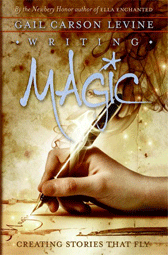
1. Writing Magic by Gail Carson Levine

writing_magicMy parents bought this for me at a Scholastic Book Fair in elementary school and I had read it by the time we got home.  So I promptly read it again.  Already a fan of Gail Carson Levine’s Ella EnchantedThe Two Princesses of Bamarre, and The Princess Tales series, I wanted to learn how one of my favorite authors made her books come alive.  It might be written for 4th graders, but I’ve revisited the prompts and advice in this book time after time, even now that I’m in college.  This was the book that instructed me never to get rid of anything I write – and, cringe-worthy as some of my early “stories” are, I’ve followed that mandate ever since I read it.

I think reading this was also a step in taking ownership of my writing process.  At one point, Levine writes that to her, revision is a relief: “When I’m working on a first draft, I feel like a prisoner…I notice a bit of moisture condensing on the walls, four or five beads of water.  Each bead is an idea. I scrape them off and write feverishly till I use them up.  Then I wait for more moisture.  But when I finish my first draft, the walls come down…No more waiting for condensation.  All I have to do is make the book better.”  I feel the opposite way.  I hate revising.  It feels like I’m penned in, cut off from the excitement of finding out where the story goes.  But that, Levine acknowledges, is just as legitimate a process as her own.

2. Bird by Bird by Anne Lamott

download (5)Part memoir, part writing advice book, part general life advice book, this is another one I reread over and over.  I just love the way Lamott writes, the anecdotes she tells, and the brutal honesty she displays about writing.  It sucks sometimes, trying to be a writer.  Lamott doesn’t romanticize it, but she also understands that it’s not about fun (or at least, not entirely).  It’s that you have to write, or go crazy.  Or maybe a little bit of both.

Lamott gives advice more episodically than anything else, but that makes her relatable as another writer.  When I discovered Levine’s writing guide, I was looking up to an idol; this was my introduction to Lamott’s writing, so I took the advice differently.

Best of all, the stories she tells and the people she quotes send me running to look them up.  I actually bought another book on this list purely because Lamott quotes from it a few times.

3. Do Story by Bobette Buster

do storyThis one has a bit of a back story.  I found it originally in a bookshop down an alley in Nottingham, UK, but didn’t have enough cash on hand.  When I went back, the last copy had been sold – a trial run of only 5 copies, the proprietor said.  But if I emailed him, he’d let me know when he got another order in.  Which turned out to be the day I went home.  So instead he put me directly in touch with the publisher so I could order my book, regardless of whether he ever saw a penny.  I think I love the book more for the story of obtaining than for any advice it gave me.  (So by the way, if you’re ever in Nottingham, go find Ideas On Paper down an alley from Market Square – it’s worth it!)  Although this little book is more about storytelling in general than writing specifically, I liked what it had to say.  It emphasizes the idea that everyone has a story to tell, and everyone’s story is valuable.  It also plucks examples from history, showing how our ever-shifting global culture depends on stories like ours, and on telling those stories well.  “And, why should you do this?  Risk your vulnerability?  Because…someone is telling a story all the time…it is necessary for us to harness our own stories, and tell them well.  If not, then someone else will come in and wallpaper our culture with their stories…In the end, all you have is your story.  Tell us your story.  Do.”

4. Writing Down the Bones by Natalie Goldberg

writing down the bonesAfter reading excerpts from various bits and pieces of this book in numerous creative writing classes, I figured I might as well go ahead and read the whole thing.  Specifically, I loved the chapter/section/essay on living twice.  I loved the idea that being a writer makes you experience the world differently, and not always at the same pace as everyone else.  This is also a book that can be read in fits and starts, depending on how much time one has.  I haven’t read all of it, but I read the sections I need when I need them.

My Life in Books, Part 2: Rereading Runaways

Elementary school was a time of reading and rereading for me as I discovered the escapism of my favorite books.  Several of my favorites tended toward children cleverly making their own way in the world – with a lot of detailed lists of the chores and tasks involved in their survivalist adventures.

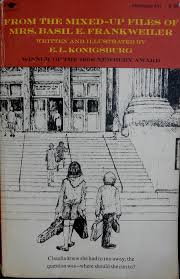
1. From the Mixed-Up Files of Mrs. Basil E. Frankweiler by E. L. Konigsburg

download (4)This was the best runaway book ever.  Claudia spends the first several chapters of the book preparing extensively for her escape from her boring suburban life – saving her tiny allowance, choosing a sibling to accompany her, selecting a destination.  Needless to say, I identified with this level of forethought; I was never one to just take off in anger.  I also loved the idea of living in a museum, having it all to myself at night, and investigating a mysterious statue.  And then, when Claudia and her brother meet Mrs. Basil E. Frankweiler?  I wanted to be her too, this little old lady living in a house full of her own personal collection of artifacts with a secretive filing system that makes sense only to her.  She was great!  But more than that, the characters seemed to understand the escapism I was seeking in the very books I read.  It wasn’t about anything specifically bad in everyday life.  It was about “coming home different,” as Claudia puts it, having something to assuage the ordinariness of home life.  It was about having a piece of adventure to hold onto while one quietly assumed one’s daily duties – precisely the reason I read.

2. Julie of the Wolves by Jean Craighead George

9780064400589_custom-0dc27ef1292bfe782c935e615a12b66a172f4107-s6-c30Like Claudia, Julie is realistic about her plans.  She wants a change of life, not just to make a scene.  Escaping a fairytale-esque step-family situation (in other words, not good), Julie ends up living on the Arctic tundra and befriending a pack of wolves.  She lives by the same rhythms of nature as the animals she follows, from lemmings to caribou to the wolves themselves.  Even though the book was full of detailed technical descriptions (e.g., Julie makes her own winter clothes out of caribou skin…after making her own needle and thread from other parts of the caribou), I pored over it as a kid.  I think I liked the idea of being self-sufficient, of filling my day with simple but useful things.  There wasn’t much dialogue, except between Julie and her imagined voices for the wolves, but it reassured me that I wasn’t the only one who imagined conversations in her head.

It was also one of my first books with a bittersweet ending; the wolves move on.  So does Julie, who goes to live with her father.  As much as I wished she could go with the wolves every time I reread the book, Julie’s sense of self was more important than a happy ending for the sake of happy endings.

3. My Side of the Mountain by Jean Craighead George…again.  Hmm.  Honestly never knew that.

JacketAnother self-sufficient, outdoorsy runaway book, I think I mainly loved this one because of the falcon.  I wasn’t planning to burn my home out of a hollow tree, or make snares, but falconry?  That’s just cool.  Minus the part about stealing a nestling.  However, in case I ever did decide to dash off to the forests of Washington (and goodness knows there are plenty to choose from), this book would have provided a wonderful manual.

This was another unsatisfying ending, at least for me.  Sam’s family shows up, agreeing that they could all “get away” from society.  But I wanted Sam to live happily ever after in his solitude.  It frustrated me that his family caught up with him, even if he was lonely.  I liked the idea of carving out a life (literally) alone somewhere.  It appealed to my introversion.  So I kept rereading it, despite the ending.

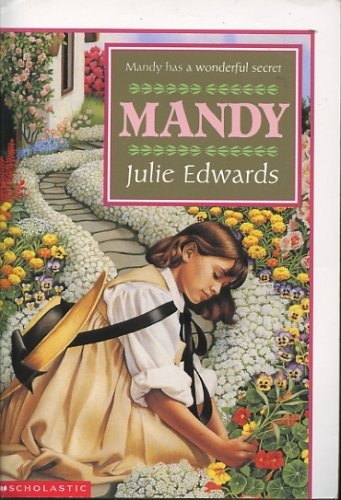
4. Mandy by Julie (Andrews) Edwards

mandyEven before I became familiar with the flawless Queen of Everything Julie Andrews, I loved this book.  I actually recommended this book to my kindergarten teacher’s daughter (she was in 4th grade at the time, so this made me very proud).  Although not exactly like the other runaways on this list, Mandy also has a secret escape from her everyday life.  Again, this appealed to my introverted side; I preferred my books, imagined experiences of my own or shared with Bird, to playdates or sports.  Mandy climbs over the orphanage wall (what young reader doesn’t love a good orphan story?) and discovers an abandoned cottage on the neighboring estate.  She begins fixing it up.  She figures out how to budget for supplies, schedules her visits when she knows no one will be looking, and works until her fingers blister.  Weirdly, I enjoyed the lists of her chores.  It was like vicarious cleaning pleasure, and as a kindergartener I wished I could find my own little house to fix up just right.  This may sound as though it goes against my feminist grain, but it was more about creating a world, a haven of one’s own (Mandy only wants something that’s hers, rather than something charity or the orphanage gives her) than just following some kind of societal norm.

Manuscript

the original text of an author’s work, handwritten or now usually typed,that is submitted to a publisher
writing, as distinguished from print
I attended my first writers’ conference a few weeks ago.  For the first time in my life, I was surrounded by people who talked and thought about writing and books and reading and storytelling as much as I do – and they didn’t look at me like I’d grown a second head when I described my writing process or gushed about the diction in my favorite novels.
Being surrounded by likeminded individuals, I’m learning, is very affirming.
While there, I had the opportunity to pitch my idea for a novel to editors and agents from publishers of all shapes and sizes all over the country.  It was a rather terrifying process, but I connected with an editor and an agent who both seemed genuinely interested in reading my story and asked to see it.  Suddenly, it all felt real – this idea that I would be a writer, that I was always writing anyway, was suddenly made more corporeal by the idea that someone (outside friends and family who kind of have to like whatever I do anyway) actually wants to read my story.
!!!!!!!!!!!!!!!!
So now I’m frantically working to get my story into presentable shape so I can send it off.  Except they don’t call it a story, like I’ve been calling all my bits and pieces and fragments all these years.  It’s a manuscript (or at least, it will be).
Originating from medieval Latin for “written by hand,” manuscript to me suggests a sheaf of slightly crinkled papers covered in looping cursive and a few artistically placed ink blots, gently puffing out dust motes from the garret in which their creator scribbled down her ideas in a feverish haze.  It seems the kind of thing Jo March brought to her publishers, tied up with a ribbon.  My typed, double-spaced, Times New Roman pages seem too clean, too modern to merit such a literary term.
And yet, the painstaking work that goes into uncovering the precise language a story demands, the hours spent getting to know the characters, the effort taken to give a scene just the right effect, the feeling of giving up part of myself when I let someone else act as a beta reader (usually Bird, who is supportive but not blindly so)…yes, this is writing of my own hand, transcribed from imagination by my rapidly tapping fingers on the keyboard.  It’s the original text of my own work.
Now I just have to find a garret to hole up in until I finish.

My Life in Books, Part 1: The Formative Favorites

I can divide up my life by books: epochs of reading indicated by the particular volume that served as my security blanket, my favorite refuge, for that period.  These are the formative few that found me at exactly the moment I needed them.

1. Angelfish by Laurence Yep

41LEKDC-oYL._SX343_BO1,204,203,200_The W-Z shelf in my elementary school library formed a corner with another, lower shelf that, when I settled criss-cross onto the nubbly carpet, made me feel safe – walled up in a castle.  The books at eye level when I situated myself this way included Angelfish, which I checked out so many times throughout the years at St. C’s that the librarian gave me that copy as a graduation present at the end of 8th grade.  She said it was clearly mine.  I called it my Belle book, after the scene in Disney’s Beauty and the Beast when the bookseller gives Belle her favorite book free of charge.  The reason I read it 17 times in a single year is that Angelfish is a love story about a girl and dance.  Robin, the narrator, loves ballet so much she declares she will always find some way to be a part of it, even if it means just sweeping the stage.  “That’s the way you love something when you’re young,” her teacher responds.  The plot involves Robin helping a victim of the Chinese Revolution rediscover his own art – originally dance as well, now painting – and reaffirm the value of having that joy in one’s life.  Having quit my own ballet lessons years before, I probably couldn’t have told you in 8th grade why I loved this book so much.  Now I think I needed it to give me an example of how to hold on to your passion despite the naysayers.

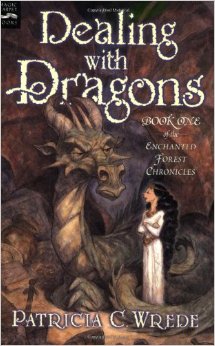
2. Dealing With Dragons by Patricia Wrede

51eC4uO6deL._SY344_BO1,204,203,200_This must have been one of my first feminist books.  The stubborn, witty heroine, Cimorene, gets bored being a princess, so she runs away to serve a dragon.  Although irritated by the conventions that bind her (dealing with all those princes trying to rescue her against her will, for instance), Cimorene also frequently uses her society’s stereotypes of silly princesses to her own advantage (e.g., getting an evil wizard to let slip a few details of his plan).  She finds a way of life that makes her happy and fulfilled even though few people originally understand her desires.  Beyond the quips and amusing dialogue that appealed to me as a sarcastic teenager, Dragons showed me that if you persist in chasing your dreams, you’ll find people who will listen to you.  The dragon she serves, for instance, believes Cimorene when everyone else wants to write her off as just another hysterical princess.  Plus there’s swordfighting.  Who doesn’t love swordfighting?

3. Girl Meets God by Lauren Winner

41unxgoV6iL._SY344_BO1,204,203,200_I gave up reading anything but religious books for Lent one year, and it led me to this memoir of a Jewish girl turned Episcopalian.  Nearly every page held a turn of phrase that made me think, “Yes, exactly,” or “I thought that was just me!”  In a section on Lent, the author’s priest asks her to give up reading for the liturgical season, and I nearly dropped the book in surprise.  I just saw so much of myself and my own questions and confusion about faith (and life in general) in this book, even though I was raised Catholic and intend to remain in the Church.  I love the honesty about the difficult parts of belief and the self-awareness the author demonstrates in her writing.  Once I finished the book, I immediately turned to the first page again, this time with a pencil to underline and annotate the parts that spoke to me the most.  Since then, I’ve read it nearly a dozen times, at least once a year, each time making new notes and looking back on my past self’s questions and scribbles about faith and life.

4. The Disreputable History of Frankie Landau-Banks by E. Lockhart

6a00d8345169e469e2016760e64a3f970bFrankie does not get the guy.  Her friends and family don’t accept her as she is.  But that’s not the point.  When I started high school, I could identify with Frankie’s sense of confinement within others’ perceptions of her.  Her family doesn’t deem her smart enough to use her cell phone when she gets lost or attend a prestigious boarding school without a nice boyfriend to “look after her.”  The boyfriend is not much better; although most of Frankie’s schemes are designed to earn his respect, she soon discovers that he preferred it when she was arm candy in need of his protection.  But she keeps going, realizing that she actually wants to prove something to herself more than to her boyfriend.  After that, others’ opinions don’t matter so much.  By the end, no one quite knows what to do with Frankie, except Frankie herself.  In my freshman year of high school, when I discovered this book, I had just been frozen out by the group of girls I used to rely on for approval.  I needed the self-discovery role model that Frankie provides.  And I needed the honesty of the last chapter: “She might go crazy…They do sometimes go crazy, these people, because the world is telling them not to want the things they want…another possibility – the possibility I hold out for – is that Frankie Landau-Banks will open the doors she is trying to get through.  And she will grow up to change the world.”

Book Hangover

This state of mind makes me think there must be something to the idea that there are imperceptible veils between worlds that prevent certain kinds of Creatures, Spirits, and Sundry from completely inhabiting one universe or another – veils that leave you drifting, not unpleasantly, just above the surface of your proper world, before allowing you to emerge completely from the novel you have just put down.

Good writing does that, good books – no, good stories – in particular.  The words sweep you off your conscious feet, twitch aside the veils, and deposit you firmly In The Story.  There’s a reason some fanfictions are labeled AU for Alternate Universe (I’m a child of the Internet/Tumblr.  Sorry.) – wherever your physical body may be, your essence, if the writer does their job, is far away and unreachable.

It may not seem like it.  Family members, roommates, concerned colleagues can all reach out and tap your shoulder, jolting you from The Story to ask you something, but sudden as the tug was, you’re not really back.  The Story is still hovering, hazing a more current reality.  You submerge yourself again as quickly as you can.

But oh.  When you finish the book.

When you finish the book you float for a while.  You drift.  Neither your own world nor the novel’s can quite pull you down to the ground again so you’re nudged this way and that by memories of both – on the one hand you have chores to do, but on the other you have a character death to deal with.  There’s a plot twist you still haven’t quite processed, and a meal to eat, but neither has any weight because you’re still somewhere between the veils, uncertain as to the anchor for your perceptions.

It takes a bit to come back down to earth.

The longest time I spent in that In Between Space was after devouring The Fault in Our Stars in one day, huddled in my lower bunk in my freshman dorm room, barely speaking to either of my roommates and only stopping for one meal.  The Engineer and I had only been dating for two months at that point, so he hadn’t yet experienced my Book Hangover State.  To his credit, he took my silent, somewhat somber expression in stride, only occasionally squeezing my hand for reassurance that I was okay.

I know how it looks to outsiders, to non-readers – I must be angry, or upset, or at least annoyed about something.  I must not be feeling social, or, when I tell them a book did this to me, it must have had a terrible, terrible, ending.  But that’s not the point.  The point is feeling my way back from The Story I’ve been immersed in for the past several hours, and reconciling it with my own reality.

Enjoy

to experience with joy; to take pleasure in

For someone whose brain rarely shuts up, I have a tough time with mindfulness.  The concept of being present, of taking in each thing as it comes instead of constantly planning and worrying, makes plenty of sense when I look at it objectively.  Executing the practice, on the other hand…

Sometimes it seems as though there’s too much space in my mind devoted to doubts, worries, rants, complaints, and failures.  My memories love to dredge up classic reruns of my most embarrassing moments, so much so that I’ll be squirming in my seat at the thought of something that happened years ago.  I may not be the best at this “adult” thing, but I feel like blurting out something awkward in 5th grade shouldn’t still bother me so much.  (Then again, if any of you have found a way to truly get over your middle school embarrassments, for the love of all that is good in this world, TELL ME YOUR WAYS.)

Some people call this “negative self-talk.”  These same people tell me of something called “self-compassion,” which is, again, a concept that sounds grand but is tricky to implement.  My thoughts have worn ruts of worry in my synapses.  I don’t have the time, it seems, to stop and breathe.

That’s why I’ve been thinking about the word “enjoy” lately.  It caught me while I was rereading Madeleine L’Engle’s excellent memoir A Circle of Quiet, where she spends several early chapters discussing the concept of joy.  She talks about existing, about resting, in that joy she feels in a simple moment – and she talks, too, about how rare it is for her to quiet herself enough to do that.  It comforts me that I am not the only one who has difficulty simply being.

The word “enjoy” originally came from Middle English for “to make joyful,” or Old French for “to give joy to.”  Joy, it seems to me, is a much more serious business than mere contentment or happiness.  “Happy” has something of a giddiness to it.  “Joy” has weight.  It leaves an imprint.  But that mark, that gentle, comforting weight like a hand on our shoulder, only comes when we let ourselves “enjoy,” when we let ourselves exist in the moment.  In joy.

So I’ve been trying to pay attention to the joyful moments, to the little things that allow me to exist “in joy” for a second or two, and to rest, rather than squirm, in the unusual quiet of my brain.

I started off easy – it’s all too natural for me to enjoy the first sip of coffee in the morning, or a well-written sentence that makes me close the book and stare off into space for a moment to absorb the craft of the words, or a monarch butterfly flashing across my path, or a fuzzy puppy rolling over and begging to be petted.

But it’s other things too.  It’s realizing that it doesn’t bother me to eat lunch alone in a strange town because I know I’m here for an internship that provides me with work I truly love doing.  It’s one-word texts from the Engineer.  It’s establishing witty rapport almost immediately with my new coworkers.  And it’s stepping outside the trailer in the evening and letting comfort seep down from a starry dome, even though it’s cold, even though I should go to sleep, because it feels good just to be – just to exist in joy.

Now I’m curious – what do you enjoy?

Stuff To Do This Summer

Pray.

Bible study with Bird.

Study for the GRE.

Enjoy and learn from my new internship.

Do DuoLingo or something to keep up my extremely rusty Spanish.

Maybe learn some basic Italian while I’m at it.

Keep up an exercise routine.

Keep up this blog.

Work on some of my own stories.

Get back in touch with old friends.

Go to a friend’s wedding.

Start research for my thesis.

Speaking of which, should probably get that proposal revised and turned in.

Visit the Engineer.

Visit the Southern Belle.

Learn my way around my new town, including finding a bookshop and coffee place to frequent in my down time.

Start journaling again.

Put on sunscreen.

Drink a lot of coffee.

Be happy.