Review: The Girl Who Saved the King of Sweden

*Note: This is a review of a book I have already finished and therefore contains spoilers.  Proceed with appropriate caution.

When I was younger, I went through a phase where my storytelling strategy largely consisted of taking a set of ridiculous characters, throwing them together in an absurd situation, and seeing what happened.  (This may have been triggered by my first reading of Douglas Adams’s The Hitchhiker’s Guide to the Galaxy, in which I mostly focused on the Improbability Drive and the falling whale it generated.  Also the depressed robot.) Since this was middle school, the dialogue was primarily one-liners and bad puns, and most of these plots ran out of steam after a few pages.  I was a novice writer who hadn’t yet discovered the process or genres that worked for me, so these bits and pieces of stories just sort of haunt my Documents folder and provide occasional hilarity when I rediscover them.  (My personal favorite is ambitiously entitled, “The Story of a Forwarded Letter, a Post Office Worker, and a Mailbox.”  The mailbox decides to break as many laws of physics as it can.  It’s a gem.)

Though my own attempts at this sort of thing have (mercifully) fallen by the wayside, I still have a special place in my heart for books that truly test the limits of fiction with style and absurdity, like the masterful Hitchhiker’s Guide.  In this vein, Jonas Jonasson’s The Girl Who Saved the King of Sweden is one of the most recent additions to my library, and a phenomenal read.  It’s not quite magical realism or fantasy, because it doesn’t contain anything that couldn’t physically happen in our world, but definitely includes plot points that set it apart from mere contemporary fiction (I mean, how many other books about South Africa’s nuclear arms development include the king of Sweden being kidnapped in the back of a potato truck with a bomb and a twin, neither of which officially exist?).  But I could believe every word of it, because it was the sort of book where I wanted the delightful characters (and even the irritating ones) to be real.

The eponymous girl, Nombeko, is definitely going on my list of Heroines I Want To Be When I Grow Up.  She reads everything she can get her hands on and actively seeks out knowledge about anything and everything.  This intelligence serves her well, whether it’s letting a bumbling engineer think he’s running things or negotiating a nuclear arms exchange with two agents who want to kill her.  In confrontations, she behaves exactly as I always pretended I would: shrugs and pours the bad guy some tea, thoroughly discomfiting him.  Nombeko is also snarky, compassionate, and hardworking.  She’s not perfect, of course, but her distrust of happiness is not only understandable, it made me relate to her more.  She is unwilling to make plans for the future, no matter how much she and her companions want them, until their current problem (the itty bitty matter of the bomb in the potato truck) is solved; Nombeko does not skip ahead.

Though I obviously took its representation of historical events with a grain of salt, I also enjoyed the way the book expanded my cultural horizons.  Nombeko is born in a slum in South Africa, a country I know almost nothing about.  Her adventures bring her (and the reader) into contact with such people as the prime minister, an ambassador from China, and engineers in charge of building nuclear bombs for South Africa.  The book spans some thirty years, touching on events I’ve heard of but never really learned about, and describing international relationships I had never considered before.  Recently I’ve realized how Eurocentric my reading tends to be (especially given my penchant for old English novels and the depths of academic English literature), which has left me with a disproportionate understanding of world cultures, so fiction like this might be a good way to start learning more.

I gasped, laughed, and mumbled, “Nonononono” – causing the Engineer a little concern.  An excellent book, from style to character development to plot.

5/5 stars on Goodreads


Have you read this?  Share your thoughts!  Or go read it and tell me what you think!
Binge-Reading

Ever since my graduation a week and a half ago, I’ve been staying up way too late.  Not partying.  Not playing videogames.  Not even as a mild form of continued celebration that I no longer have to get up for class in the mornings.

No, I’ve been staying up late to read.

I’m reading old-fashioned books filled with madcap hi-jinks, nonfiction books about introversion and vulnerability, contemporary fiction that makes me think, fluff that requires no thinking at all, and old favorites that I’ve already read a few dozen times.

It seems that my brain, overexcited by the realization that I am allowing it to read whatever it pleases, instead of using up all its energy on schoolwork, is getting carried away.  Even if a book isn’t really that exciting, I can’t put it down until the words are swimming before my eyes.

I don’t really mind this.  During the school year, I felt as though the “reader” part of my identity was only active when I sped through novels assigned in class.  I missed being the sort of person who had a book in her purse, and another one waiting at home, and a third one for reading at bedtime.

I won’t be able to read a book a day forever.  But for now I am a happy little bookworm.

Gonfalonier

When Saturday dawned, though I’d slept poorly from nerves, I was honestly more anxious and emotional about my friends’ graduations than my own.  I was proud of them, and excited for them, and a little bit sad, but my own arrival at this academic pinnacle didn’t quite seem real.  I got up early to see the Southern Belle and the Commodore (who carried the gonfalon!) at the 8 a.m. ceremony.  I teared up several times, and I clapped and cheered wildly when my two best friends walked across the stage to receive their diploma covers, and I took many blurry, zoomed-in pictures from my faraway seat because I was determined to capture the moment.

I met up with the Engineer and his family, who were in town for his brother’s graduation (having earned a master’s degree) at the next ceremony.  I walked back to my apartment in the sun, meeting soon-to-be graduates in their regalia going the other way, and I still couldn’t quite think, “Me too.  I’m graduating.”

For most of the day, Bird and I read quietly at my apartment, with brief flurries of activity when the Commodore’s and my own family descended for visits and hellos between events.  Rather than wrapping my head around my own reality, I escaped into the adventures of The Girl Who Saved the King of Sweden (highly recommended, by the way).

Then it was time to start getting ready.  Rented gown, a stolen stole (borrowed from the Commodore, signifying that I had studied abroad; I didn’t get my own because I never bothered to get my Fancy Summer Institute in Nottingham credits transferred to my own university), honors cords for my major, honors cords for a national honors society, a medallion from the Honors college, and the rented yoke.  Cap pinned in place (I had finally decided on a C.S. Lewis quote the day before – appropriately, the Commodore’s hat featured a J.R.R. Tolkien quote…in Elvish).  Tassel draped to the right.

Dad drove us to the coliseum and dropped us off, where I headed in through the behind-the-scenes passageway because I was carrying the Honors gonfalon.  What exactly is a gonfalon, you may ask?  Basically, it’s a banner.  A flag.  The standard behind which I will amass my armies as we ride forth into battle.  By virtue of my carrying this 10-foot-tall piece of fabric on a stick, my family was seated in the VIP section.  Bird, Mom, and my cousin all took pictures when they spotted me standing in the back.  I looked around the coliseum, all decked out in university colors, and took pictures with the deans in their regalia as my co-gonfalonier and I stood next to our banners.

When the band played “Pomp and Circumstance,” the Engineer caught my eye and made a swimming turtle with his hands.  “My turtle swims sideways, your turtle swims upside down…” were the lyrics he and his brothers sang to the graduation march.  Naturally it was stuck in my head all day.

Once all the other graduates had filed in, we hoisted the gonfalons overhead and strode down the center aisle.  I had expected, seeing as it was the whole College of Arts and Sciences graduating, that I would barely know anyone in the graduating class.  Instead, my friends and coworkers shouted out to me as I walked by with the gonfalon.  They made me smile, a realer smile than the one I had directed at the cameras lining the aisle.

The ceremony proceeded apace, with speakers and applause and occasional technical difficulties.  We gonfaloniers stood to be recognized and tried not to smile too awkwardly while the cameras stayed on us.  Eventually, an usher pulled us out of the front row to join our respective groups, and I squeezed in between two of my friends from English.

Had my picture taken with the prop diploma cover.  Handed my name card to the announcer.  Smiled into the camera as he said my (thankfully phonetically simple) name.  Walked forward.  Shook with my right hand, took the diploma cover with the left.  Walked across to the center.  Shook hands with the university president, who wished me luck.  Slipped out of the receiving line to return to my front row seat.  Smiled and posed for the Commodore, who had gotten a great seat and was snapping pictures.

When I got back to my seat, I held the diploma cover in my lap.  Never mind that it was empty, that I will get the real thing in the mail a few weeks from now.  All of a sudden it hit me.  College was over.  I did the Thing, the Accomplishment toward which roughly three quarters of my life had been aimed.  It was finished.  All done.DSC_6072

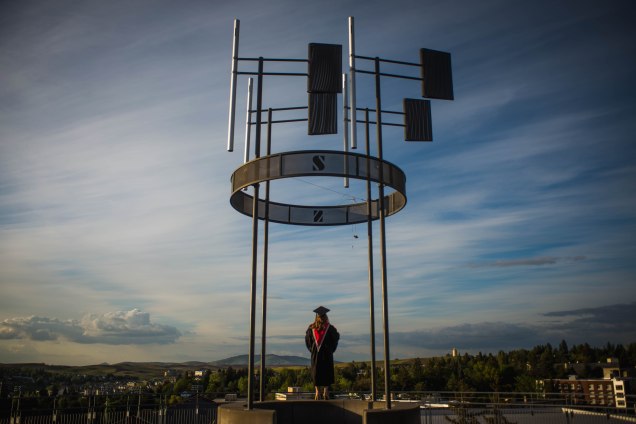
When I took this picture, I stepped up onto a cement barrier (in heels, no less).  Looking out over the campus, I had no visual cues to reassure me.  It seemed as though I were at the immediate edge of a cliff, even though the drop to the flowerbed below was no more than a foot and a half.  Logically, I knew I was safe.  Irrationally, I felt like I was about to fall.

But for a moment, buried in the jolt of fear, it was exhilarating.

This feeling returned as I looked down at the crimson rectangle in my hands.  But I couldn’t cry, not really, not in the front row, not as several hundred others made their way across the stage.  So I smiled, blinked away the welling emotions, and looked around for the friends I knew would be coming up in line.

Stood back up.  Moved the tassel.  Cheered as the confetti rained down.  Slipped a few pieces into the diploma cover, hoping my bittersweet tears wouldn’t dissolve it later.

IMG_20160507_191312

Mortarboards and “Mischief Managed”

I’m having the hardest time deciding what quote to put on my graduation cap.  It’s the only part of the regalia I get to keep, the tassel and the mortarboard, so I figured why not personalize it a little?  The Commodore has a LOTR quote (in Elvish because she is awesome) and the White Tree of Gondor, and the Southern Belle decorated hers in a nod to her future grad school.  I’ve seen Disney themes, puns on student debt, gaming metaphors, etc.

I looked up C.S. Lewis quotes and found “There are far better things ahead than any we leave behind.”  But that kind of sounds like college sucked and I’m happy to be leaving, and that’s not my attitude.

Then there’s an Augustus Waters quote from John Green’s The Fault in Our Stars: “You are going to live a good and long life filled with great and terrible moments that you cannot even imagine yet!”  But that’s kind of long.

Or there’s Disney, something from Beauty and the Beast, but “I want adventure in the great wide somewhere” doesn’t quite seem to fit when I’m staying in my college town for the immediate future.

I considered a lyric from Hamilton, something like “I am indomitable, I am an original” or “Write day and night like you need it to survive.”  Those are still kind of obscure, though, as popular as the musical is.

Maybe a Bible verse?  “God is within her; she will not fail”?  Something literary, from Harry Potter or Arabian Nights?

I have so many options my friends have joked that I should just put a notebook on my cap that includes all the quotes, with the tassel for a bookmark.  I feel like I’ll know the right quote when I hear/read it – but I only have 8 more days to find it!

“They John Boy-ed Him!”

Because my mom enjoyed The Waltons, Bird and I occasionally ended up watching her DVDs of the eponymous family and their neighbors on Walton’s Mountain.  Usually it was just the early years, the ones before Ma got sent to a sanitarium for tuberculosis (because the actress quit) and Mary Ellen got married.  The later episodes just weren’t as good, according to Mom, for multiple reasons.  But one day we found The Waltons on TV and decided to watch it.  Other than the actors all looking a bit older and dealing with somewhat more dramatic issues, it seemed pretty normal.  There was a stranger living with the Waltons now, but we figured he was a cousin or something.

Except everyone kept calling him John Boy.  The narrator.

“That’s not John Boy!” we exclaimed.  Mom laughed.  Apparently the role had been recast between seasons at some point.

We couldn’t believe it.  They were just asking us to believe that this was John Boy, the aspiring writer through whose eyes we saw everything on Walton’s Mountain?  It was clearly a completely different person.

“Yeah,” said Mom, “one season he went off to fight in the War and when he came back, it was this guy!”

“Wow,” said Bird.  “War really changed him.”

Once we recovered from our laughter and agreed never to watch those later seasons again, this experience gave rise to a new phrase in our household. “John Boy” became a verb, meaning “to recast a character without warning or transition and simply ask the audience to go along with it.”

I was home on a break from school one day when Mom and Bird wanted to catch up on the season finale of a show we were currently watching.  Bird, who was texting a friend who had already seen the episode, suddenly burst out laughing at her phone.

“They replaced the brother!” she gasped.  “Oh my gosh, they John Boy-ed him!”

Sure enough, toward the end of the episode, the family entered their home to find a strange boy leaning against the kitchen table.  Gasping, they all embraced him, addressing him by the brother character’s name.  Apparently he had been at boarding school (because the old actor was in rehab or something).

“Well,” Bird deadpanned, “John Boy’s home from the War.”

Shell Shock

When my professor called on me, I couldn’t contain an inarticulate growl before proceeding with my response to his question.

“Wow,” he said.  “The rage is strong with you today.”

It was indeed.  We were discussing the two doctors who “treat” Septimus Warren Smith in Virginia Woolf’s Mrs. Dalloway, and which of the two was worse/more destructive in his treatment of PTSD.  If you never read Mrs. Dalloway, Septimus is a character suffering from “shell shock” – hearing voices, seeing his dead friends, believing himself the recipient of a grand message from the universe, and feeling suicidal in the aftermath of serving in WWI.  The first doctor, Holmes, literally pushes Septimus’s wife, and therefore her worries for her husband, aside in order to lecture Septimus about how there is nothing at all the matter with him and how he should just get a hobby and go outside more.  The second, Sir William, agrees that Septimus is ill, but his focus is on normalization – that is, getting Septimus back to being a Contributing Member of Society, Back to Normal, and if he can’t do that, then letting him stay in an asylum rather than burden society any longer.

Grr.

These two delightful characters undoubtedly spring from Woolf’s own experiences with medical professionals while struggling with manic depression.  And even though Mrs. Dalloway was published in 1925, these doctors are still representative of social reactions to mental illness.

Setting my rage aside for moment (difficult as that is), I can understand the outside perspective.  It’s difficult to “believe in” an affliction we can’t see.  It’s not like a broken leg or a bleeding wound – there’s nothing visibly wrong, so a tiny doubt wriggles its way in.  He seemed fine two weeks agoIs she really that sick if she’s still getting all her work done?  He’s always been so reasonable – is he really thinking of suicide?  We base our assumptions on what we’ve seen and known of people up to this point, and sometimes it’s difficult to overcome that desire for them to “prove” that they’re “really sick.”  Similarly, I can see why, once we realize that something really is wrong, we want our friend/family member/classmate to Get Well Soon.  We want them Back to Normal, because isn’t that what they’re supposed to want too?  Our society often views healing as a process with an end point, a time in the future when the sick person will have Gotten Over It, whether It is a cold or the flu or the death of a loved one.  Of course, we are not completely callous.  We know that some things take longer to heal from than others.  But we’re still envisioning an end point rather than the possibility of “living with” the thing.  “Living with” seems to suggest an uneasy compromise, which we don’t like, because there’s the underlying possibility of another upset where the Bad Thing takes over, and of course we don’t want to see this person go through that again.

So I can understand these viewpoints.

But people who hold these views usually cannot understand me.

Both Holmes and Sir William fail to recognize and validate the reality of mental illness.  Yes, it’s difficult to “see” sometimes, but that doesn’t mean the person is making it up.  Visibility does not equal proof.  And, while there are sadly a few individuals who do make things up to get attention, why should that be our default assumption?

As for the push to Get Better Soon, while it usually comes from a place of genuine care and concern, it forces the sufferer to “take responsibility” for their illness – a problem that is actually beyond their control.  It may make the person feel as though the longer they take to get Back to Normal, the more irritated or fed up their support system will get.  Believing that the people around you think you should be over something makes you question yourself and begin devaluing the reality of your experience.  Also, prioritizing Back to Normal-ness denies a major fact of mental illness: it doesn’t always go away.  Balance can be achieved.  Strategies can be developed.  But when there is something chemically awry in a person’s brain, it can’t always magically be fixed.  So in that case, “living with” it instead of being crushed by it is actually a victory.

We have progressed significantly since the days of Septimus Warren Smith and his two horrible, horrible doctors.  But there is still room for improvement and understanding.


Still Alive, Just FYI

Sorry about the radio silence lately, but my undergraduate thesis is due tomorrow so I’ve spent the past few weeks alternately crying, tearing my hair out, complaining a lot  to the Engineer (he is a saint and a far better human being than I deserve in my stress spirals), and occasionally hitting a great writing streak and slamming out a dozen pages at once.  At the moment, I’m trying to write my precis (basically an abstract, but I can’t use any “jargon,” which I didn’t realize was a thing that happened when you’re just talking about storytelling, but apparently it is) and then format my final draft.

And then I turn it in.

Eek.

So anyway, once that’s turned in and I give my presentation in 2 weeks, I’ll have more brain space to write blog posts, so there will be a regular(ish) schedule again after that.

Pinky swear.

A New Year’s Post

I’m trying something new this year.  Well, multiple new things, really.  In looking at my schedule, taking on all 27 or so of my proposed resolutions at once just isn’t going to happen.  For one thing, I have zero free time until the end of February, when I present my undergraduate thesis (further freakouts regarding the state of this ginormous project will be forthcoming, I’m sure).  For another, trying to implement a billion new pieces of a routine simultaneously just doesn’t work.  I’ve tried it.  It’s like carrying an armful of cats.  You want to hold onto all of them, but one or two are bound to wriggle out and go scampering off somewhere.  And you end up with a lot of claw marks from the ones that are left.

So my theory is that gradually adding clusters of new habits every two weeks or so might be easier to manage, particularly since my schedule is already going to drastically change about halfway through the semester.  My loose idea for this organizational tactic is as follows:

Immediate

The daily changes I want to make right away – drink a full water bottle daily; get outside once a day; journal every evening; read for pleasure; write literally anything, even just a sentence, for my own personal manuscript

New Semester

The stuff that will be easier to start when I get back to school and therefore has been pushed back until then – cut out mindless snacking; don’t skip Zumba classes; set up a real workspace instead of just sitting on the couch with Netflix on in the background; do homework the day it is assigned; incorporate daily Bible readings into my new semester routine; block out specific times to work on my thesis; don’t forget about meals

Post-Thesis Haze

The bigger picture things that will undoubtedly nag at the back of my mind but that I physically cannot spend time on until my thesis is done – start applying for post-grad jobs; devote an hour minimum each day to my own manuscript; get certified as a Zumba instructor; seek out freelance editorial and authorial work, even unpaid internships; focus on online professional development

Post-Grad

Honestly, I haven’t really dared to think this far ahead.  But if I’m still not skipping Zumba and I’m eating healthy and staying hydrated and working on my manuscript and feel like I’ve got my job situation sort of under control for the moment, then I’ll probably focus on my general theme for the year: be present.

I’ve fallen down many a stress spiral before, particularly this past semester, and these are frequently brought on by focusing too hard on the future.  I will never be completely happy-go-lucky or loosey-goosey with my schedule (I love my planner too much!) nor do I think that thinking about and planning for the future is a bad thing.  But when it makes me forget about how happy I am in the moment with the Engineer or how much I’m enjoying this particular sentence in my book or how great this writing session is going, it does become a problem.

And, as stressful as it may be at times, I really am looking forward to the year ahead, so I want to hold onto that and appreciate where I am in the life I’m building for myself.

Winter Break

Well, I survived my penultimate undergraduate finals week.  And now I sit in our living room across from the Christmas tree, surrounded by festive Yuletide decorations and books (seriously – we have four bursting plastic totes of Christmas books alone) and it still doesn’t feel like The Most Wonderful Time of The Year.

I’m still in that dazed letdown phase that follows a period of intense stress.  Relieved as I may be to have finished up my classes, going-going-going for two and a half weeks straight leaves me a little bewildered when I get home and there’s not as much to do.  I sit here casting around for the assignment or project I’m certain I forgot about, too used to having Something To Do hanging over my head.  The Engineer once “assigned” me coloring pages to do over the summer so I wouldn’t stress out about not having anything to stress out about.

This year, of course, I do have something to do – my thesis project.  Which is due at the end of February.  Which I’m trying not to freak out about just yet.  After all, the vacation is young.  And I do love my topic (the Arabian Nights), so the reading will probably go faster than I think it will.

But stress is not exactly conducive to the magic of Christmas.

So I suppose it couldn’t hurt to give myself a few days to breathe – and watch my favorite Christmas movies from childhood.

Decision

the act of or need for making up one’s mind
something that is decided; resolution
the quality of being decided; firmness
I make lists.  I run a pencil down the edge of a ruler and divide my cardstock into two columns, one Pro, one Con.  I begin jotting, neatly at first, then scribbling as it becomes a stream of consciousness, leaping from one side to the other like a Highland sword dance.
I ask advice.  I gather opinions like berries, examining each one for ripeness, letting them dye my fingers and adding my stained fingerprints to the already constructed lists.
I consider myself, my own head and heart.  I still have trouble with this one – for a long time, emotions had very little to do with my major choices, unless it was to tip a balanced scale at the last minute.  Choosing a high school came down to academic reputation.  Picking my college came down to finances.  Making a decision based on feelings didn’t seem “smart,” and I was all about making the “smart” choice.
Which is probably why I was so stuck.  Why I couldn’t articulate to my friends, my family, even to myself what I wanted.  Why my heart still beats a little faster when I say it out loud, much less type it out.
I’ve decided to stay in my college town for the next year after graduation.  I can keep my apartment and my job, both of which I love.  I can be near the Engineer while he finishes up his last year of undergrad (switching majors sophomore year throws things a little out of whack).  And I can work on my own writing so the next time I pitch a manuscript to someone and they want to read it, I’ll actually have something to send them.
And I’m pretty excited about all that.