First Day of School!

This might be my last first day of school.

Well, sort of.  I realize that I’ve got another semester after this, and technically those will be all new classes, but I only get the true Back To School Sensation when, as Fitzgerald says, “life starts all over again when it gets crisp in the fall.”  It doesn’t matter if school starts in August or October – on the first day of school, I view everything through a frame of rustling, reddish leaves.  Back To School smells like the spice of crunching foliage underfoot, like the fresh wax of a new box of crayons, like the curlicue wood shavings emptied from a pencil sharpener.  And Back To School has all the potential of a freshly sharpened pencil, smoothing perfectly from school-bus-yellow barrel to graphite spear point.

Never mind that I haven’t actually used crayons for school since 5th grade, or that it’s August and smells more like a campfire than spicy leaves outside (thank you, wildfires).  No matter what year it is, Back To School is a comforting blend of fresh start and familiarity.  Everything is new and clean and open, but I also know already that I’m good at it.

Some of the comfort has departed from this particular First Day of School in that it is no longer one in a reassuringly lengthy series.  For the first time in my life, I don’t know what I’m going to be doing next year.  Even during other transition years in my academic career, I knew, in broad terms, my plan.  High school, whether B or C (I picked B).  College, whether B, P, or W (I went with W).  Essentially, the plan was always More School.

That’s an option here, too.  I could go to grad school.  I took the GRE in the hopes of keeping that avenue open.  I could choose to stay at my undergrad university or go somewhere else.  I rather like the sound of an advanced degree.

But it’s not a given, like all the other times have been.  The decision is no longer a formality.  And depending on which choice I make, this could be my last first day until my own child dashes off into a kindergarten classroom, backpack full of crayons and safety scissors.

So forgive me, fellow college seniors who are too cool for school, if I ruin our collective jaded image by joining Nemo in excitedly chanting “First day of school!  First day of school!  First day of school!”58303176

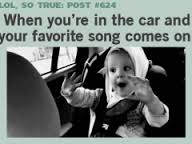
Sister Car Dancing Level: Pro

19a4839788909bdabb46838c9630e130One of my favorite things to do in traffic is defuse the tension by being that weirdo jamming out in her car, and I blame my sister for that.

My family has always been vehicularly musical; our road trips to visit relatives always involved rotating through tried and true soundtracks.  I knew the words to CamelotGodspellYou’re a Good Man Charlie Brown, etc. before I started first grade.  We still bust out Hairspray and The Best of Andrew Lloyd Webber.  So I sang in the car a lot growing up.

But car dancing didn’t really start until I taught Bird the moves to a dance associated with a particular retreat at my high school.  Although The Dance is and always will be connected to that retreat, the more I chauffeured my sister around, the more it became our thing.  If either of us was having a bad day, we’d put on The Song.  If we were bored driving home, we’d put on The Song.

Now, initially we only tended to do this while moving, so we felt like no one could see us (side note: I always toned down the moves enough to maintain full control of the vehicle at all times).  But one day, when the other drivers at a lengthy stoplight looked particularly irritable, Bird turned to me and said with that little-sister grin, “These people need Jesus.”  Before I realized what she meant, she had cranked up The Song to full volume and rolled down her window.  We were attracting glances from our neighboring cars, but the moves hadn’t started yet.  They thought we were just another couple of teenagers with really loud music.

I sighed and rolled down my window too.

When the lyrics began, we bounced in rhythm to the song and performed the moves in perfect synchronization.  The drivers across the intersection started to stare.  By the time the chorus came around, pretty much everyone was watching us.  The light turned green, and we drove on, still dancing and singing, but I definitely noticed some smiles.  Maybe they just thought we were ridiculous.  We probably looked ridiculous.

But who doesn’t love telling stories about ridiculous stuff?

Our car dance performances are not necessarily restricted to The Song or religious music.  We make up moves to Ariana Grande and Hunter Hayes.  The point is that it’s fun to get weird looks from total strangers and to make their day a bit more interesting.  (We also love to do this when we’re stopped by construction workers.)

car dance gif

And yet, for all our unbridled enthusiasm for car dancing, there has been only one spectator who dared to, as they say, get on our level.

Remember how Bird and I volunteered at VBS?  Well, one year we were given our own class to teach, a group of rambunctious 2nd and 3rd graders.  Like every other class group, our students had to learn a song.  At the concert at the end of the week, each class would perform their song, with the corresponding dance moves, for an audience of parents.

And as the teachers prompting them at the foot of the stage, Bird and I had to learn the moves too.

We were in the car on the way to St. C’s, practicing the moves and lyrics, music at full blast, when we stopped at a red light.  Since the choreography was designed for little kids, the chorus was mostly just waving your arms back and forth.  So that’s what we were doing – when we noticed the guy behind us staring.  And so was the lady next to us.

We bounced all the harder in our seats (restrained by our seatbelts, of course – safety first!) and exaggerated the ridiculous dance moves even more for our audience.  We figured we might as well.

And then, just as the light was about to turn, I glanced in the rearview mirror to see the guy behind us grinning and waving his arms back and forth in time with ours.

Well danced, sir.  Well danced.

Things I Used to Imagine at Night

On the nights I couldn’t seem to fall asleep, I used to employ my favorite “Imaginings.”

I used to pretend that the walls to my bedroom expanded out and out and out into a vast dormitory with rows and rows of old fashioned hospital beds, the kind with metal bars and headboards like the backs of folding chairs.  In this dormitory lived a hundred other girls, all the cliques one would expect from high school, and we were in the charge of at least one surly matron and occasionally her kinder, younger helper.  I would whisper to the other girls in the beds surrounding me until we had to hush because the matron was walking by.  The circumstances surrounding the dormitory changed.  Sometimes it was a camp for training us to be servants to the upper classes.  Sometimes it was an orphanage.  (It really depended what books I’d been reading lately.)  But that didn’t matter so much, because I only played this game at night, so I only imagined the dormitory itself.

I used to pretend that the ground below my bedroom window dropped away to a moat far below my tower, because I was a queen tucked up in her castle.  Except I was no orthodox queen – I had privateers with whom I could only meet at night for fear of tipping my hand to the sleazy ambassadors at my court.  I imagined a trusted maidservant showing the fierce pirates up to my sitting room, where we pored over battle plans until the wee hours of the night.  Sometimes I even held audiences with thieves from all over the provinces, gleaning evidence of treason by sending them to steal from my nobles.

I used to pretend that mine was the nicest room the boardinghouse had to offer, a respite from my long, secretive journey.  But I couldn’t rest just yet.  I had to listen for suspicious murmurs from the hostess downstairs, who looked at me sidelong when I paid for the room (a girl traveling alone?) and who might this very moment be disclosing my whereabouts to my pursuers – for a pretty penny, of course.

I used to pretend I was a favored servant in the palace of a sultan (particularly after I discovered the Arabian Nights), keeping tabs on court intrigue from my strategically placed room at the center of the harem.  My true loyalties shifted from night to night – sometimes I would pass on information to the sultan, and sometimes I would bide my time.

On the nights I couldn’t seem to fall asleep, I used to pretend a lot of things.  And even though I always woke up as myself again, I think the Imaginings – especially the ones I revisited over and over and over – left their mark.

Teaching Moments with Skits and Donuts

Summer always meant Vacation Bible School when I was growing up.  My mother complains says that she can still remember all six or seven verses of “the Moses Song” from my first year in VBS (“Mooooooses, floating in a basket, drifting down the river Nile.  Whoooooooo will, who will save him?  God will save this lit-tull child!”  There were hand motions and a lot of six-year-olds screaming the words.  I’m sure it was memorable indeed).  I loved this five-day opportunity to make summer as much like school as possible.  My mom probably loved the opportunity to have someone else entertain Bird and I while she ran errands.

You could only attend VBS as a student through 5th grade, so then, naturally, because I hadn’t had enough of the mind-numbingly repetitive songs and the cutesy themes (OK, I actually love the decorations in the Social Hall every year), I decided to be a volunteer for several years – until I graduated high school, actually.

One year, the Social Hall was set up to look like a Roman marketplace.  I forget the theme, but it was something about the book of Acts and the apostles trying to avoid persecution in the early Church.  There was even a cave (made of gray butcher paper and stacks of chairs) set up in the hallway for students to duck into whenever the “guards” walked by.  I worked in the abacus stall, helping kids string beads in cardboard frames (which usually took so long we didn’t have time to show them how it worked…which was fortunate, since we didn’t actually know).

I was also in a skit.

Every morning, volunteers would act out a short scene teaching one of the values related to that day’s Bible story.  I was supposed to be the kindly baker who buys a thief’s freedom from the surly guard, even though he steals bread right off my tray.  It was supposed to demonstrate forgiveness or something.

However, there were several problems with this plan.

  1. This skit took place at snack time, with a tray of actual pieces of bread/donuts to entice the kids, instead of during the morning assembly when they were all sitting quietly already. Obviously, the kids found the food more interesting than the stilted dialogue.
  2. The boy chosen to play the thief and the boy chosen to play the guard were brothers.  Identical twins, actually.  Who spoke very fast.  And got a little too into the whole “arrest” part of the skit.  Which led to…
  3. …an adult volunteer mistaking the spectacle for a real fight, coming over, physically separating the brothers, interrupting the skit to lecture them on acting their age in front of the kids.  At which point I noticed the students turning toward us with wide eyes.  Oh, sure, now they paid attention.
  4. None of us knew how seriously to take this, so we weren’t sure at what point we were supposed to break character.  I tried to explain to the adult that we were acting, but he didn’t seem to get it.
  5. The second time we performed the skit (there were 2 snack time shifts), no one had reset the gold I was supposed to use to pay off the guard, so I had to run around to the stalls looking for the plastic “gold” coins the kids used to gain entrance to their activities.  So essentially it looked like I was stealing in order to save a thief.  Oy.
  6. We were supposed to use a microphone so the kids could hear us, but passing the mic from person to person doesn’t make for a particularly realistic argument, nor does it make a lot of sense for a baker handing out trays of donuts to be holding a microphone in the other hand.

Hopefully our failure of a skit did not make or break anyone’s VBS experience.  But the important thing is, the kids learned their theme songs by the end-of-week show.

23cf52a34572d8b5011596abf9bea45a

My Life in Books, Part 2: Rereading Runaways

Elementary school was a time of reading and rereading for me as I discovered the escapism of my favorite books.  Several of my favorites tended toward children cleverly making their own way in the world – with a lot of detailed lists of the chores and tasks involved in their survivalist adventures.

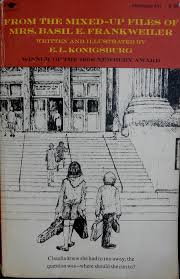
1. From the Mixed-Up Files of Mrs. Basil E. Frankweiler by E. L. Konigsburg

download (4)This was the best runaway book ever.  Claudia spends the first several chapters of the book preparing extensively for her escape from her boring suburban life – saving her tiny allowance, choosing a sibling to accompany her, selecting a destination.  Needless to say, I identified with this level of forethought; I was never one to just take off in anger.  I also loved the idea of living in a museum, having it all to myself at night, and investigating a mysterious statue.  And then, when Claudia and her brother meet Mrs. Basil E. Frankweiler?  I wanted to be her too, this little old lady living in a house full of her own personal collection of artifacts with a secretive filing system that makes sense only to her.  She was great!  But more than that, the characters seemed to understand the escapism I was seeking in the very books I read.  It wasn’t about anything specifically bad in everyday life.  It was about “coming home different,” as Claudia puts it, having something to assuage the ordinariness of home life.  It was about having a piece of adventure to hold onto while one quietly assumed one’s daily duties – precisely the reason I read.

2. Julie of the Wolves by Jean Craighead George

9780064400589_custom-0dc27ef1292bfe782c935e615a12b66a172f4107-s6-c30Like Claudia, Julie is realistic about her plans.  She wants a change of life, not just to make a scene.  Escaping a fairytale-esque step-family situation (in other words, not good), Julie ends up living on the Arctic tundra and befriending a pack of wolves.  She lives by the same rhythms of nature as the animals she follows, from lemmings to caribou to the wolves themselves.  Even though the book was full of detailed technical descriptions (e.g., Julie makes her own winter clothes out of caribou skin…after making her own needle and thread from other parts of the caribou), I pored over it as a kid.  I think I liked the idea of being self-sufficient, of filling my day with simple but useful things.  There wasn’t much dialogue, except between Julie and her imagined voices for the wolves, but it reassured me that I wasn’t the only one who imagined conversations in her head.

It was also one of my first books with a bittersweet ending; the wolves move on.  So does Julie, who goes to live with her father.  As much as I wished she could go with the wolves every time I reread the book, Julie’s sense of self was more important than a happy ending for the sake of happy endings.

3. My Side of the Mountain by Jean Craighead George…again.  Hmm.  Honestly never knew that.

JacketAnother self-sufficient, outdoorsy runaway book, I think I mainly loved this one because of the falcon.  I wasn’t planning to burn my home out of a hollow tree, or make snares, but falconry?  That’s just cool.  Minus the part about stealing a nestling.  However, in case I ever did decide to dash off to the forests of Washington (and goodness knows there are plenty to choose from), this book would have provided a wonderful manual.

This was another unsatisfying ending, at least for me.  Sam’s family shows up, agreeing that they could all “get away” from society.  But I wanted Sam to live happily ever after in his solitude.  It frustrated me that his family caught up with him, even if he was lonely.  I liked the idea of carving out a life (literally) alone somewhere.  It appealed to my introversion.  So I kept rereading it, despite the ending.

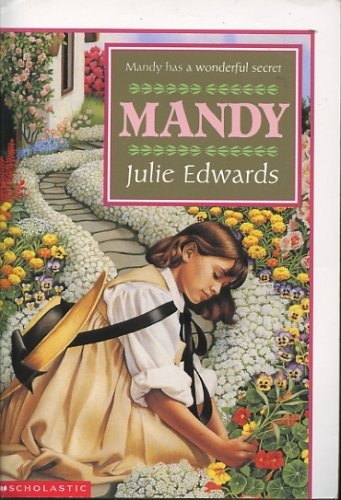
4. Mandy by Julie (Andrews) Edwards

mandyEven before I became familiar with the flawless Queen of Everything Julie Andrews, I loved this book.  I actually recommended this book to my kindergarten teacher’s daughter (she was in 4th grade at the time, so this made me very proud).  Although not exactly like the other runaways on this list, Mandy also has a secret escape from her everyday life.  Again, this appealed to my introverted side; I preferred my books, imagined experiences of my own or shared with Bird, to playdates or sports.  Mandy climbs over the orphanage wall (what young reader doesn’t love a good orphan story?) and discovers an abandoned cottage on the neighboring estate.  She begins fixing it up.  She figures out how to budget for supplies, schedules her visits when she knows no one will be looking, and works until her fingers blister.  Weirdly, I enjoyed the lists of her chores.  It was like vicarious cleaning pleasure, and as a kindergartener I wished I could find my own little house to fix up just right.  This may sound as though it goes against my feminist grain, but it was more about creating a world, a haven of one’s own (Mandy only wants something that’s hers, rather than something charity or the orphanage gives her) than just following some kind of societal norm.

Manuscript

the original text of an author’s work, handwritten or now usually typed,that is submitted to a publisher
writing, as distinguished from print
I attended my first writers’ conference a few weeks ago.  For the first time in my life, I was surrounded by people who talked and thought about writing and books and reading and storytelling as much as I do – and they didn’t look at me like I’d grown a second head when I described my writing process or gushed about the diction in my favorite novels.
Being surrounded by likeminded individuals, I’m learning, is very affirming.
While there, I had the opportunity to pitch my idea for a novel to editors and agents from publishers of all shapes and sizes all over the country.  It was a rather terrifying process, but I connected with an editor and an agent who both seemed genuinely interested in reading my story and asked to see it.  Suddenly, it all felt real – this idea that I would be a writer, that I was always writing anyway, was suddenly made more corporeal by the idea that someone (outside friends and family who kind of have to like whatever I do anyway) actually wants to read my story.
!!!!!!!!!!!!!!!!
So now I’m frantically working to get my story into presentable shape so I can send it off.  Except they don’t call it a story, like I’ve been calling all my bits and pieces and fragments all these years.  It’s a manuscript (or at least, it will be).
Originating from medieval Latin for “written by hand,” manuscript to me suggests a sheaf of slightly crinkled papers covered in looping cursive and a few artistically placed ink blots, gently puffing out dust motes from the garret in which their creator scribbled down her ideas in a feverish haze.  It seems the kind of thing Jo March brought to her publishers, tied up with a ribbon.  My typed, double-spaced, Times New Roman pages seem too clean, too modern to merit such a literary term.
And yet, the painstaking work that goes into uncovering the precise language a story demands, the hours spent getting to know the characters, the effort taken to give a scene just the right effect, the feeling of giving up part of myself when I let someone else act as a beta reader (usually Bird, who is supportive but not blindly so)…yes, this is writing of my own hand, transcribed from imagination by my rapidly tapping fingers on the keyboard.  It’s the original text of my own work.
Now I just have to find a garret to hole up in until I finish.

My Life in Books, Part 1: The Formative Favorites

I can divide up my life by books: epochs of reading indicated by the particular volume that served as my security blanket, my favorite refuge, for that period.  These are the formative few that found me at exactly the moment I needed them.

1. Angelfish by Laurence Yep

41LEKDC-oYL._SX343_BO1,204,203,200_The W-Z shelf in my elementary school library formed a corner with another, lower shelf that, when I settled criss-cross onto the nubbly carpet, made me feel safe – walled up in a castle.  The books at eye level when I situated myself this way included Angelfish, which I checked out so many times throughout the years at St. C’s that the librarian gave me that copy as a graduation present at the end of 8th grade.  She said it was clearly mine.  I called it my Belle book, after the scene in Disney’s Beauty and the Beast when the bookseller gives Belle her favorite book free of charge.  The reason I read it 17 times in a single year is that Angelfish is a love story about a girl and dance.  Robin, the narrator, loves ballet so much she declares she will always find some way to be a part of it, even if it means just sweeping the stage.  “That’s the way you love something when you’re young,” her teacher responds.  The plot involves Robin helping a victim of the Chinese Revolution rediscover his own art – originally dance as well, now painting – and reaffirm the value of having that joy in one’s life.  Having quit my own ballet lessons years before, I probably couldn’t have told you in 8th grade why I loved this book so much.  Now I think I needed it to give me an example of how to hold on to your passion despite the naysayers.

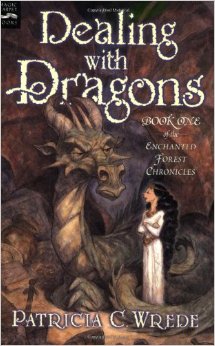
2. Dealing With Dragons by Patricia Wrede

51eC4uO6deL._SY344_BO1,204,203,200_This must have been one of my first feminist books.  The stubborn, witty heroine, Cimorene, gets bored being a princess, so she runs away to serve a dragon.  Although irritated by the conventions that bind her (dealing with all those princes trying to rescue her against her will, for instance), Cimorene also frequently uses her society’s stereotypes of silly princesses to her own advantage (e.g., getting an evil wizard to let slip a few details of his plan).  She finds a way of life that makes her happy and fulfilled even though few people originally understand her desires.  Beyond the quips and amusing dialogue that appealed to me as a sarcastic teenager, Dragons showed me that if you persist in chasing your dreams, you’ll find people who will listen to you.  The dragon she serves, for instance, believes Cimorene when everyone else wants to write her off as just another hysterical princess.  Plus there’s swordfighting.  Who doesn’t love swordfighting?

3. Girl Meets God by Lauren Winner

41unxgoV6iL._SY344_BO1,204,203,200_I gave up reading anything but religious books for Lent one year, and it led me to this memoir of a Jewish girl turned Episcopalian.  Nearly every page held a turn of phrase that made me think, “Yes, exactly,” or “I thought that was just me!”  In a section on Lent, the author’s priest asks her to give up reading for the liturgical season, and I nearly dropped the book in surprise.  I just saw so much of myself and my own questions and confusion about faith (and life in general) in this book, even though I was raised Catholic and intend to remain in the Church.  I love the honesty about the difficult parts of belief and the self-awareness the author demonstrates in her writing.  Once I finished the book, I immediately turned to the first page again, this time with a pencil to underline and annotate the parts that spoke to me the most.  Since then, I’ve read it nearly a dozen times, at least once a year, each time making new notes and looking back on my past self’s questions and scribbles about faith and life.

4. The Disreputable History of Frankie Landau-Banks by E. Lockhart

6a00d8345169e469e2016760e64a3f970bFrankie does not get the guy.  Her friends and family don’t accept her as she is.  But that’s not the point.  When I started high school, I could identify with Frankie’s sense of confinement within others’ perceptions of her.  Her family doesn’t deem her smart enough to use her cell phone when she gets lost or attend a prestigious boarding school without a nice boyfriend to “look after her.”  The boyfriend is not much better; although most of Frankie’s schemes are designed to earn his respect, she soon discovers that he preferred it when she was arm candy in need of his protection.  But she keeps going, realizing that she actually wants to prove something to herself more than to her boyfriend.  After that, others’ opinions don’t matter so much.  By the end, no one quite knows what to do with Frankie, except Frankie herself.  In my freshman year of high school, when I discovered this book, I had just been frozen out by the group of girls I used to rely on for approval.  I needed the self-discovery role model that Frankie provides.  And I needed the honesty of the last chapter: “She might go crazy…They do sometimes go crazy, these people, because the world is telling them not to want the things they want…another possibility – the possibility I hold out for – is that Frankie Landau-Banks will open the doors she is trying to get through.  And she will grow up to change the world.”

Reclaiming Blue

I’m something of a pen thief.  If someone hands me a really awesome pen, the kind of pen that rolls smoothly across the page without smearing and seems to suggest beautiful things will come naturally to one’s head when one uses it, I’m liable to slip it into my purse without thinking and only later realize my transgression.

And then keep that pen for five years.

One such pen is a light blue ballpoint that has lasted me since study hall my senior year of high school when I accidentally stole it from Ashleigh H.  (I’ll probably apologize to her at our five year reunion.)  It’s lived in my pencil case ever since, usually employed to note important events in my beloved planner (which, as we’ve established, I love to color code).

Freshman year of college, I designated this blue pen for events pertaining to the Catholic student center where I spent most of my free time.  Dinners, movie nights, youth group, etc. were all recorded in light blue ballpoint, next to the green fountain pen reserved for work and the orange highlighter that means something horrible like a test or a huge paper is about to happen.  Through the beginning of sophomore year, I associated blue with this student center, and because this place was such a huge part of my life, blue showed up a lot in my planners.

Then, midway through sophomore year, a Really Big Conflict arose.  The details are a story for another time, as is the extent of the fallout, but it involved A Certain Person from the student center, and led to me pulling away from some of that involvement.

I fought with a lot of mental murkiness following this Really Big Conflict.  I fought to regain my faith, and I fought to maintain friendships, and I fought to keep the community that had become central to my college life.  Things have gotten better – a lot better – in the year and a half since.

But I realized that I stopped using blue.

The events I still went to at the center were labeled in plain black.  Even my blue highlighter was getting far less use.  Green, which now represented a job I love, made me happy, but when I flipped a page in my planner and found an event I’d written months earlier in blue, I flinched.  I was avoiding a color I’d chosen originally for its calming qualities!

So I’ve made an Executive Decision.  I am reassigning blue.  Blue is now for things that are good for me, things that help me with self care, things that make me happy.  My anniversary with the Engineer, for instance, or my dad’s wedding, or a girls’ weekend with the Southern Belle.  (I might even put some dinners at the Catholic student center in blue again.)

I am reclaiming blue.  And it does feel good to write with that wonderful pen again.

An Announcement

For a while now, I’ve been toying with the idea of incorporating my stories and creative nonfiction pieces into this blog, but thought that it might disrupt the tone and the types of posts I normally write.  So I decided to create a separate-but-linked site called Changeling Scribbles where I could publish my narratives in serial form (not serial killer form, mind you – that’s a different blog entirely – but in installments).  I think working like this will help me a) force myself to actually keep writing every day, b) finish some of the ideas that have been floating around my laptop forever, c) stick to a schedule, since hopefully people will be anticipating the next chapter, and d) start getting used to the idea of people actually reading my writing, since I’m typically very private about my works in progress.

The beauty of this arrangement is that if you’re interested in reading my stories, you can follow this other blog, but if that sounds like one of the most boring/terrible/torturous propositions in the world, you don’t have to!

My first post on the new blog, changelingscribbles.wordpress.com, will go up on Monday.

I’m kinda nervous.

But I think this will be a fun experiment, even if no one ends up reading it.

Book Hangover

This state of mind makes me think there must be something to the idea that there are imperceptible veils between worlds that prevent certain kinds of Creatures, Spirits, and Sundry from completely inhabiting one universe or another – veils that leave you drifting, not unpleasantly, just above the surface of your proper world, before allowing you to emerge completely from the novel you have just put down.

Good writing does that, good books – no, good stories – in particular.  The words sweep you off your conscious feet, twitch aside the veils, and deposit you firmly In The Story.  There’s a reason some fanfictions are labeled AU for Alternate Universe (I’m a child of the Internet/Tumblr.  Sorry.) – wherever your physical body may be, your essence, if the writer does their job, is far away and unreachable.

It may not seem like it.  Family members, roommates, concerned colleagues can all reach out and tap your shoulder, jolting you from The Story to ask you something, but sudden as the tug was, you’re not really back.  The Story is still hovering, hazing a more current reality.  You submerge yourself again as quickly as you can.

But oh.  When you finish the book.

When you finish the book you float for a while.  You drift.  Neither your own world nor the novel’s can quite pull you down to the ground again so you’re nudged this way and that by memories of both – on the one hand you have chores to do, but on the other you have a character death to deal with.  There’s a plot twist you still haven’t quite processed, and a meal to eat, but neither has any weight because you’re still somewhere between the veils, uncertain as to the anchor for your perceptions.

It takes a bit to come back down to earth.

The longest time I spent in that In Between Space was after devouring The Fault in Our Stars in one day, huddled in my lower bunk in my freshman dorm room, barely speaking to either of my roommates and only stopping for one meal.  The Engineer and I had only been dating for two months at that point, so he hadn’t yet experienced my Book Hangover State.  To his credit, he took my silent, somewhat somber expression in stride, only occasionally squeezing my hand for reassurance that I was okay.

I know how it looks to outsiders, to non-readers – I must be angry, or upset, or at least annoyed about something.  I must not be feeling social, or, when I tell them a book did this to me, it must have had a terrible, terrible, ending.  But that’s not the point.  The point is feeling my way back from The Story I’ve been immersed in for the past several hours, and reconciling it with my own reality.